Introduction
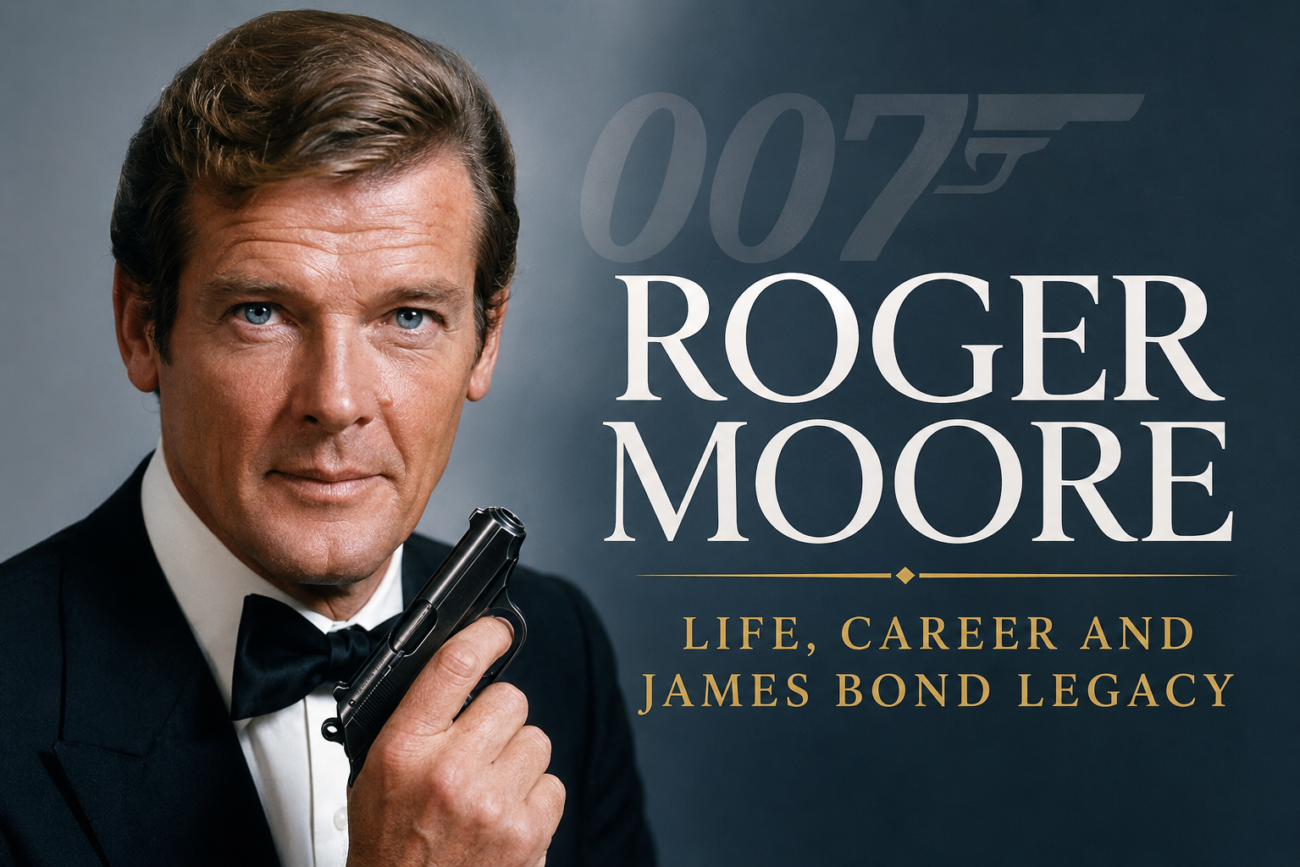
Roger Moore remains one of the most recognizable actors to portray James Bond. For more than a decade, he brought a distinctive combination of sophistication, humor, charm, and adventure to the role of 007. Yet his career extended well beyond the Bond franchise. Before becoming the third actor to play the famous British secret agent, Moore had already established himself through successful television and film work.
Born in Stockwell, South London, Moore developed from a young performer into an international star. His work in television series such as The Saint and The Persuaders! helped establish the screen persona that eventually made him a natural choice for Bond. He first appeared as 007 in Live and Let Die in 1973 and went on to make seven official Bond films.
This article explores Roger Moore’s early life, acting career, James Bond years, major films, humanitarian work, and lasting influence on popular culture.
Key Takeaways
- Roger Moore was born on October 14, 1927, in Stockwell, South London.
- He became internationally famous through The Saint before taking over the James Bond role.
- Moore played James Bond in seven films between Live and Let Die and A View to a Kill.
- His version of Bond was particularly known for elegance, humor, wit, and a lighter touch.
- Beyond acting, Moore became a prominent UNICEF Goodwill Ambassador and was recognized for his humanitarian work.
- He died in 2017 at the age of 89, leaving a lasting legacy in film, television, and charity.
Biography Table
| Category | Details |
|---|---|
| Full Name | Roger George Moore |
| Date of Birth | October 14, 1927 |
| Age | 89 at the time of his death |
| Birthplace | Stockwell, South London, England |
| Nationality | British |
| Profession | Actor |
| Education | Royal Academy of Dramatic Art (RADA) |
| Years Active | Primarily from the 1940s through 2017 |
| Known For | James Bond, The Saint, The Persuaders! |
| Major Achievements | Seven James Bond films; UNICEF Goodwill Ambassador; CBE; knighthood for charity work |
| Estimated Net Worth | Omitted because reliable contemporary reporting varies |
Roger Moore’s Early Life and Education
Roger Moore was born in Stockwell, South London, in 1927. His early path toward acting was not an overnight transformation into an international celebrity. Like many successful performers, he built his career through smaller roles and professional training.
Moore eventually attended the Royal Academy of Dramatic Art, commonly known as RADA. His time there was significant because it helped him develop the polished voice, manner, and stage presence that later became central to his screen identity. One of his classmates was Lois Maxwell, who would eventually become famous as Miss Moneypenny in the James Bond series.
His early professional experiences included stage and television work, as well as a period of military service. He gradually gained more substantial opportunities in British and American productions.
These early years helped Moore develop the refined screen presence that would later become one of his defining characteristics.
Roger Moore’s Rise to Television Stardom
Before he became James Bond, Roger Moore was already a familiar face to television audiences.
One of his most important roles came in The Saint, the popular television series based on Leslie Charteris’s fictional character Simon Templar. Moore’s performance established many qualities that audiences would later associate with his Bond portrayal: sophistication, confidence, wit, and effortless charm.
The success of The Saint transformed Moore into an international television star. His career continued with other film and television productions, including The Persuaders!.
His television success was particularly important because it demonstrated that Moore could carry a major action-adventure series. When the opportunity to play James Bond eventually arrived, audiences were already familiar with his ability to combine action with humor and sophistication.
How Roger Moore Became James Bond
Roger Moore was not an entirely unexpected choice for James Bond.
He had been considered for the role as early as the early 1960s. However, circumstances prevented him from taking the part at that time. His commitment to The Saint, along with production circumstances involving planned filming locations, contributed to the delay.
When Sean Connery eventually left the Bond role, Moore again became a potential candidate. The timing finally worked in 1972, allowing him to accept the role.
His first Bond film was Live and Let Die, released in 1973. Moore immediately established a different interpretation of 007. Rather than attempting to simply imitate Connery, he developed his own version of the character.
Moore’s Bond was elegant and confident, but he also relied more heavily on humor and self-awareness.
Roger Moore’s Seven James Bond Films
Roger Moore played James Bond in seven films, making him one of the longest-serving actors in the role during the classic era of the franchise. His Bond films were:
| Year | Film | Roger Moore’s Bond |
|---|---|---|
| 1973 | Live and Let Die | First appearance as 007 |
| 1974 | The Man with the Golden Gun | Second Bond film |
| 1977 | The Spy Who Loved Me | Third Bond film |
| 1979 | Moonraker | Fourth Bond film |
| 1981 | For Your Eyes Only | Fifth Bond film |
| 1983 | Octopussy | Sixth Bond film |
| 1985 | A View to a Kill | Final Bond appearance |
The official James Bond archive confirms all seven appearances, from Live and Let Die through A View to a Kill.
Live and Let Die
Live and Let Die introduced Roger Moore as James Bond in 1973.
The movie took Bond into a different environment, combining espionage with action, humor, and elements of crime thriller storytelling. Moore’s confident performance helped establish him as a successful successor to Sean Connery.
His interpretation was immediately recognizable as his own. He brought a lighter and more playful quality to Bond while retaining the character’s sophistication.
The Man with the Golden Gun
Released in 1974, The Man with the Golden Gun placed Bond against Francisco Scaramanga, a professional assassin played by Christopher Lee.
The film gave Moore an opportunity to balance traditional spy-movie action with the humorous style that would increasingly characterize his tenure.
The Spy Who Loved Me
Many fans regard The Spy Who Loved Me as one of the defining films of Moore’s Bond era.
Released in 1977, the film featured Bond working alongside Soviet agent Anya Amasova, played by Barbara Bach. It also introduced the memorable villain Jaws, played by Richard Kiel.
The movie included spectacular international locations and elaborate action sequences, helping reinforce Bond’s status as one of cinema’s biggest adventure franchises.
Moonraker
Moonraker took the Bond formula into outer space.
Released in 1979, the film followed Bond as he investigated a hijacked space shuttle and uncovered Hugo Drax’s larger plan. It pushed the series toward spectacular science-fiction adventure and reflected the era’s fascination with space exploration.
Moore’s relaxed comedic style suited the film’s more extravagant tone.
For Your Eyes Only
For Your Eyes Only, released in 1981, represented a somewhat different direction.
Compared with the enormous spectacle of Moonraker, the film placed greater emphasis on espionage, pursuit, and grounded action. Moore remained at the center of the story while demonstrating that his interpretation of Bond could work effectively in a more restrained setting.
Octopussy
Released in 1983, Octopussy continued Moore’s successful run as 007.
The story combined international espionage, elaborate set pieces, humor, and the traditional Bond formula. Moore’s ability to move between serious action and comic moments remained an important part of the film’s identity.
A View to a Kill
A View to a Kill, released in 1985, became Roger Moore’s final appearance as James Bond.
The film featured Christopher Walken as villain Max Zorin and took Bond through locations including Paris and San Francisco. Its climax involved the Golden Gate Bridge, while the production also incorporated extensive action and stunt sequences.
After seven Bond films, Moore left the role. His departure marked the end of one of the longest and most recognizable eras in the franchise.
What Made Roger Moore’s James Bond Different?
Every actor who plays James Bond brings a different interpretation to the character. Roger Moore’s version was especially distinctive because of his emphasis on charm and humor.
Elegance and Sophistication
Moore naturally projected a refined image. His formal clothing, polished delivery, and relaxed manner helped define his version of 007.
Humor and Self-Awareness
Moore’s Bond often responded to dangerous situations with a joke or dry observation. This made his interpretation lighter than some later portrayals.
A Different Kind of Action Hero
Rather than presenting Bond primarily as a hard-edged fighter, Moore often emphasized intelligence, social confidence, and improvisation.
His portrayal showed that James Bond could remain an action hero while also functioning as a sophisticated comedic lead.
Roger Moore’s Career Beyond James Bond
Although Bond became his most famous role, reducing Roger Moore’s career to 007 overlooks a substantial body of work.
His television career, particularly The Saint, was essential to his rise to international fame. He also appeared in numerous films and television productions before, during, and after his Bond years.
This broader career explains why Moore was already an established international star when he became Bond.
His ability to work successfully across television and film gave him a level of experience that was unusual for an actor entering one of cinema’s most demanding franchise roles.
Roger Moore and UNICEF
One of the most important parts of Roger Moore’s later life was his humanitarian work.
Moore became a UNICEF Goodwill Ambassador in 1991 and spent many years supporting the organization’s work on behalf of children. His charitable activities eventually became an important part of his public identity beyond acting.
His humanitarian contributions were formally recognized. He received a CBE in 1999 and was knighted in 2003 for his charity work.
This aspect of Moore’s legacy is particularly significant because it demonstrated that his public influence extended beyond entertainment.
Roger Moore’s Legacy
Roger Moore’s legacy rests on more than the number of Bond films he made.
He helped redefine James Bond for a new generation during the 1970s and 1980s. His interpretation emphasized wit, elegance, humor, and an unmistakable sense of style.
The official Bond organization describes Moore as a worldwide star before he became Bond and credits his distinctive charisma with helping make the cinematic 007 highly successful during the period.
His influence can also be understood through the contrast between different Bond eras. Sean Connery established one foundational interpretation. Moore then demonstrated that the character could successfully evolve without losing the qualities audiences associated with 007.
Later actors would take Bond in different directions, but Moore’s era remains an essential part of the character’s cinematic history.
Why Roger Moore Still Matters
Roger Moore continues to attract interest because his career connects several important areas of entertainment history.
First, he represents the evolution of British screen acting from television stardom to international cinema. Second, his seven Bond appearances form one of the franchise’s most substantial eras. Third, his humanitarian work gave his later public life a purpose beyond acting.
His career is therefore useful to examine not simply as the story of a Bond actor, but as the story of a performer who successfully reinvented himself several times.
Frequently Asked Questions
Who was Roger Moore?
Roger Moore was a British actor best known for playing James Bond in seven films between 1973 and 1985. He was also widely known for television roles including Simon Templar in The Saint.
How many James Bond films did Roger Moore make?
Roger Moore appeared as James Bond in seven films: Live and Let Die, The Man with the Golden Gun, The Spy Who Loved Me, Moonraker, For Your Eyes Only, Octopussy, and A View to a Kill.
What was Roger Moore’s first James Bond movie?
His first James Bond film was Live and Let Die, released in 1973.
What was Roger Moore’s final James Bond movie?
His final Bond film was A View to a Kill, released in 1985. It was his seventh appearance as 007.
Was Roger Moore in The Saint?
Yes. The Saint was one of the television roles that established Moore as an international star before he became James Bond.
When did Roger Moore die?
Roger Moore died in 2017 at the age of 89 following a short illness.
What was Roger Moore known for besides acting?
Moore was particularly known for his humanitarian work with UNICEF. He became a UNICEF Goodwill Ambassador in 1991 and was later recognized with a CBE and a knighthood for his charity work.
Why is Roger Moore important to James Bond history?
Moore gave James Bond a distinctive personality built around elegance, humor, charm, and adventure. His seven-film tenure became one of the longest and most recognizable periods in the franchise’s history.
Conclusion
Roger Moore’s career was much larger than his seven appearances as James Bond, although 007 remains the role most closely associated with his name. From his early training at RADA to his television success in The Saint, Moore built a career based on versatility, charisma, and a distinctive screen presence.
As Bond, he created an interpretation defined by sophistication, humor, and effortless charm. His seven films carried the franchise through much of the 1970s and 1980s, while his work outside Bond demonstrated that he was an accomplished television and film performer in his own right.
His later humanitarian work added another important dimension to his legacy. As a UNICEF Goodwill Ambassador, Moore used his international profile to advocate for children, and his charitable contributions were recognized with major British honors.
Roger Moore died in 2017, but his contribution to cinema remains enduring. For generations of viewers, he will be remembered not only as James Bond, but as an actor who brought his own personality, style, and sense of humor to one of the most famous characters in film history.
