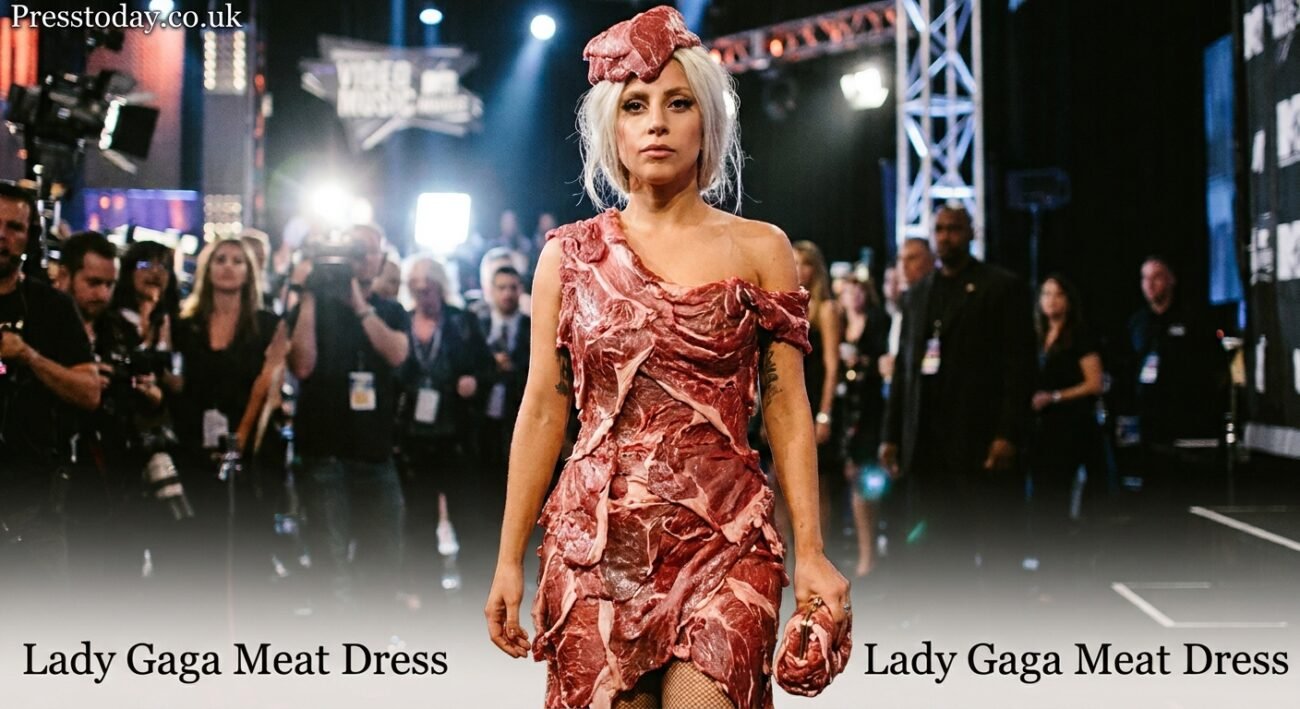
The Lady Gaga meat dress remains one of the most recognizable and controversial outfits in modern pop culture. When Lady Gaga arrived at the 2010 MTV Video Music Awards wearing a dress made from raw beef, she created a fashion moment that sparked worldwide discussion. Some people viewed the outfit as an unforgettable artistic statement, while others questioned its symbolism and use of animal products.
More than an unusual red-carpet look, the dress became part of a broader conversation about celebrity fashion, personal expression, political messaging, and the boundaries of performance art. It also demonstrated Lady Gaga’s ability to turn a public appearance into a cultural event that people would continue discussing years later.
But why did she wear a dress made of meat? Who designed it? What happened to it afterward, and what message was she trying to communicate?
This article explores the history of the Lady Gaga meat dress, its design, the explanation behind its symbolism, the public reaction, and its lasting influence on entertainment and fashion.
Key Takeaways
-
Lady Gaga wore her famous meat dress to the MTV Video Music Awards on September 12, 2010.
-
The outfit was designed by Argentine-born fashion designer Franc Fernandez, with stylist Nicola Formichetti involved in its creation and presentation.
-
The dress attracted international attention because of its unusual material and the debates surrounding its meaning.
-
Gaga later connected the outfit to a message about fighting for personal rights, particularly in the context of the US military’s former “Don’t Ask, Don’t Tell” policy.
-
The original dress was preserved rather than simply discarded, becoming part of the singer’s fashion legacy.
-
The outfit remains a significant example of how celebrity fashion can become a cultural talking point far beyond the red carpet.
Who Is Lady Gaga?
Lady Gaga, born Stefani Joanne Angelina Germanotta on March 28, 1986, is an American singer, songwriter, and actress known for her distinctive musical style, theatrical performances, and unconventional fashion choices.
She became internationally famous through songs such as “Just Dance,” “Poker Face,” and “Bad Romance.” Throughout her career, Gaga has used fashion as a form of artistic expression, often choosing outfits that challenge conventional ideas about beauty, identity, and celebrity culture.
Her meat dress fits into this broader approach. Rather than wearing a conventional designer gown, she appeared in an outfit that immediately attracted attention and prompted questions about its purpose.
When Did Lady Gaga Wear the Meat Dress?
Lady Gaga wore the meat dress on September 12, 2010, at the MTV Video Music Awards (VMAs) in Los Angeles, California.
The outfit became one of the defining moments of the ceremony. Gaga had already established a reputation for unconventional fashion, but a dress made from actual meat took her approach to a new level.
The event was especially memorable because she wore the outfit while accepting the award for Video of the Year for her hit song “Bad Romance.” The moment brought together music, celebrity fashion, performance art, and social commentary.
The dress was not an isolated fashion experiment, either. Gaga also wore matching meat accessories, including shoes, and carried a meat purse. Together, these pieces created a coordinated look that extended the concept beyond a single garment.
The unusual material made the outfit difficult to ignore. Photographs circulated widely, and news organizations, fashion commentators, and animal rights advocates debated the decision.
Why the 2010 VMAs mattered
The VMAs offered Gaga a high-profile platform where fashion and entertainment regularly intersect. By wearing such an unconventional outfit at a major televised event, she ensured that her appearance would become part of the wider cultural conversation.
The dress also arrived during a period when Gaga was publicly advocating for LGBTQ+ rights and challenging discrimination. That context helped explain why the outfit became associated with a message beyond fashion.
Who Designed Lady Gaga’s Meat Dress?
The Lady Gaga meat dress was designed by Franc Fernandez, an Argentine-born designer and artist based in Los Angeles.
Stylist Nicola Formichetti played an important role in the styling and creative presentation of Gaga’s looks during this period. Gaga’s creative team helped develop the broader visual concept, while Fernandez was responsible for constructing the garment.
Creating clothing from raw meat presented challenges that ordinary fashion materials do not. Meat is perishable, heavy, and difficult to handle. It also lacks the predictable flexibility of fabric, making the construction process more complicated.
Fernandez used cuts of beef, including flank steak, to assemble the dress. Reports from the time described the outfit as weighing approximately 35 pounds, although figures varied depending on whether the accompanying accessories were included.
The designer had to arrange and sew the pieces together to create a wearable shape. The resulting garment resembled a structured dress while retaining the irregular textures and colors of the meat.
What made the design unusual?
Several features distinguished the outfit from conventional red-carpet clothing:
-
Unconventional material: The dress used actual meat instead of fabric, leather, or synthetic textiles.
-
Sculptural construction: The meat pieces were arranged to form a recognizable garment.
-
Matching accessories: The shoes, hat, and purse extended the concept across the entire look.
-
Visual impact: The deep red and pale tones created a striking appearance that photographs could easily capture.
-
Performance-art qualities: The outfit communicated an idea through its material, presentation, and setting.
The dress demonstrated how fashion can function as more than clothing. In this case, the material itself became central to the public’s interpretation of the look.
Why Did Lady Gaga Wear a Meat Dress?
The question of why Gaga wore the outfit has generated discussion for years. Although people have offered different interpretations, Gaga herself explained that the dress was intended to communicate a message about rights, dignity, and how people are treated.
During an appearance on The Ellen DeGeneres Show shortly after the VMAs, she said the dress had multiple interpretations. She connected it to the importance of standing up for one’s beliefs and fighting for individual rights.
Her explanation included the idea that people should not allow their rights to be reduced or disregarded. The comparison between human beings and meat was intended to challenge the treatment of people as objects rather than individuals with dignity.
The connection to “Don’t Ask, Don’t Tell”
One of the most important parts of the dress’s historical context was the United States military’s former “Don’t Ask, Don’t Tell” policy.
Implemented in 1994, the policy restricted openly gay, lesbian, and bisexual people from serving openly in the US military. It was repealed in 2010, with the repeal taking effect in September 2011.
Gaga was an outspoken supporter of LGBTQ+ equality and opposed the policy. She attended the 2010 VMAs alongside service members who had been discharged under it, connecting her celebrity platform to the debate over military service and sexual orientation.
In subsequent explanations, she discussed the idea that people willing to sacrifice their lives for their country should not be treated differently because of their sexual orientation.
The meat dress therefore became associated with the argument that people deserve equal respect regardless of their identity.
Was the dress intended to offend people?
Gaga said she did not intend to disrespect vegans or vegetarians. She acknowledged that the outfit could be interpreted in different ways and presented her own explanation in the context of human rights.
However, her stated intention did not prevent criticism. Many viewers considered the use of animal flesh disturbing or ethically unacceptable.
Understanding the dress requires distinguishing between its intended message and the reactions it produced. Those two things were not always the same.
What Was Lady Gaga’s Meat Dress Made Of?
The dress was made from real raw beef, rather than imitation meat or a printed fabric designed to resemble it.
Flank steak was among the cuts used in its construction. The meat was selected and assembled to create a garment that could be worn during the ceremony.
The choice of material was essential to the concept. A dress made from red fabric would not have created the same reaction because it would have lacked the physical connection to food, animal products, and the idea of human beings being treated as commodities.
How was the dress assembled?
Constructing the outfit required more than simply placing meat over the body.
The designer arranged the pieces to follow the shape of a dress, using a supporting structure and stitching to hold the material together. The construction process took place shortly before the awards ceremony.
Unlike ordinary garments, the dress had no long-term durability in its original state. Fresh meat changes over time, particularly when exposed to unsuitable temperatures.
This created an additional challenge: the team needed to handle and transport the outfit carefully before it was worn.
Was it comfortable to wear?
The dress was not designed primarily for comfort or everyday use. It was a one-time statement outfit intended for a major public appearance.
Gaga wore the garment under the bright lights of a televised awards ceremony. Its weight, cold initial feel, and unusual construction made it very different from a conventional gown.
Although the outfit was wearable for the event, it was never a practical alternative to ordinary clothing.
Public Reaction to the Lady Gaga Meat Dress
The reaction to the dress was immediate and divided. Some people praised its originality and viewed it as an effective example of fashion used for social commentary. Others regarded it as shocking, distasteful, or unnecessarily provocative.
The debate spread beyond fashion magazines and entertainment news. It also involved animal welfare, food ethics, artistic freedom, and the responsibilities of celebrities with large audiences.
Supporters praised its originality
Supporters argued that Gaga had successfully used fashion to create a memorable cultural moment.
The outfit challenged conventional expectations about what a celebrity should wear on a red carpet. It also encouraged people to discuss the relationship between clothing, identity, and public messaging.
In December 2010, Time named the meat dress its top fashion statement of the year, reflecting the outfit’s extraordinary visibility and cultural impact.
For admirers, the dress illustrated Gaga’s willingness to take creative risks and use visual symbolism to communicate ideas.
Animal rights groups criticized the outfit
Animal rights advocates strongly objected to the use of real meat as clothing.
PETA, an organization that campaigns for animal welfare, criticized the dress, arguing that using animal flesh in this way disregarded the suffering of the animal.
For critics, the outfit raised questions about whether artistic expression justified the use of animal products for spectacle.
These objections were distinct from the dress’s connection to LGBTQ+ equality. Someone could support Gaga’s message about equal rights while still disagreeing with the material she chose.
Why did the controversy last so long?
The dress combined several elements that made it especially likely to generate debate:
-
An instantly recognizable appearance: The unusual material made photographs memorable.
-
A major public event: The VMAs gave the outfit a large audience.
-
A political context: Gaga’s advocacy for equal rights added meaning beyond fashion.
-
An ethical disagreement: Viewers differed over the treatment of animals and the use of meat.
-
A lasting physical object: Preserving the garment allowed it to remain part of fashion and music history.
The controversy was not simply about whether the dress looked attractive. It involved competing interpretations of art, ethics, and personal expression.
What Happened to Lady Gaga’s Meat Dress?
One of the most frequently asked questions about the outfit concerns its fate after the 2010 VMAs.
Because the dress was made from real meat, it could not be stored like an ordinary costume. Without appropriate treatment, the material would deteriorate, making long-term preservation a significant challenge.
The garment was eventually preserved by a taxidermist so it could be displayed as a historical fashion artifact.
How was the dress preserved?
The preservation process involved treating the meat to prevent ordinary decomposition and preparing it for display.
Reports published in 2011 described the process as a specialized treatment that included cleaning, preservation, and reassembly. The meat had begun to deteriorate before the treatment, so preserving the garment in a form resembling its original appearance required considerable work.
The preserved version was darker than the dress Gaga originally wore. It was also mounted on a mannequin to maintain its shape.
The process transformed the outfit from a temporary wearable garment into a museum object.
Where was the dress displayed?
The preserved dress was displayed at the Rock and Roll Hall of Fame and Museum in Cleveland, Ohio, in 2011 as part of the Women Who Rock: Vision, Passion, Power exhibition.
The garment later became associated with other displays and collections connected to Gaga’s fashion legacy.
In 2019, it became part of the Haus of Gaga exhibition in Las Vegas, where fans could encounter pieces connected to the singer’s career.
Its exact current display status should not be assumed from earlier exhibition reports, since museum and attraction collections can change.
Can the original dress be worn again?
The preserved garment is a historical display object, not a practical item of clothing.
The treatment changed the meat’s physical properties, and the outfit is no longer equivalent to the garment Gaga wore in 2010. Its purpose is to preserve the memory of the event rather than provide something that can be worn again.
Its survival also adds another layer to its meaning. A garment originally associated with decay became an object that could be studied, displayed, and discussed long after the original event.
The Lady Gaga Meat Dress and Its Influence on Fashion
The meat dress is frequently discussed alongside other memorable celebrity fashion moments because it challenged established ideas about red-carpet clothing.
Traditional awards-show fashion often emphasizes luxury, craftsmanship, designer labels, and visual elegance. Gaga’s outfit took a different approach: it made the material itself the central message.
Fashion as a form of communication
Clothing communicates information about identity, culture, social expectations, and personal values. Designers have long used unusual materials and silhouettes to challenge conventions.
Gaga’s meat dress brought that idea to a mass audience. It showed how a single garment could prompt discussions that extended well beyond its appearance.
The outfit also highlighted the difference between fashion as decoration and fashion as performance. In the latter, the setting, audience, symbolism, and public reaction all contribute to the experience.
How it compares with other iconic Gaga looks
Gaga has worn numerous outfits that became closely associated with her public image. Each used a different visual strategy.
| Fashion moment | Main characteristic | Cultural significance |
|---|---|---|
| Meat dress, 2010 | Garment made from real meat | Social commentary and controversy |
| Bubble dress era | Sculptural transparent bubbles | Experimental pop-fashion styling |
| Alexander McQueen’s armadillo shoes | Dramatic, futuristic footwear | Avant-garde design in mainstream pop culture |
| 2019 Met Gala appearance | Multiple theatrical outfit transformations | Fashion as a staged performance |
These examples demonstrate that Gaga’s fashion legacy cannot be reduced to a single outfit. The meat dress stands out because its material and symbolism made it especially controversial, but it forms part of a wider pattern of experimentation.
Did the dress change celebrity fashion?
It would be difficult to attribute a broad change in celebrity fashion to one outfit alone. However, the dress remains a useful example of how a red-carpet appearance can become an event in its own right.
It also demonstrated the media value of a distinctive visual concept. Rather than relying solely on a designer name or conventional glamour, the dress encouraged viewers to ask what the outfit meant and why Gaga had chosen it.
Its influence is best understood as part of the continuing relationship between fashion, performance art, celebrity branding, and media attention.
The Artistic Meaning Behind the Meat Dress
The meat dress can be interpreted through several connected ideas. Gaga’s own explanation provides the clearest starting point, but the outfit also invites broader discussion about the role of provocative art.
Human rights and personal dignity
Gaga connected the outfit to the importance of defending individual rights. Her comments about not being treated like a piece of meat placed the garment within a wider discussion about dignity and discrimination.
The visual comparison was deliberately uncomfortable. By wearing the material literally, she made the expression more immediate than it would have been in an ordinary speech.
The relationship between art and discomfort
Art does not always aim to make an audience feel comfortable. Some works provoke disagreement or force viewers to reconsider familiar assumptions.
The meat dress illustrates this approach. Its material generated a strong physical reaction, while its political associations encouraged a different kind of discussion.
However, discomfort alone does not establish artistic value. The lasting significance of the outfit comes from the combination of its design, context, symbolism, and the debate surrounding it.
Why people interpret it differently
Not everyone approaches the dress from the same perspective.
-
A fashion enthusiast might focus on its construction and originality.
-
An LGBTQ+ rights supporter might emphasize the message about equality.
-
An animal welfare advocate might object to the use of animal flesh.
-
A pop culture historian might examine how the outfit became a global media event.
-
An art critic might consider its relationship to earlier examples of clothing made from unconventional materials.
These interpretations can coexist. Understanding the dress means recognizing both Gaga’s stated intention and the legitimate reasons different audiences responded differently.
Frequently Asked Questions
1. When did Lady Gaga wear the meat dress?
Lady Gaga wore the meat dress on September 12, 2010, at the MTV Video Music Awards in Los Angeles. She wore it while accepting the Video of the Year award for “Bad Romance.”
2. Who designed Lady Gaga’s meat dress?
Argentine-born designer Franc Fernandez created the dress. Nicola Formichetti was involved in the styling and presentation of Gaga’s fashion looks during that period, alongside her wider creative team.
3. Was Lady Gaga’s meat dress made from real meat?
Yes. The dress was constructed from real raw beef, including flank steak. Matching accessories, such as shoes and a purse, extended the look.
4. What did Lady Gaga’s meat dress symbolize?
Gaga explained that the dress had multiple interpretations and connected it to defending individual rights. It became particularly associated with her opposition to the US military’s former “Don’t Ask, Don’t Tell” policy and her support for LGBTQ+ equality.
5. What happened to the meat dress after the VMAs?
The garment was professionally preserved for display. It was exhibited at the Rock and Roll Hall of Fame and Museum in 2011 and later became associated with the Haus of Gaga exhibition in Las Vegas.
6. Did animal rights groups criticize the meat dress?
Yes. Animal rights advocates, including PETA, criticized the use of real meat. Their objections focused on animal welfare and the ethics of using animal flesh as a fashion statement.
7. How much did Lady Gaga’s meat dress weigh?
Reports from the period put the dress at approximately 35 pounds, although some accounts cited different weights depending on whether accessories and additional materials were included.
8. Is Lady Gaga’s meat dress considered iconic?
Yes. The outfit is widely remembered as one of the most recognizable celebrity fashion moments of the 2010s. Its unusual construction, political associations, public controversy, and preservation have kept it relevant in discussions about pop culture and fashion history.
Conclusion
The Lady Gaga meat dress became much more than an unconventional awards-show outfit. Worn at the 2010 MTV Video Music Awards, it combined experimental design, provocative symbolism, and a political context that made it one of the most discussed celebrity fashion moments of its era.
Designed by Franc Fernandez, the garment challenged traditional expectations about red-carpet clothing. Gaga connected it to personal rights and human dignity, while critics raised serious objections about the use of animal products. Its preservation and later exhibition ensured that the outfit remained part of fashion and music history.
More than a decade later, the dress continues to attract attention because it raises questions that extend beyond appearance: What makes fashion meaningful? Can clothing communicate a political message? And where should artists draw the line between creative expression and ethical responsibility?
Its lasting significance lies not in universal agreement about its meaning, but in its ability to inspire discussion. That combination of fashion, controversy, and cultural symbolism is what keeps Lady Gaga’s meat dress memorable.
