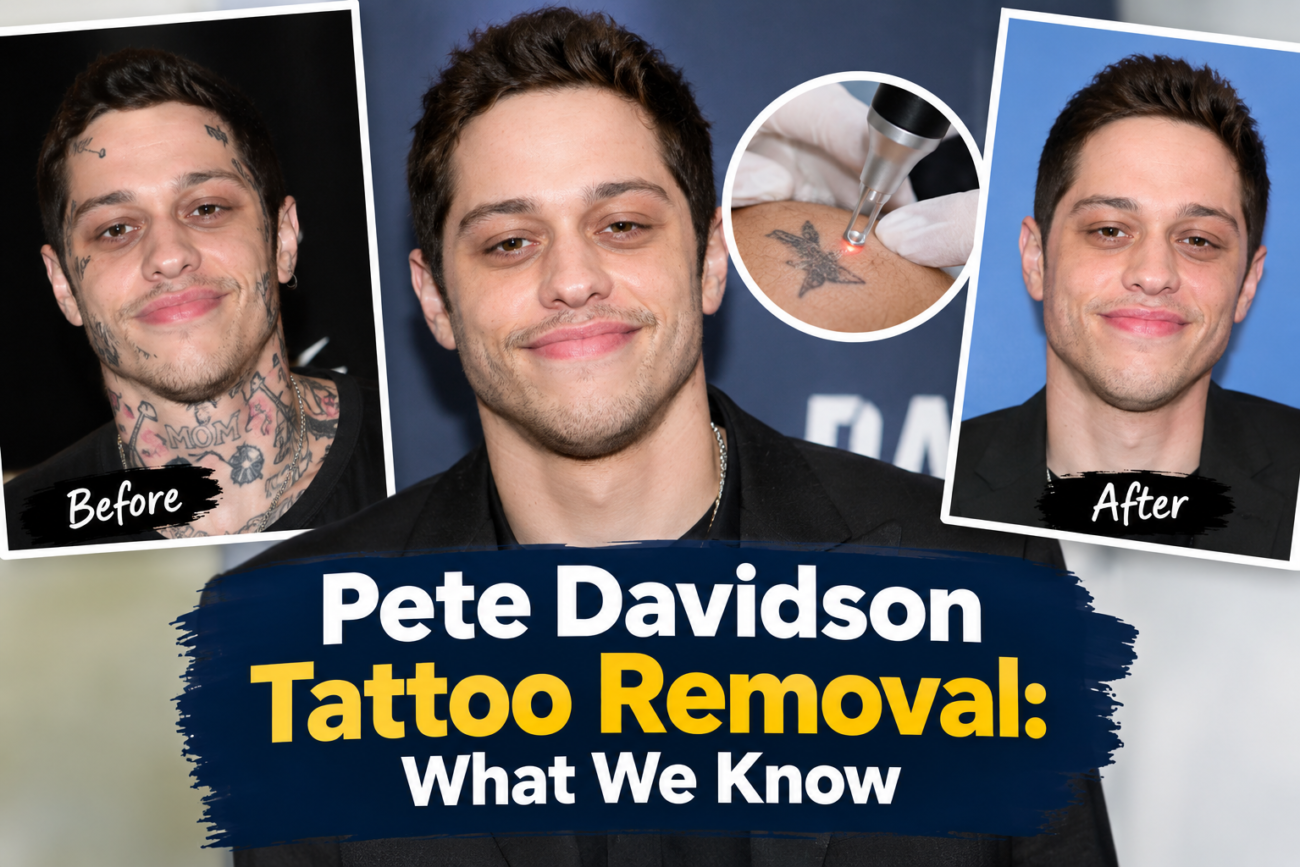
Pete Davidson has become known for his comedy, acting career, and distinctive collection of tattoos. For years, the comedian’s body art was a recognizable part of his public image, with designs reflecting personal experiences, relationships, humor, and interests. However, his decision to pursue tattoo removal attracted widespread attention and raised questions about why he wanted to change his appearance.
The topic of Pete Davidson tattoo removal has interested fans because the process represents more than a cosmetic change. Davidson has discussed the practical considerations behind removing his tattoos, including the demands of acting and the time required for treatment. His experience has also brought greater public attention to how laser tattoo removal works and why removing tattoos can take considerable time.
In this article, we explore what is publicly known about Davidson’s tattoo removal journey, the reasons he has discussed, how laser treatments work, what the process involves, and what readers should understand before drawing conclusions about his results.
Key Takeaways
-
Pete Davidson began removing his tattoos in 2020 and has spoken publicly about the long process.
-
He has cited personal growth, sobriety, and wanting a fresh start as reasons for removing much of his body art.
-
His tattoos also created practical challenges in acting, particularly when makeup teams had to cover them for film and television roles.
-
Laser tattoo removal typically requires multiple sessions, recovery time, and careful sun protection.
-
Davidson has said that he intends to keep certain meaningful tattoos, including designs connected to his family.
-
His removal journey has been expensive and painful, demonstrating that removing extensive body art can be a lengthy commitment.
Pete Davidson Biography
| Detail | Information |
|---|---|
| Full Name | Peter Michael Davidson |
| Date of Birth | November 16, 1993 |
| Age | 32 years old as of October 2026 |
| Birthplace | Staten Island, New York City, United States |
| Nationality | American |
| Profession | Comedian, actor, writer, and producer |
| Education | Attended St. Francis College |
| Years Active | 2010–present |
| Known For | Saturday Night Live, The King of Staten Island, and The Suicide Squad |
Main Article
Why Is Pete Davidson Removing His Tattoos?
Pete Davidson’s decision to remove most of his tattoos reflects a combination of personal change, professional convenience, and a desire to move forward from an earlier period of his life.
For years, his tattoos were a defining feature of his appearance. He accumulated more than 200 designs, including small illustrations, words, symbols, and references to people and experiences that had influenced him.
However, his feelings about that collection changed over time.
A desire for a fresh start
Davidson has explained in interviews that he obtained many of his tattoos during a difficult period in his life. He later reconsidered those decisions as his circumstances and outlook changed.
In a 2025 interview, he described looking at himself while sober and realizing that he wanted to change his appearance. He also connected some of his tattoos with memories of an earlier stage of his life that he no longer wanted to carry with him so visibly.
This perspective helps explain why his decision was not simply about following a fashion trend. For Davidson, removing tattoos became part of creating a different relationship with his past.
Importantly, his experience does not mean that tattoos are inherently negative or that everyone should remove body art associated with an earlier period. Personal meaning changes from one individual to another.
His changing perspective on tattoos
Davidson has also made clear that he does not consider tattoos themselves a bad idea. His decision is about his own collection and how he feels about the designs he chose when he was younger.
A tattoo that feels meaningful at one stage of life may become less relevant later. Someone might change careers, develop different interests, or simply prefer a different appearance.
Davidson’s experience illustrates why it can be useful to consider the long-term implications of permanent body art before getting tattooed.
How Did Pete Davidson’s Acting Career Influence His Decision?
Personal reasons were not the only factor behind Davidson’s decision. His acting career also made his tattoos more complicated to manage.
The challenge of covering tattoos for film roles
When an actor has extensive tattoos, production teams may need to cover them to match a character’s appearance.
This can involve specialized makeup, body paint, concealer, and repeated touch-ups throughout filming. The process becomes particularly demanding when tattoos cover large areas of the arms, hands, neck, or chest.
Davidson previously explained that covering his tattoos for acting roles could require him to arrive on set hours before filming began.
For a performer working on multiple projects, that additional preparation can create scheduling difficulties and increase production costs.
Why a tattoo-free appearance can help an actor
Removing visible tattoos can give an actor more flexibility when accepting different roles.
For example, a character may be written as someone with no tattoos, while another role may require a specific design that differs from the actor’s personal body art.
Without extensive existing tattoos, makeup teams have fewer details to conceal or modify.
That does not mean actors must remove their tattoos to succeed. Many performers retain their body art throughout their careers. In Davidson’s case, however, the practical demands of acting contributed to his decision.
When Did Pete Davidson Start Tattoo Removal?
Davidson began his tattoo removal journey in 2020. He later discussed the process publicly as his appearance changed and more of his tattoos became noticeably lighter or disappeared.
The transformation attracted particular attention in early 2025, when he appeared in promotional photographs for the fashion brand Reformation with a significantly different look.
His reduced tattoo coverage surprised people who had associated him with heavily tattooed arms, hands, and upper body.
Why the transformation took years
Removing tattoos is rarely a one-appointment procedure, particularly when someone has a large number of designs.
Laser treatments break tattoo pigment into smaller particles that the body can gradually clear. The skin also needs time to recover between appointments.
Davidson has discussed the need to repeat treatments over an extended period. His experience demonstrates why a person with hundreds of tattoos cannot expect an immediate transformation.
The time required depends on several factors, including the size of each tattoo, the colors used, the depth of the ink, and how the person’s skin responds to treatment.
How Does Pete Davidson Tattoo Removal Work?
Although Davidson’s treatment has received celebrity-level attention, the underlying process is similar to laser tattoo removal performed for other patients.
Laser treatment is widely used to fade or remove unwanted tattoo pigment. A qualified medical professional evaluates the tattoo and chooses an appropriate treatment approach.
Step 1: Assessing the tattoos
Before treatment begins, a specialist evaluates the tattoo’s size, location, colors, and depth.
The practitioner also considers the patient’s skin type, medical history, and risk of complications.
Because Davidson had so many tattoos, different designs may have required different treatment considerations. The exact settings and treatment plans used for his individual tattoos are not all publicly documented.
Step 2: Applying laser energy
During laser removal, pulses of light target pigment within the skin.
The energy breaks the pigment into smaller particles, which the body gradually processes. Different wavelengths may be needed for different ink colors.
Black ink often responds relatively well to laser treatment, while some colors can be more difficult to remove.
Step 3: Allowing the skin to heal
After treatment, the skin may become red, swollen, tender, or temporarily blistered. The treated area needs appropriate care to reduce the risk of infection, scarring, and pigmentation changes.
Davidson has described his own experience as extremely painful and has spoken about the time needed for healing between sessions.
Patients should follow their clinician’s aftercare instructions rather than attempting to speed up the process by irritating or damaging the treated skin.
Step 4: Repeating treatments
One session rarely removes a large, dark tattoo completely.
Multiple appointments are typically necessary, with intervals that allow the skin to recover and the body to clear pigment. Some tattoos may fade substantially without disappearing entirely.
For a person with extensive body art, removing every design can require years of treatment.
How Painful Is Pete Davidson’s Tattoo Removal?
Davidson has described tattoo removal as significantly painful. In interviews, he has rated the experience at the extreme end of the pain scale.
His comments highlight an important distinction: removing a tattoo can be more uncomfortable than people expect, even when a practitioner uses measures to manage pain.
Why laser removal hurts
Laser pulses deliver energy to pigment in the skin. The sensation is often compared with a hot snapping or stinging feeling.
The level of discomfort varies according to:
-
The location of the tattoo.
-
The size of the treated area.
-
The laser technology used.
-
The individual’s pain tolerance.
-
The methods used to reduce discomfort.
Areas with thinner skin or greater sensitivity may be more uncomfortable to treat.
Can the pain be managed?
Depending on the treatment and the patient, clinicians may use cooling devices, topical anesthetics, or other appropriate pain-management options.
Davidson has publicly discussed using stronger measures to cope with the discomfort of extensive removal. Those details should not be interpreted as a recommendation for everyone.
Anyone considering treatment should discuss pain management, potential side effects, and available options with a qualified medical professional.
How Much Did Pete Davidson Spend on Tattoo Removal?
Davidson has publicly discussed spending approximately $200,000 on removing his tattoos.
That figure has been widely reported in entertainment coverage and illustrates the potential expense of treating a large number of tattoos over several years.
However, it should not be treated as a typical price for tattoo removal.
Why his treatment was so expensive
Several factors can increase the overall cost of extensive tattoo removal.
| Cost factor | Why it matters |
|---|---|
| Number of tattoos | Each separate design may require treatment and follow-up appointments. |
| Tattoo size | Larger designs generally require more treatment time. |
| Ink color and density | Some pigments are more difficult to remove than others. |
| Number of sessions | Multiple appointments increase the total cost. |
| Treatment area | The size and location of tattoos can affect the treatment plan. |
| Clinical setting | Provider fees and technology vary by location and practice. |
Davidson’s reported expenditure reflects an unusually extensive personal treatment journey. Someone removing a single small tattoo may pay substantially less.
Is complete tattoo removal worth the cost?
That depends on individual priorities and circumstances.
Some people choose removal because a tattoo no longer reflects their identity. Others want to change their appearance for professional reasons or eliminate an unwanted reminder of a past relationship or experience.
Before committing to treatment, patients should ask for an assessment, an estimated number of sessions, a realistic cost range, and an explanation of the possible results.
It is also important to understand that complete removal is not guaranteed.
Pete Davidson Tattoo Removal Before and After
The visual difference between Davidson’s earlier appearance and his more recent public appearances has been one of the most noticeable aspects of his transformation.
His arms, hands, and neck previously featured numerous visible tattoos. By early 2025, photographs showed a dramatically reduced amount of visible body art.
However, the phrase “before and after” can oversimplify a process that takes place gradually.
What changed in his appearance?
The main difference has been the reduced visibility of tattoos that once covered substantial areas of his body.
As the removal process progressed, some designs became much lighter while others appeared to have disappeared.
In late 2025, Davidson said that he had prioritized his hands and neck before focusing on finishing his arms. He also indicated that a significant proportion of his tattoos remained, although many had faded.
These comments demonstrate why a particular photograph cannot establish that every tattoo has been completely removed.
Is Pete Davidson completely tattoo-free?
Not necessarily.
Davidson’s removal journey has continued through multiple stages, and his public statements have described both substantial progress and tattoos he intends to keep.
In April 2026, entertainment coverage reported that he had a new tattoo on his face bearing his child’s name, Scottie.
That development is a reminder that removing older tattoos does not prevent someone from choosing new body art later.
The most accurate description is that Davidson has removed or faded much of his earlier tattoo collection while retaining some meaningful designs and making new choices about his appearance.
Which Tattoos Does Pete Davidson Plan to Keep?
Despite his decision to remove most of his tattoos, Davidson has said that some designs are important enough to remain.
His comments about the tattoos he intends to keep show that he distinguishes between body art he no longer identifies with and designs that continue to carry personal meaning.
Tattoos connected to his family
Davidson has discussed keeping tattoos related to his family, including one honoring his father, Scott Matthew Davidson.
His father was a New York City firefighter who died during the September 11, 2001, terrorist attacks.
Davidson has also spoken about keeping a tattoo connected to his mother. He has explained that certain family-related designs are exceptions to his broader removal plan.
These tattoos carry a different significance from designs he associates with an earlier period of his life.
Tattoos inspired by The Sopranos
Davidson has also mentioned tattoos inspired by The Sopranos, the influential television drama.
His decision to retain selected designs demonstrates that the goal is not necessarily to eliminate every tattoo. Instead, he has approached the process selectively, removing the body art he no longer wants while preserving some of the designs he values.
What his choices reveal
Davidson’s approach offers a useful reminder that tattoo removal does not have to be an all-or-nothing decision.
Some people remove a single design, others fade a tattoo before covering it with a new one, and some choose to remove nearly all their existing body art.
The appropriate choice depends on the individual’s preferences and the practical possibilities of treatment.
How Long Does Tattoo Removal Take?
Pete Davidson’s experience shows that removing extensive body art can take several years.
However, there is no universal timetable for tattoo removal. A small, lightly colored tattoo may fade relatively quickly, while a large, densely inked design can require many sessions.
Factors that affect treatment time
Tattoo size: Larger tattoos usually need more treatment time and may require more extensive work.
Ink color: Different pigments respond differently to laser wavelengths. Some colors are more challenging to remove.
Ink depth and density: Tattoos with dense or deeply deposited pigment may take longer to fade.
Skin response: Healing and pigment clearance vary between individuals.
Time between sessions: Treatment intervals allow the skin to recover and the body to process fragmented pigment.
Desired result: Fading a tattoo for a cover-up may require fewer sessions than trying to achieve near-complete removal.
Davidson has discussed a lengthy treatment schedule and the need to allow several weeks for healing after sessions. His experience should not be used as an exact timetable for another person’s treatment.
A qualified provider can give a more useful estimate after examining the specific tattoo.
What Are the Risks of Laser Tattoo Removal?
Laser tattoo removal is an established treatment, but it is not risk-free.
Anyone considering the procedure should understand the potential side effects and seek care from an appropriately qualified practitioner.
Common short-term effects
Following treatment, patients may experience:
-
Redness and swelling.
-
Tenderness or discomfort.
-
Temporary blistering or crusting.
-
Changes in skin pigmentation.
-
Temporary irritation around the treated area.
These effects vary depending on the treatment and individual response.
Potential complications
Possible complications include scarring, infection, persistent changes in skin color, and incomplete removal.
Some pigments may respond poorly to treatment or change color in unexpected ways. Certain tattoos may never disappear entirely, even after numerous sessions.
Choosing an experienced medical professional, following aftercare instructions, and avoiding unproven home-removal methods can help reduce risks.
Why aftercare matters
Proper aftercare supports healing and lowers the chance of complications.
Patients should follow instructions about cleaning the area, protecting it from sunlight, avoiding picking at scabs, and recognizing signs of infection.
If severe pain, worsening redness, pus, fever, or other concerning symptoms develop, they should contact a healthcare professional promptly.
What Can People Learn From Pete Davidson’s Tattoo Removal Journey?
Davidson’s experience offers several practical lessons for anyone considering a tattoo.
Think carefully before getting permanent body art
A tattoo that feels right today may not reflect your preferences in ten years.
Taking time to consider the design, placement, size, and personal significance can help reduce the likelihood of future regret.
Understand that removal is a commitment
Tattoo removal requires time, money, patience, and repeated appointments.
It is not a quick correction, particularly when a person has multiple large or densely inked designs.
Choose a qualified treatment provider
People interested in removal should seek an appropriately qualified clinician who can assess their skin, explain the treatment options, and discuss realistic expectations.
They should also ask about possible side effects, total costs, and how the clinic handles complications.
Remember that preferences can change
Davidson’s decision reflects his own circumstances, not a universal rule about tattoos.
Some people remain happy with their tattoos for life. Others change their minds and decide to remove or modify them.
Neither choice needs to define a person’s character. What matters is making an informed decision that fits their current preferences and circumstances.
Frequently Asked Questions
1. Why is Pete Davidson removing his tattoos?
Davidson has explained that many tattoos reminded him of an earlier period in his life. He has also cited personal growth, sobriety, and the practical difficulty of covering tattoos for acting roles as reasons for removing them.
2. When did Pete Davidson start tattoo removal?
He began removing his tattoos in 2020. The process has continued over several years because extensive tattoo removal typically requires multiple treatments and recovery periods.
3. How many tattoos did Pete Davidson have?
Davidson has been widely reported to have had more than 200 tattoos. The exact number has varied across entertainment reports, and not every design has been individually documented.
4. How much did Pete Davidson spend removing his tattoos?
Davidson has publicly discussed spending approximately $200,000 on tattoo removal. This is his reported expenditure, not a standard price for the procedure.
5. Is Pete Davidson’s tattoo removal painful?
Yes. Davidson has described the treatment as extremely painful. Laser tattoo removal commonly causes a stinging or snapping sensation, although the discomfort varies by person and treatment area.
6. Has Pete Davidson removed all his tattoos?
He has removed or faded much of his earlier body art, but public updates have indicated that some tattoos remain. He has also discussed keeping meaningful designs and was reported to have a new tattoo of his child’s name in 2026.
7. How long does tattoo removal take?
The process can take months or years, depending on the tattoo’s size, color, ink density, and the number of sessions required. Large collections generally take longer to treat than individual small tattoos.
8. Can laser tattoo removal completely erase a tattoo?
Sometimes, but complete removal is not guaranteed. Certain colors and densely inked designs can be difficult to eliminate, and some people experience residual pigment or permanent skin changes.
Conclusion
Pete Davidson’s tattoo removal journey is an example of how personal preferences and priorities can change over time. After accumulating more than 200 tattoos, the comedian began removing much of his body art in 2020, citing personal growth and the practical challenges of maintaining tattoos while working as an actor.
His experience has also highlighted the realities of laser tattoo removal: the process can be painful, expensive, and time-consuming, with results that vary from one tattoo to another. Although he has removed or faded much of his earlier collection, he has indicated that some meaningful designs will remain.
Ultimately, the story behind Pete Davidson tattoo removal is not simply about changing his appearance. It is about deciding which parts of an earlier chapter of life to leave behind and which personal reminders are still worth keeping.
