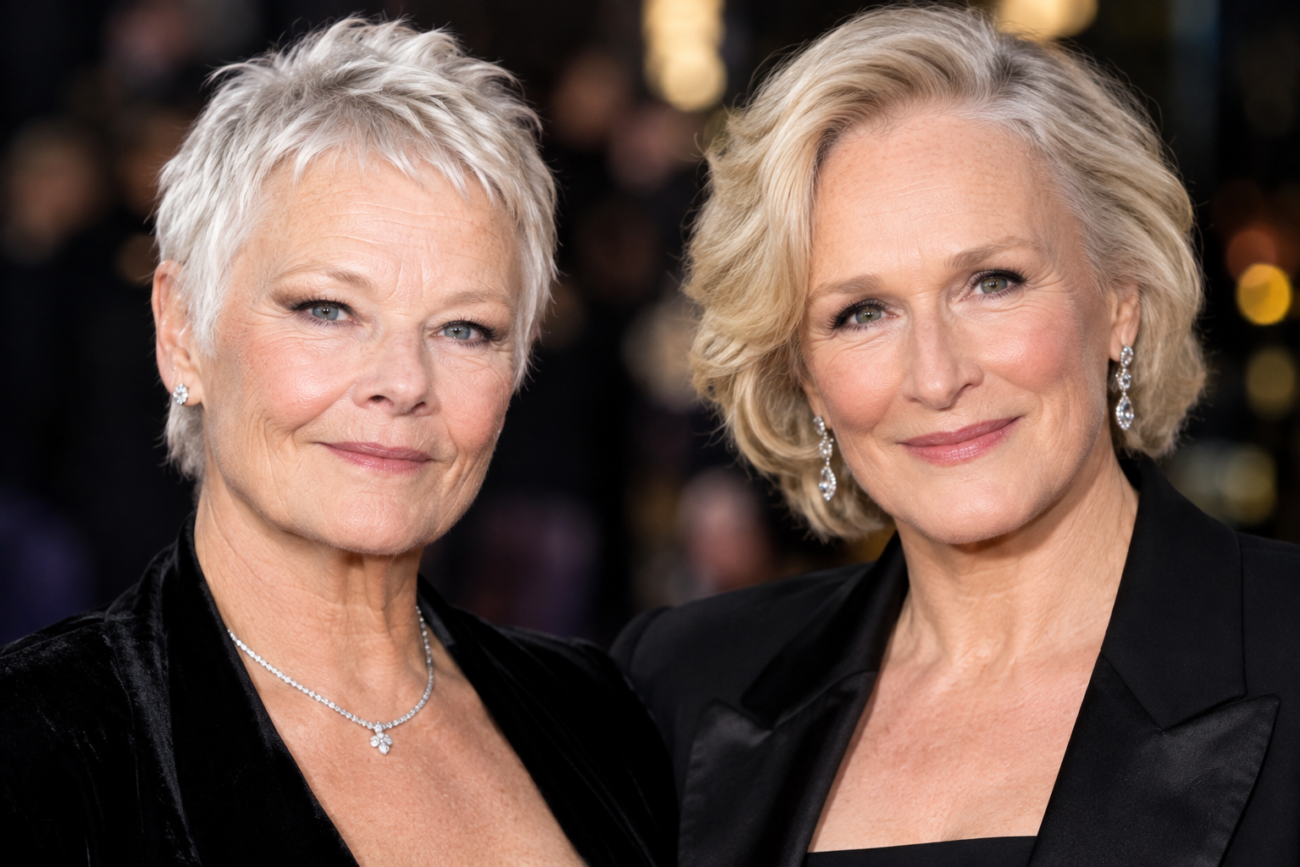
Judi Dench and Glenn Close are two of the most respected actresses of their generations, with careers that span theatre, television, and film. Although they come from different countries and developed their careers through somewhat different paths, both became known for remarkable versatility, commanding performances, and an ability to bring complexity to a wide range of characters.
Judi Dench established herself as a major force in British theatre before becoming internationally recognized through films such as Shakespeare in Love, Mrs Brown, Notes on a Scandal, and the James Bond series. Glenn Close, meanwhile, built a distinguished American career across stage and screen, earning recognition for performances in The Big Chill, Fatal Attraction, Dangerous Liaisons, Albert Nobbs, and The Wife.
This comparison of Judi Dench and Glenn Close looks at their backgrounds, careers, acting styles, major performances, awards, and contributions to entertainment. Rather than simply asking which actress is better, it explains what makes each performer distinctive.
Key Takeaways
- Judi Dench developed a major reputation through British theatre before achieving worldwide film recognition.
- Glenn Close has built a similarly versatile career across Broadway, Hollywood, television, and film.
- Both actresses have played sophisticated, emotionally demanding, and complex characters.
- Dench won an Academy Award for Shakespeare in Love, while Close has received multiple Oscar nominations without winning.
- Their careers demonstrate different but equally notable approaches to combining theatre and screen acting.
- Neither actress is defined by one genre or character; both have repeatedly transformed their performances across decades.
Biography Table
| Full Name | Dame Judi Dench | Glenn Close |
|---|---|---|
| Date of Birth | December 9, 1934 | March 19, 1947 |
| Age | 91 (as of September 2026) | 79 (as of September 2026) |
| Birthplace | York, England | Greenwich, Connecticut, U.S. |
| Nationality | British | American |
| Profession | Actress | Actress |
| Education | Central School of Speech and Drama | College of William & Mary |
| Years Active | 1950s–present | 1970s–present |
| Known For | Shakespeare in Love, James Bond, Philomena, Notes on a Scandal | Fatal Attraction, Dangerous Liaisons, The Wife, The Big Chill |
| Major Achievements | Academy Award, BAFTAs, Golden Globes and major theatre honors | Multiple Academy Award nominations, Tony Awards and Emmy recognition |
Main Article
Judi Dench and Glenn Close: Two Different Paths to Stardom
One of the most interesting aspects of Judi Dench and Glenn Close is that neither actress followed a straightforward Hollywood route to success.
Dench’s professional identity was strongly shaped by British theatre. She became associated with major stage productions and the Royal Shakespeare Company, developing a reputation for precision, emotional intelligence, and an ability to move between comedy and drama.
Close’s career also had a strong theatrical foundation, but her breakthrough came through the American stage. Her Broadway work helped establish her as a serious performer before Hollywood increasingly sought her for challenging dramatic roles.
Their backgrounds help explain an important similarity between them: both actresses approached screen acting with the discipline and depth associated with theatre.
Judi Dench’s Career
Judi Dench began acting professionally in the 1950s and became one of Britain’s most celebrated performers. Her stage career included Shakespearean productions and work with the Royal Shakespeare Company.
Her film career eventually brought her to a global audience.
One of her most significant early screen roles was Queen Victoria in Mrs Brown. The performance earned her an Academy Award nomination and demonstrated her ability to make a historical figure feel intimate and emotionally accessible.
Her international profile grew even further when she played M, the head of the British Secret Service, in the James Bond films. The role gave Dench a very different kind of screen presence: authoritative, intelligent, dryly humorous, and capable of holding her own opposite the franchise’s action-oriented characters.
Dench’s performance in Shakespeare in Love became another defining achievement. Her appearance as Queen Elizabeth I was brief, but it made a major impression and earned her the Academy Award for Best Supporting Actress.
She later delivered acclaimed performances in films including Chocolat, Iris, Notes on a Scandal, Philomena, and Victoria & Abdul.
Her career demonstrates that a performer does not need to rely on one type of character to remain relevant. Dench has moved comfortably among Shakespeare, historical drama, comedy, contemporary drama, and mainstream franchise cinema.
Glenn Close’s Career
Glenn Close emerged as a major stage performer in the 1970s before making her film breakthrough in The World According to Garp.
Her early film career quickly established her as an actress capable of playing emotionally complicated characters. She followed that success with roles in films such as The Big Chill and The Natural.
One of Close’s most famous performances came in Fatal Attraction, where she played Alex Forrest. The psychological thriller became a major commercial success and turned the role into one of the most recognizable performances of her career.
Close demonstrated another side of her talent in Dangerous Liaisons, playing the calculating Marquise de Merteuil. The film received several Academy Award nominations, including one for Close, and remains one of her most acclaimed screen performances.
Her later career included Albert Nobbs, Guardians of the Galaxy, The Wife, and television projects. The Wife was particularly important because it gave Close another opportunity to explore questions of identity, ambition, marriage, artistic recognition, and sacrifice.
Like Dench, Close has never been limited to a single genre.
Acting Styles: Judi Dench vs. Glenn Close
Comparing acting styles is more useful than simply trying to determine which actress is superior.
Judi Dench’s Strengths
Dench is particularly admired for her ability to communicate significant emotion through subtle changes in expression, voice, timing, and physical presence.
She can play characters who appear outwardly controlled while suggesting considerable emotional complexity beneath the surface.
Her comic timing is another important part of her appeal. Films such as The Best Exotic Marigold Hotel demonstrate her ability to combine warmth and humor with dramatic credibility.
Glenn Close’s Strengths
Close is frequently associated with psychologically intense performances. Her characters can be vulnerable, intimidating, intelligent, ambitious, or deeply conflicted.
She is particularly effective when a character has competing motivations. Rather than presenting a role as simply heroic or villainous, Close often gives audiences reasons to examine what is happening beneath the character’s behavior.
Her stage experience has also contributed to a strong vocal and physical presence.
Their Most Recognizable Roles
Both actresses have accumulated extensive filmographies, but certain roles have become especially associated with their names.
Judi Dench
Some of Dench’s best-known screen roles include:
- Queen Elizabeth I in Shakespeare in Love
- M in the James Bond franchise
- Queen Victoria in Mrs Brown
- Philomena Lee in Philomena
- Barbara Covett in Notes on a Scandal
- Evelyn Greenslade in The Best Exotic Marigold Hotel
- Miss Matilda in Chocolat
These roles demonstrate the breadth of her career, moving from historical figures to fictional characters and from serious drama to comedy and blockbuster cinema.
Glenn Close
Close’s most recognizable roles include:
- Alex Forrest in Fatal Attraction
- Marquise de Merteuil in Dangerous Liaisons
- Jenny Fields in The World According to Garp
- Sunny von Bülow in Reversal of Fortune
- Cruella de Vil in 101 Dalmatians
- Albert Nobbs in Albert Nobbs
- Joan Castleman in The Wife
Close’s filmography similarly covers psychological drama, historical stories, comedy, literary adaptations, and mainstream entertainment.
Awards and Recognition
Awards provide one way to understand the industry’s recognition of both performers, although they cannot fully measure an actor’s artistic contribution.
Judi Dench won the Academy Award for Best Supporting Actress for Shakespeare in Love. She has also received multiple BAFTA Awards and other major honors throughout her career.
Glenn Close has received numerous major award nominations, including multiple Academy Award nominations. Her performances in The World According to Garp, The Big Chill, Fatal Attraction, Dangerous Liaisons, Albert Nobbs, The Wife, and other films have contributed to her reputation as one of America’s most accomplished screen performers.
Their careers also show an interesting contrast: Dench has an Academy Award win, while Close’s career has been notable for repeated Oscar recognition without an Academy Award victory.
Theatre Remains Central to Both Careers
A comparison of Judi Dench and Glenn Close would be incomplete without discussing theatre.
Dench’s reputation was built substantially through British stage work, particularly Shakespearean theatre. Her experience performing for live audiences became an important foundation for her later screen career.
Close likewise established herself on Broadway before becoming one of Hollywood’s most recognizable actresses. Her stage work earned her significant recognition and demonstrated that her talents extended well beyond cinema.
This theatrical foundation is one of the strongest connections between the two actresses.
How Their Screen Careers Differ
Despite their similarities, Dench and Close have occupied different positions within popular culture.
Dench became closely associated with British cultural institutions, Shakespearean performance, the James Bond franchise, and character-driven British cinema.
Close became strongly associated with Hollywood psychological dramas and complex female characters, while also appearing in major studio productions and television.
Their filmographies therefore overlap in seriousness and range, but their public identities developed differently.
What Makes Their Careers Comparable?
Several characteristics make the careers of Judi Dench and Glenn Close particularly interesting to compare.
Longevity
Both actresses have maintained careers lasting for decades. They have continued taking on substantial roles well beyond the period when many performers experience a decline in major opportunities.
Versatility
Neither actress has depended on one genre. Both have worked in drama, comedy, literary adaptations, historical productions, television, and theatre.
Complex Characters
Both have frequently played characters with multiple layers rather than straightforward heroes.
Theatre Experience
Their stage backgrounds helped establish strong foundations for their screen performances.
Critical Recognition
Both have received substantial recognition from major awards organizations throughout their careers.
Judi Dench and Glenn Close in Popular Culture
Their influence extends beyond individual movies.
Dench became especially recognizable to international audiences through the James Bond series. Her version of M helped redefine the character as a powerful authority figure and became one of the franchise’s most memorable supporting performances.
Close, meanwhile, became associated with some of the most psychologically distinctive female characters in American cinema. Her performance in Fatal Attraction became an enduring reference point in discussions of 1980s film and popular culture.
Both actresses have also demonstrated that older performers can continue to deliver commercially and critically significant work.
Did Judi Dench and Glenn Close Work Together?
Despite frequent comparisons between them, Judi Dench and Glenn Close do not have a major shared film or television project that defines their careers.
Their connection is primarily based on their status as highly accomplished actresses whose careers developed across theatre and screen.
It is therefore more accurate to discuss them as contemporaries in the broader acting world rather than as a famous on-screen acting partnership.
Their filmographies also sometimes appear in the same broader discussions of acclaimed actresses, awards history, and major dramatic performances, but that does not mean they regularly worked together.
Which Actress Has the More Diverse Career?
The answer depends on how diversity is measured.
If diversity means moving between theatre, British cinema, Hollywood productions, television, comedy, drama, and major franchises, both have exceptionally broad careers.
Dench’s work spans Shakespearean theatre, British television, prestige cinema, comedy, historical drama, and the James Bond franchise.
Close’s career spans Broadway, Hollywood drama, psychological thrillers, television, comedy, fantasy, and independent cinema.
Rather than identifying one actress as more diverse, it is more useful to recognize that they achieved versatility through different career paths.
Frequently Asked Questions
Are Judi Dench and Glenn Close friends?
There is no widely established public record showing that the two actresses have a close personal friendship. They are better understood as highly respected performers whose careers are often discussed together because of their longevity and accomplishments.
Have Judi Dench and Glenn Close worked together?
They are not known for having a major shared acting project that defines their careers. Comparisons between them generally focus on their individual achievements in theatre, film, television, and awards.
Who is older, Judi Dench or Glenn Close?
Judi Dench is older. Dench was born on December 9, 1934, while Glenn Close was born on March 19, 1947.
Did Judi Dench win an Oscar?
Yes. Dench won the Academy Award for Best Supporting Actress for playing Queen Elizabeth I in Shakespeare in Love.
Has Glenn Close won an Oscar?
Glenn Close has received multiple Academy Award nominations but has not won the Academy Award for acting.
What is Judi Dench best known for?
Dench is particularly known for Shakespeare in Love, the James Bond films, Mrs Brown, Philomena, Notes on a Scandal, and her extensive theatre career.
What is Glenn Close best known for?
Close is widely known for films including Fatal Attraction, Dangerous Liaisons, The World According to Garp, The Big Chill, 101 Dalmatians, Albert Nobbs, and The Wife.
What do Judi Dench and Glenn Close have in common?
Both are acclaimed actresses with extensive stage and screen careers. They have demonstrated remarkable longevity, versatility, and an ability to portray complex characters across different genres.
Conclusion
Judi Dench and Glenn Close represent two remarkable approaches to a long and successful acting career. Dench built a formidable reputation through British theatre before becoming an international film star, while Close moved from American theatre into major Hollywood productions and acclaimed television work.
Their similarities are striking: both have exceptional longevity, extensive stage experience, major award recognition, and a reputation for bringing depth to complicated characters. Their differences are equally important, particularly in the kinds of roles and industries that shaped their public identities.
Ultimately, the careers of Judi Dench and Glenn Close are valuable to compare not because one needs to be declared better than the other, but because each illustrates how versatility, discipline, and sustained creative work can produce an extraordinary career across generations.
