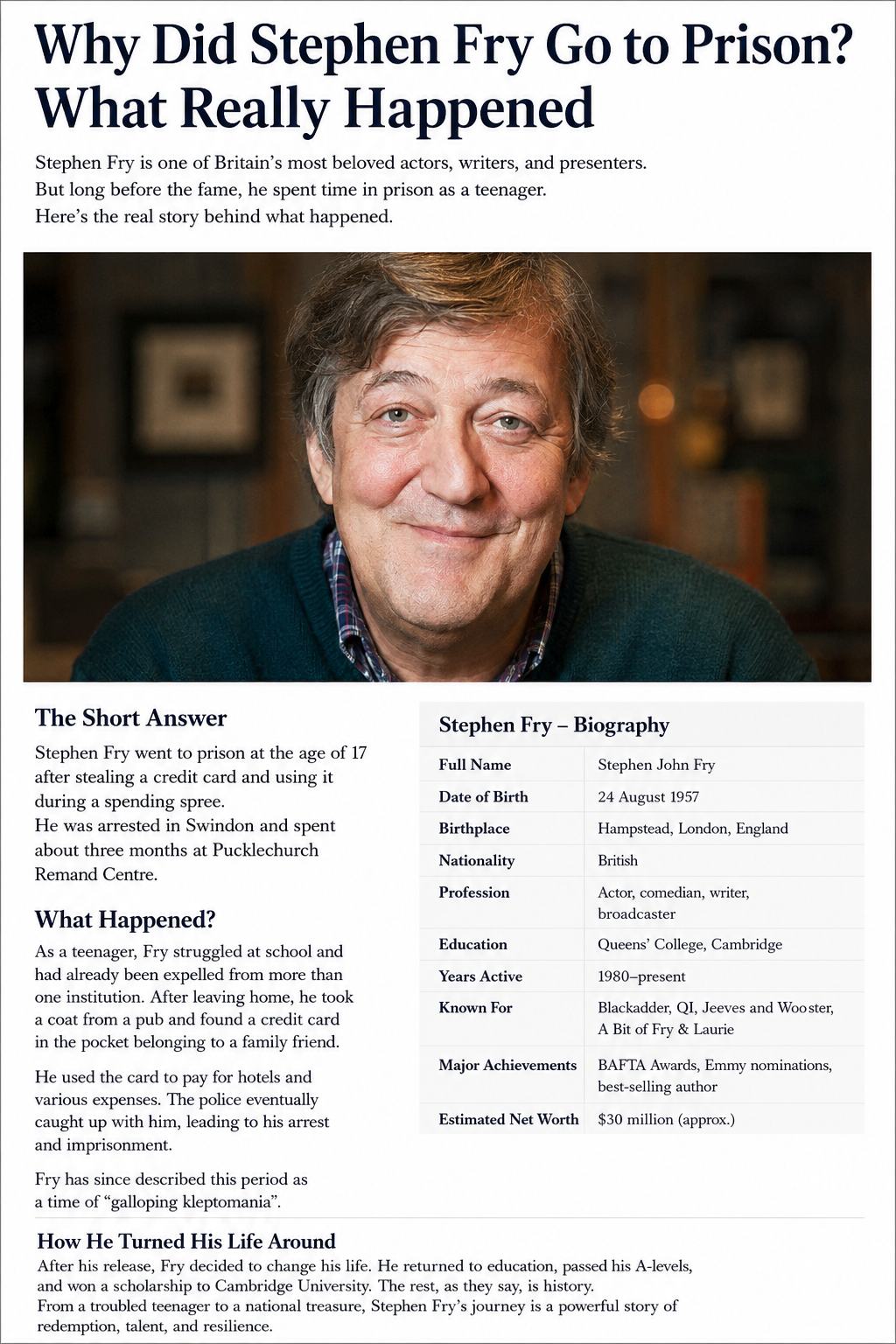
Introduction
The question “why did Stephen Fry go to prison” refers to a difficult period in the British actor, comedian, writer, and broadcaster’s teenage years. Long before he became famous for Blackadder, A Bit of Fry & Laurie, Jeeves and Wooster, QI, and his many books and films, Fry experienced serious problems with school, education, and the law.
At the age of 17, Fry stole a credit card belonging to a family friend and used it during a spending spree after leaving home. He was eventually arrested in Swindon and spent about three months at Pucklechurch, a young offenders’ institution/remand centre.
Fry has spoken openly about this period of his life, including his teenage tendency toward what he later described as “galloping kleptomania.” His experience became an important part of his autobiography and the story of how he eventually turned his life around.
This article explains what happened, why he was imprisoned, what his teenage years were like, and how he went from a troubled adolescent to one of Britain’s best-known entertainers.
Key Takeaways
- Stephen Fry went to prison as a 17-year-old after stealing and using a credit card belonging to a family friend.
- He was arrested in Swindon after using the card during a spending spree.
- Fry spent approximately three months at Pucklechurch Remand Centre, although sources sometimes describe it simply as Pucklechurch Prison.
- He later described his teenage behaviour in terms of “galloping kleptomania.”
- After his release, Fry returned to education, passed his A-levels and won a scholarship to Cambridge.
- His imprisonment became part of the story of his troubled youth and subsequent transformation into a successful writer and performer.
Biography Table
| Detail | Information |
|---|---|
| Full Name | Stephen John Fry |
| Date of Birth | 24 August 1957 |
| Age | 69 |
| Birthplace | Hampstead, London, England |
| Nationality | British |
| Profession | Actor, comedian, writer, broadcaster and presenter |
| Education | Uppingham School, Paston School, Norfolk College of Arts and Technology, Queens’ College, Cambridge |
| Years Active | 1980–present |
| Known For | Blackadder, A Bit of Fry & Laurie, Jeeves and Wooster, QI, Wilde and numerous books |
| Major Achievements | Successful career across television, film, theatre, literature and broadcasting |
Why Did Stephen Fry Go to Prison?
Stephen Fry went to prison as a teenager after stealing a credit card from a family friend and using it without permission.
The incident happened when Fry was 17 and going through an extremely unsettled period. He had already experienced difficulties at school and had been expelled from more than one institution. After failing to complete his A-level examinations, he left his education behind for a period and eventually ran away.
According to accounts of his life, Fry took a coat when leaving a pub because he intended to spend the night sleeping rough. He then discovered a credit card in the coat’s pocket. The card belonged to a family friend. Instead of returning it, Fry used it, beginning a spending spree that eventually brought him to the attention of the police.
He travelled to Swindon and used the stolen card on hotels and other expenses. He was subsequently arrested.
The episode was not simply a youthful misunderstanding. Fry was prosecuted over his use of the stolen credit card and spent around three months in Pucklechurch.
What Did Stephen Fry Steal?
The central item involved in the case was a credit card belonging to a family friend.
Some accounts describe the incident as credit-card fraud, while other biographical accounts focus on the theft itself. The important point is that Fry found a card that did not belong to him and then used it to pay for goods and services. Contemporary and later biographies consistently connect the incident with his three-month stay at Pucklechurch.
Fry himself has discussed the episode several times. In later reflections, he described his teenage behaviour as involving “galloping kleptomania,” providing an important insight into how he understood his actions when looking back on them.
How Old Was Stephen Fry When He Went to Prison?
Stephen Fry was 17 years old when he was arrested and imprisoned.
This is an important part of the story because the incident occurred before he had begun his university education or established himself professionally.
At that stage, Fry’s future was far from certain. He had experienced repeated educational problems and had failed his A-levels. His arrest could easily have become the defining event of his adult life.
Instead, it became one chapter in a much larger story.
Where Was Stephen Fry Imprisoned?
Fry spent approximately three months at Pucklechurch Remand Centre, in the Bristol area.
Different sources use slightly different descriptions of the institution. Some call it Pucklechurch Prison, while biographical accounts identify it as Pucklechurch Remand Centre. Fry’s time there is also sometimes described as a period in a young offenders’ institution.
The distinction matters because “prison” is the simplest description commonly used in biographies, while the specific institution and remand terminology provide more historical context.
The safest summary is that Fry was arrested as a teenager over the stolen credit card and spent roughly three months at Pucklechurch.
What Happened During Stephen Fry’s Time in Prison?
Fry has subsequently recalled his time at Pucklechurch with a mixture of seriousness and humour.
One particularly well-known detail concerns his academic interests. He was reportedly nicknamed “The Professor” during his stay because of his knowledge and ability to read and write. Accounts also describe him helping another inmate with reading and writing.
His mother also played an important supportive role during this difficult period. Accounts of Fry’s imprisonment describe her sending him newspaper crossword puzzles, which became a source of comfort and mental stimulation.
Although Fry later joked about aspects of the experience, the imprisonment was clearly a serious turning point.
He was still a teenager, and the consequences could have followed him for the rest of his life.
What Led to Stephen Fry’s Arrest?
The prison episode did not happen in isolation. Fry’s teenage years had already been marked by significant instability.
Before the credit-card incident, he had been expelled from Uppingham School and later dismissed from Paston School. He subsequently attended Norfolk College of Arts and Technology but failed to complete his A-level examinations successfully.
This period of his life involved a pattern of impulsive behaviour and difficulty fitting into conventional educational structures.
Fry has written about these experiences in his autobiography Moab Is My Washpot, which explores his childhood, adolescence and early adulthood.
His later reflections are valuable because they show that he did not simply present the prison episode as something that happened to him. He acknowledged his responsibility for the choices he made.
Did Stephen Fry Serve a Prison Sentence or Stay on Remand?
This is one area where descriptions of the story can vary.
Many biographies and newspaper profiles describe Fry as having served a three-month prison sentence for fraud or credit-card offences. The Guardian, for example, describes the period as a three-month prison sentence connected with his use of a stolen credit card.
Other biographical accounts specifically say that he spent three months at Pucklechurch Remand Centre on remand.
For readers researching the question “why did Stephen Fry go to prison?”, the key fact is not the terminology but the underlying event: Fry was arrested as a 17-year-old after stealing and using a family friend’s credit card, and he spent approximately three months in custody at Pucklechurch.
What Did Stephen Fry Say About His Teenage Behaviour?
Fry has been unusually candid about his youth.
In later interviews and autobiographical writing, he has discussed the impulsive behaviour that led to his arrest. He has referred to having “galloping kleptomania” as a teenager, a phrase that captures how he viewed his repeated stealing behaviour during that period.
However, it would be misleading to reduce the entire story of Fry’s adolescence to a single explanation.
His own reflections indicate that he was a complicated and troubled teenager. He experienced educational difficulties, ran away, struggled with impulsive behaviour and eventually became involved with the criminal justice system.
The important point is that his later success did not erase the seriousness of what happened. Instead, Fry incorporated the experience into his understanding of his younger self.
How Did Stephen Fry Turn His Life Around?
Fry’s release from custody was followed by a remarkable change in direction.
Rather than abandoning education permanently, he returned to studying. He attended City College Norwich and worked toward the qualifications needed to apply to Cambridge. In 1977, he passed A-levels in English and French and subsequently gained a scholarship to Queens’ College, Cambridge.
At Cambridge, Fry studied English Literature and became involved with the famous Cambridge Footlights comedy troupe.
It was also during this period that he met people who would become important to his future career, including Hugh Laurie.
His university years helped reveal the creative talents that would later make him famous.
From Cambridge to Comedy
Fry’s involvement with the Footlights was a major turning point.
The Cambridge comedy scene gave him an opportunity to write, perform and collaborate with other talented young performers. His partnership with Hugh Laurie eventually became one of the most recognizable comedy collaborations in British television.
Their work together included A Bit of Fry & Laurie and Jeeves and Wooster. Fry also became widely known through Blackadder and later QI.
This makes his teenage imprisonment particularly striking in retrospect.
The 17-year-old who had been arrested and spent months in custody eventually became a Cambridge graduate, bestselling author, acclaimed actor and one of Britain’s most recognizable broadcasters.
Did Prison Stop Stephen Fry’s Career?
No.
In fact, Fry’s later career demonstrates that a troubled adolescence does not necessarily determine a person’s entire future.
After Cambridge, Fry established himself as a writer and performer. His work expanded across television, film, theatre, radio and literature.
He became particularly well known for roles and projects including:
- Blackadder
- A Bit of Fry & Laurie
- Jeeves and Wooster
- QI
- Wilde
- Gosford Park
- V for Vendetta
- The Hobbit
- His autobiographical books and novels
His career has lasted for decades, making his teenage criminal record only one part of a much broader life story.
Why Is Stephen Fry’s Prison Story Still Discussed?
There are several reasons the story continues to attract interest.
First, the contrast between Fry’s later public image and his teenage years is striking. He is now widely associated with literature, comedy, television and intellectual curiosity. Learning that he spent time in custody at 17 can therefore come as a surprise.
Second, Fry himself has been willing to discuss the incident. He has included his early experiences in his autobiographical writing and spoken about them in interviews.
Third, his story provides an example of how dramatically a person’s circumstances can change.
The prison episode did not disappear from his biography, but neither did it prevent him from pursuing education or developing an extraordinarily successful career.
Stephen Fry’s Story: From Troubled Teenager to Cultural Figure
The simplest way to understand Fry’s life is not as a story about a celebrity who once went to prison, but as a story of significant personal change.
His teenage years involved expulsion from schools, academic failure, running away from home, theft and imprisonment. Yet after his release, he returned to education and eventually earned a place at Cambridge.
That progression is important.
His later success was not the result of ignoring his past. Fry has repeatedly revisited his younger years in his writing and interviews, allowing readers to see the mistakes, uncertainty and ambition that shaped his early life.
His prison experience is therefore best understood as a difficult episode within a much longer journey.
Frequently Asked Questions
Why did Stephen Fry go to prison?
Stephen Fry went to prison as a 17-year-old after stealing a credit card belonging to a family friend and using it during a spending spree. He was arrested in Swindon and spent approximately three months at Pucklechurch.
How old was Stephen Fry when he went to prison?
Fry was 17 years old when the incident occurred.
What did Stephen Fry steal?
He stole a credit card belonging to a family friend. He subsequently used the card to pay for hotels and other expenses during a period when he had run away from home.
Where did Stephen Fry serve his time?
He spent approximately three months at Pucklechurch Remand Centre, which is commonly referred to in biographies as Pucklechurch Prison.
Did Stephen Fry go to Cambridge after prison?
Yes. After his release, Fry returned to education, passed his A-levels and eventually won a scholarship to Queens’ College, Cambridge, where he studied English Literature.
Did Stephen Fry write about going to prison?
Yes. His autobiography, Moab Is My Washpot, discusses his childhood and adolescence, including the difficult experiences surrounding his arrest and imprisonment.
Did prison end Stephen Fry’s career prospects?
No. His later career became highly successful. He worked as an actor, comedian, writer, broadcaster and presenter, becoming known for productions including Blackadder, A Bit of Fry & Laurie, Jeeves and Wooster and QI.
Did Stephen Fry regret what he did?
Fry has spoken openly and critically about his behaviour as a teenager. His later discussions of the period acknowledge the seriousness of his actions while also examining the complicated circumstances of his youth.
Conclusion
So, why did Stephen Fry go to prison? The answer is straightforward: when he was 17, Fry stole a credit card belonging to a family friend and used it during a spending spree. He was arrested in Swindon and spent approximately three months at Pucklechurch Remand Centre.
What makes the story remarkable is what happened afterward.
Fry returned to education, passed his examinations, won a scholarship to Cambridge and eventually built an extraordinarily varied career in comedy, acting, writing and broadcasting. His teenage imprisonment remained part of his personal history, but it did not define the rest of his life.
For anyone researching “why did Stephen Fry go to prison,” the broader lesson is that his arrest was one difficult chapter in a much longer story of change, education and professional achievement.
