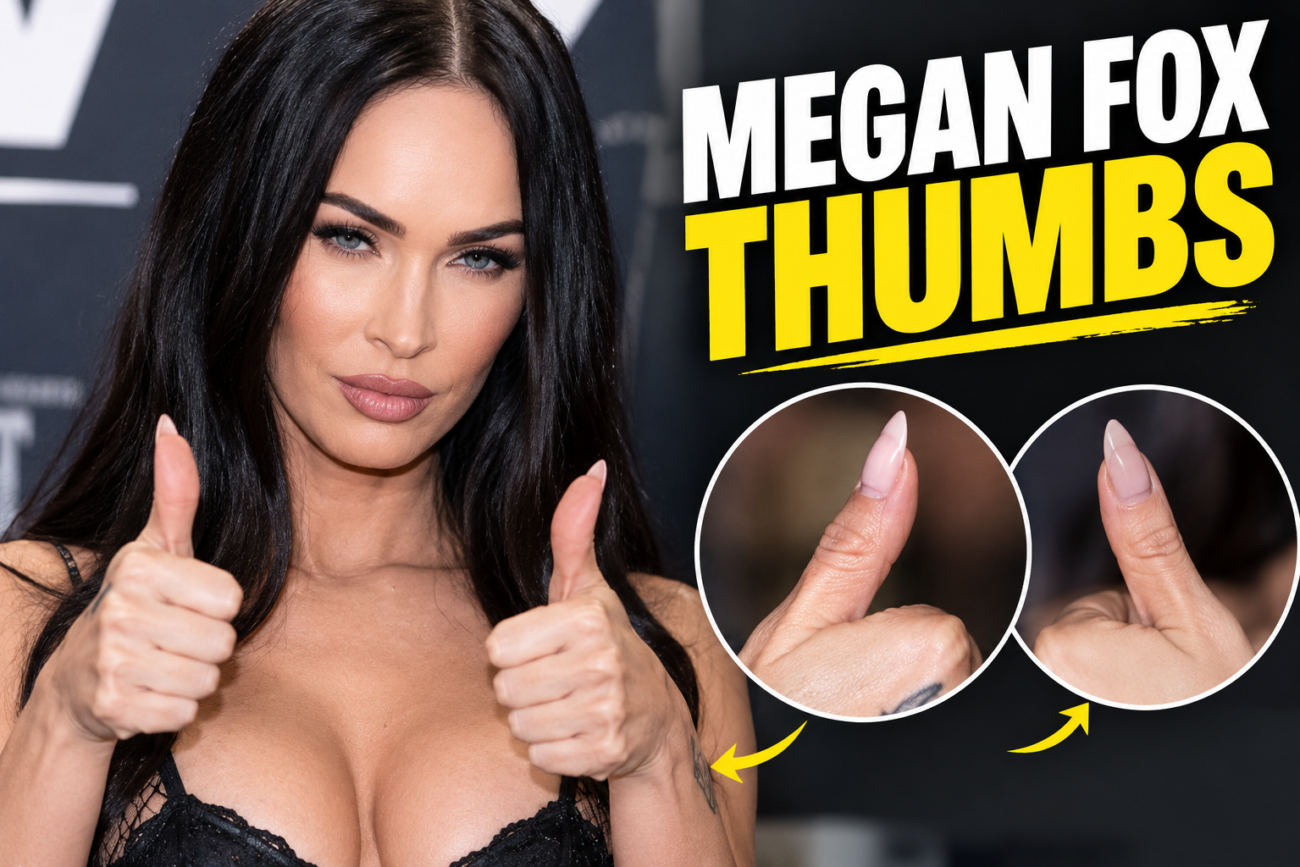
Megan Fox is widely recognized for her roles in Transformers, Jennifer’s Body, and Teenage Mutant Ninja Turtles. Over the years, however, another feature has repeatedly attracted online attention: her thumbs.
Searches for megan fox thumbs are often driven by photos in which one or both of her thumbs appear shorter or broader than people expect. This has led to discussion about whether Fox has an unusual anatomical trait and whether it has a medical name.
The term most frequently associated with the appearance is brachydactyly type D, sometimes called a “stub thumb.” Medically, type D brachydactyly involves a short, broad distal phalanx—the bone at the end of the thumb beneath the nail.
There is an important distinction, though: while online sources have long identified Fox’s thumb appearance with brachydactyly type D, a reliable public medical record or direct statement from Fox confirming a formal diagnosis is not readily available. Therefore, it is more accurate to discuss the resemblance and the condition itself than to present an unverified diagnosis as fact.
This article explains what people notice about Megan Fox’s thumbs, what brachydactyly type D actually is, and what can—and cannot—be concluded from photographs.
Key Takeaways
- Megan Fox’s thumbs have attracted attention because they can appear relatively short and broad in photographs.
- Brachydactyly type D is the medical term for a short, broad distal phalanx of the thumb.
- The condition is also known as stub thumb and is generally related to differences in bone development.
- Brachydactyly is often a cosmetic difference and does not necessarily interfere with hand function.
- Online discussions commonly associate Fox’s thumbs with type D brachydactyly, but that association should not be treated as a confirmed personal medical diagnosis without a reliable statement or clinical evidence.
- The appearance of a thumb in a photograph alone cannot establish a medical diagnosis.
Biography Table
| Detail | Information |
|---|---|
| Full Name | Megan Denise Fox |
| Date of Birth | May 16, 1986 |
| Age | 40 as of 2026 |
| Birthplace | Oak Ridge, Tennessee, United States |
| Nationality | American |
| Profession | Actress and model |
| Education | Attended Morningside Academy and St. Lucie West Centennial High School; later completed schooling through correspondence |
| Years Active | 2001–present |
| Known For | Transformers, Jennifer’s Body, Teenage Mutant Ninja Turtles, New Girl |
| Major Achievements | Multiple Teen Choice Awards and Scream Awards; international recognition following Transformers |
| Estimated Net Worth | Approximately $8 million, according to publicly reported estimates |
Fox was born on May 16, 1986, in Oak Ridge, Tennessee. She began dance and drama training as a child and started modeling as a teenager before moving toward professional acting. Her major breakthrough came with Transformers in 2007.
What Makes Megan Fox’s Thumbs Look Different?
The main reason people notice Megan Fox’s thumbs is their apparent shape and proportions.
In photographs, her thumbs can look comparatively short and broad, particularly around the end of the thumb. That visual characteristic is what has prompted comparisons with a condition known medically as brachydactyly type D.
The key point is that the appearance concerns the proportions of the thumb rather than simply its overall size. A thumb can be completely functional while having a shorter or wider distal bone.
Brachydactyly is a general medical term meaning that one or more digits are shorter than usual because of differences in bone development. Cleveland Clinic explains that there are several forms, affecting different bones and digits. Type D specifically affects the thumb.
What Is Brachydactyly Type D?
Brachydactyly type D is a particular form of brachydactyly involving the distal phalanx of the thumb.
The distal phalanx is the bone at the very end of the thumb, underneath the nail. According to the National Institutes of Health’s Genetic Testing Registry, type D is characterized by a short, broad distal phalanx in the thumb and is also known as “stub thumb.”
This explains why the condition can create an appearance that differs from the long, relatively narrow thumb shape that people may expect.
Importantly, “different” does not automatically mean “abnormal” in a way that causes a health problem. Many people with brachydactyly have normal hand function.
Cleveland Clinic notes that most cases do not affect a person’s ability to use the affected fingers or toes and may primarily represent a cosmetic difference.
Is Megan Fox’s Thumb Brachydactyly Type D?
This is where it is important to separate online claims from confirmed medical information.
Megan Fox’s thumbs have frequently been described online as an example of brachydactyly type D. The physical description often associated with her thumbs—shorter and broader than average—is consistent with the general appearance of type D brachydactyly.
However, photographs cannot establish a diagnosis.
A clinical diagnosis of brachydactyly can involve a physical examination and, when necessary, imaging such as an X-ray. Genetic testing may also be used in some circumstances to identify an associated genetic change.
There is no need to assume that a celebrity has a particular medical condition simply because photographs appear similar to examples of that condition.
Therefore, the most responsible description is:
Megan Fox’s thumbs have an appearance that is commonly compared online with brachydactyly type D, but a confirmed personal diagnosis should not be assumed without a reliable medical or first-person source.
This distinction is especially important when discussing health-related subjects involving public figures.
Why Do People Call It a “Stub Thumb”?
“Stub thumb” is a commonly used descriptive term for brachydactyly type D.
The NIH Genetic Testing Registry lists stub thumb as a synonym for brachydactyly type D. The defining feature is a short and broad distal phalanx of the thumb.
The term is descriptive rather than a judgment about someone’s appearance.
A person with this anatomical variation may have:
- A shorter-looking thumb tip
- A broader distal thumb
- A wider appearance around the nail
- A thumb that looks different from the other fingers
- Normal or near-normal hand function
The exact appearance varies considerably from person to person.
Is Brachydactyly a Medical Problem?
Not necessarily.
Brachydactyly is a congenital difference in bone development. In many people, it has little or no effect on everyday activities. Cleveland Clinic states that most cases do not interfere with normal use of the hands or feet.
That means someone with a shorter thumb may still be able to:
- Write normally
- Type on a keyboard
- Use a smartphone
- Hold objects
- Exercise
- Play sports
- Perform detailed hand movements
More significant functional problems are possible in some forms of brachydactyly, but they should not be assumed simply from appearance.
Does Brachydactyly Type D Affect Both Thumbs?
It can affect one or both thumbs.
Research on brachydactyly type D has documented both bilateral and unilateral presentations. One clinical study described affected individuals with either bilateral, symmetric involvement or involvement of a single thumb.
Another study of inheritance patterns found that the trait was bilateral in approximately three-quarters of the individuals studied and unilateral in approximately one-quarter.
This variation is one reason why photographs of someone’s hands should not be used to make assumptions about the precise anatomical condition involved.
What Causes Brachydactyly Type D?
Brachydactyly is generally associated with genetic differences affecting the development of bones in the fingers and toes.
For type D specifically, the HOXD13 gene is one of the genes associated with the condition. The NIH’s Genetic Testing Registry identifies HOXD13 in connection with brachydactyly type D.
Cleveland Clinic also explains that different types of brachydactyly can result from mutations in different genes. Type D is among the forms associated with HOXD13.
The condition can occur within families, although the inheritance pattern and expression can vary.
This does not mean that every person with a similar-looking thumb necessarily has a hereditary disorder. A clinical assessment is required to determine what is actually happening anatomically.
Why Megan Fox’s Thumbs Became a Celebrity Talking Point
Celebrity photographs are often examined in much greater detail than ordinary photographs.
Megan Fox has spent much of her career in highly photographed roles, from magazine appearances and red carpets to film premieres and promotional events. As a result, small physical characteristics can become recognizable features discussed by fans.
Her thumbs are a good example of how a minor anatomical difference can become part of online celebrity conversation.
The attention does not necessarily indicate that anything is wrong with her hands. In fact, one of the most useful lessons from the discussion is that human physical characteristics naturally vary.
A feature that appears unusual to one person may simply represent normal anatomical variation for another.
Megan Fox Thumbs: Medical Fact vs. Online Speculation
| Claim | What can responsibly be said |
|---|---|
| Megan Fox has visibly distinctive thumbs | Her thumbs have been widely discussed because of their appearance in photographs. |
| Her thumbs resemble type D brachydactyly | The commonly described short, broad thumb appearance is consistent with the general description of type D. |
| Megan Fox has a confirmed diagnosis | A reliable public medical confirmation should be provided before treating this as established fact. |
| Type D is called “stub thumb” | Yes. The NIH lists “stub thumb” as a synonym. |
| Brachydactyly always causes disability | No. Most cases do not significantly interfere with function. |
| A photograph can diagnose the condition | No. Diagnosis may require clinical examination and, in some cases, imaging or genetic testing. |
This distinction makes the topic more useful and accurate than simply repeating an internet rumor.
Can You Diagnose Brachydactyly From a Photo?
No.
A photograph can show that a thumb looks shorter, wider, or differently proportioned, but it cannot show the complete structure of the underlying bones.
Medical professionals can evaluate brachydactyly using a physical examination and may use X-rays to determine which bones are shortened. Genetic testing can sometimes help identify the underlying genetic cause.
This matters because several different anatomical variations can produce superficially similar appearances.
For Megan Fox specifically, it is therefore appropriate to describe what is visible and explain the condition people commonly associate with it without presenting an unverified diagnosis as established medical fact.
Does Brachydactyly Need Treatment?
Usually, no treatment is necessary when the condition does not interfere with function.
Cleveland Clinic states that treatment is generally unnecessary unless shortened bones create movement difficulties. In cases where function is affected, reconstructive surgery may be considered. Some people may also explore cosmetic procedures if they are unhappy with the appearance of their digits.
Treatment decisions are individual and depend on:
- The specific type of brachydactyly.
- Which bones are affected.
- Whether hand function is limited.
- Whether pain or discomfort is present.
- The person’s personal goals and preferences.
The fact that a celebrity’s thumbs look distinctive does not mean that treatment is required.
Why the Topic Continues to Attract Search Interest
The popularity of searches about megan fox thumbs reflects a broader interest in recognizable physical characteristics of celebrities.
People may encounter photographs of Fox and notice that her thumbs appear different. They then search for an explanation, often using terms such as:
- Megan Fox thumbs
- Megan Fox thumb condition
- Megan Fox stub thumbs
- Megan Fox brachydactyly
- Why do Megan Fox’s thumbs look different?
- What is wrong with Megan Fox’s thumbs?
- Megan Fox hands
These searches largely have the same underlying informational intent: readers want to understand what they are seeing.
A useful article should therefore provide anatomical context while avoiding unsupported conclusions about a person’s health.
Frequently Asked Questions
Does Megan Fox have brachydactyly?
Megan Fox’s thumbs are commonly described online as resembling brachydactyly type D, but a confirmed personal diagnosis should not be assumed without a reliable medical or first-person source.
What is brachydactyly type D?
Brachydactyly type D is a congenital form of shortened digits that specifically affects the distal phalanx of the thumb. It is also called “stub thumb.”
Why do Megan Fox’s thumbs look short?
Her thumbs have a distinctive appearance in some photographs, particularly around the thumb tip. This has led to comparisons with type D brachydactyly, which involves a short, broad distal thumb bone.
Is brachydactyly a disease?
Brachydactyly is a congenital anatomical difference involving shortened bones in the fingers or toes. It does not necessarily cause illness or disability, and many people have normal function.
Can brachydactyly type D affect only one thumb?
Yes. Type D brachydactyly can occur in one or both thumbs. Research has documented both unilateral and bilateral presentations.
Does brachydactyly affect hand function?
Usually not. Most cases do not significantly affect the ability to use the hands, although some people can experience functional limitations depending on the severity and type.
Is brachydactyly genetic?
Brachydactyly can have a genetic basis, and different types are associated with different genes. Type D is associated with the HOXD13 gene.
Can you tell if someone has brachydactyly from a photograph?
No. A photograph may show a distinctive appearance, but a diagnosis requires appropriate clinical assessment and may involve X-rays or genetic testing.
Conclusion
Megan Fox’s thumbs have become a surprisingly recognizable part of her public image because they appear shorter and broader than the thumb shape many people are accustomed to seeing.
The anatomical condition most commonly associated with this appearance is brachydactyly type D, also known as stub thumb. Medically, it involves a shortened, broad distal phalanx of the thumb and is generally a congenital difference in bone development.
At the same time, it is important not to turn an online observation into an unverified medical diagnosis. While Fox’s thumbs may resemble the characteristics associated with type D brachydactyly, photographs alone cannot confirm that she has the condition.
Ultimately, the discussion around megan fox thumbs is a useful example of normal human anatomical variation. A distinctive physical feature does not automatically indicate a health problem, and in many cases, people with brachydactyly have completely normal hand function.
