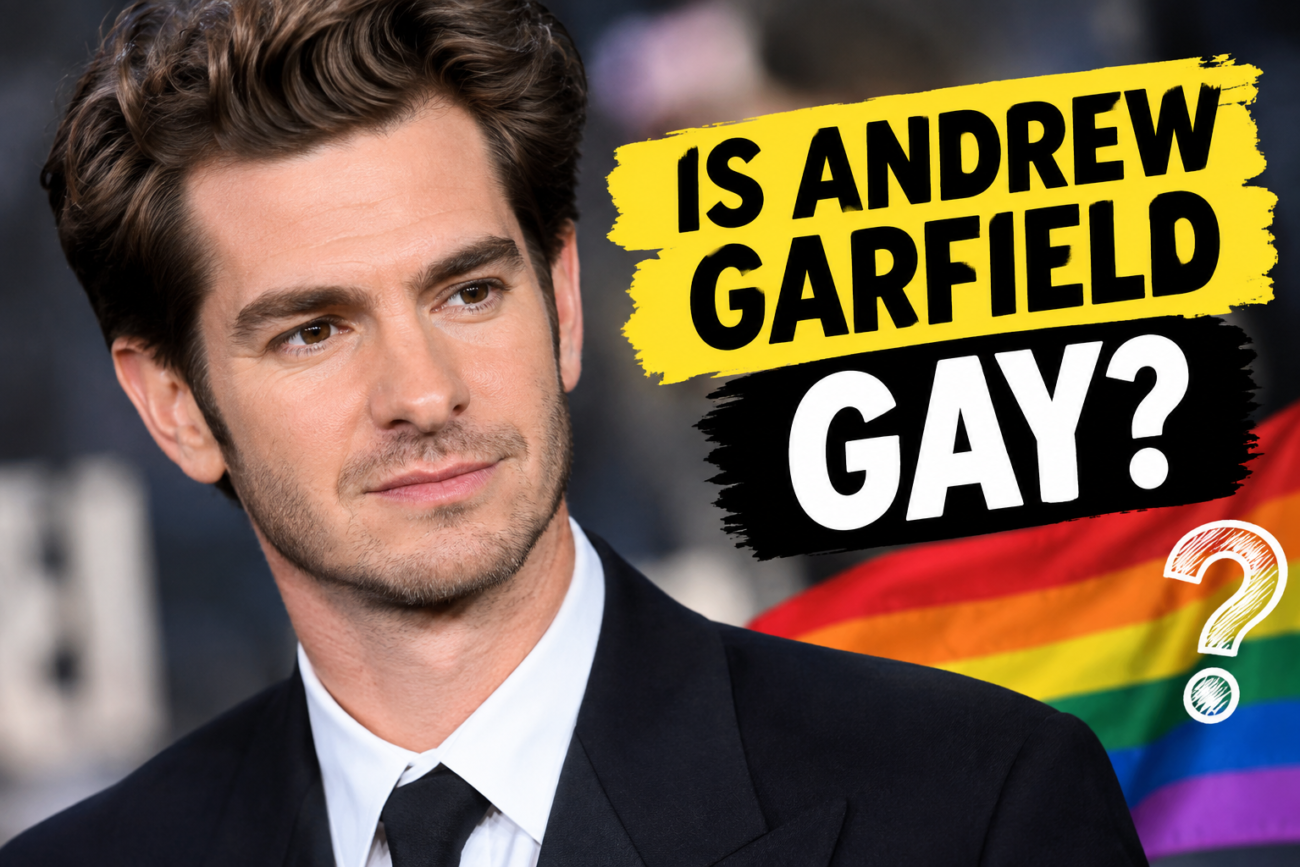
The question “is Andrew Garfield gay” has circulated for years, largely because of the actor’s openness when discussing sexuality, his support for LGBTQ+ representation, and his acclaimed performance as Prior Walter in Angels in America. Some of his comments have been taken out of context, creating confusion about whether he was making a statement about his own sexuality or discussing his approach to acting.
The clearest way to understand the subject is to focus on what Garfield has actually said publicly rather than relying on social-media speculation or assumptions based on the characters he has played.
Garfield has directly addressed the question in interviews. While discussing Angels in America in 2018, he said that he had only been sexually attracted to women up to that point and identified as heterosexual. At the same time, he described himself as open to whatever experiences or feelings life might bring. His earlier comments about being “a gay man” while preparing for the role contributed significantly to the rumors.
This article looks at those statements, explains the context behind them, and separates Garfield’s public comments from speculation about his private life.
Key Takeaways
- Andrew Garfield has publicly described himself as heterosexual.
- In a 2018 interview, he said he had only been sexually attracted to women up to that point.
- His comments about being “a gay man” were made while discussing preparation for Angels in America.
- Garfield has also expressed support for LGBTQ+ representation and greater freedom around sexual identity.
- Playing a gay character does not establish an actor’s personal sexual orientation.
- The most reliable information about Garfield’s sexuality comes from his own public statements, not rumors or fan speculation.
Biography Table
| Detail | Information |
|---|---|
| Full Name | Andrew Russell Garfield |
| Date of Birth | August 20, 1983 |
| Age | 43 years old |
| Birthplace | Los Angeles, California, United States |
| Nationality | British-American |
| Profession | Actor |
| Education | Central School of Speech and Drama |
| Years Active | 2004–present |
| Known For | The Amazing Spider-Man, Hacksaw Ridge, Tick, Tick… Boom!, Angels in America |
| Major Achievements | Tony Award; Academy Award nominations; BAFTA and Golden Globe recognition |
Is Andrew Garfield Gay?
Based on Andrew Garfield’s own public statements, he has identified as heterosexual.
During a 2018 interview about his Broadway performance in Angels in America, Garfield said that he had only been sexually attracted to women up to that point and stated that, if he were to identify himself, he would identify as heterosexual.
That statement is important because it comes directly from Garfield rather than from a tabloid, social-media account, or fan theory.
At the same time, Garfield has spoken about sexuality in a more open-ended way than a simple label might suggest. He has discussed being open to experiences and impulses that he might encounter in life. That openness has sometimes been interpreted online as evidence that he was secretly identifying as gay or bisexual.
However, being open-minded about sexuality is not the same thing as publicly identifying with a particular sexual orientation.
The most responsible answer to the question is therefore: Andrew Garfield has publicly identified as heterosexual, while also expressing an openness toward human sexuality and identity.
Why Do People Ask If Andrew Garfield Is Gay?
Much of the confusion comes from Garfield’s work in Angels in America, Tony Kushner’s acclaimed play about gay men, the AIDS crisis, politics, religion, relationships, and identity.
Garfield played Prior Walter, a gay man living with AIDS. The role required him to explore a character whose experiences were very different from those Garfield had publicly described as his own.
During discussions about preparing for the role, Garfield spoke enthusiastically about immersing himself in the world of the production. He talked about watching RuPaul’s Drag Race with friends and jokingly described himself as being like a gay man while preparing for the part.
That comment spread widely online.
Taken literally and without context, the statement could sound like Garfield was announcing something about his own sexuality. In context, however, he was discussing his preparation for an acting role and his attempt to understand a character and community different from his own experience.
He later clarified his position in interviews.
What Has Andrew Garfield Said About His Sexuality?
Garfield’s most significant public statement came in an interview surrounding the Broadway production of Angels in America.
He explained that he had only been sexually attracted to women up to that point. He also said that, if he had to identify himself, he would identify as heterosexual.
That is considerably clearer than some of his earlier comments.
At the same time, Garfield emphasized the idea of remaining open to life’s experiences. His comments reflected a broader philosophical attitude toward identity rather than a declaration that he was gay.
This distinction matters because celebrity interviews are frequently reduced to short quotations that can lose their original meaning once circulated online.
The “Gay Man Without the Physical Act” Comment
One of the biggest reasons the question “is Andrew Garfield gay” became popular was a comment he made while discussing Angels in America.
While talking about his preparation for the role, Garfield jokingly described himself as a “gay man” at that stage of the process, adding a qualification about not engaging in the physical aspect of a gay relationship.
The comment generated significant attention and criticism.
Some people interpreted it as Garfield claiming a gay identity. Others understood it as an actor using exaggerated language to describe how deeply he had immersed himself in a character.
Garfield subsequently explained that his comments were connected to his openness to exploring the character and to the process of entering the world of the play.
The important point is that the remark was made in the context of acting and character preparation. It should not be treated as a definitive announcement about his personal sexual orientation.
Andrew Garfield and Angels in America
Angels in America played an important role in the public discussion surrounding Garfield’s sexuality.
The play, written by Tony Kushner, is one of the most influential works of modern American theatre dealing with LGBTQ+ identity, the AIDS crisis, religion, politics, relationships, and mortality.
Garfield portrayed Prior Walter, one of its central characters.
His performance received widespread critical acclaim and ultimately earned him a Tony Award for Best Actor in a Play.
The role was also significant because Garfield approached it with considerable respect for the character and the history represented by the play.
His participation did not mean that he personally shared Prior’s sexual orientation. Actors regularly portray characters whose identities, experiences, professions, beliefs, or backgrounds differ from their own.
Does Playing a Gay Character Mean Andrew Garfield Is Gay?
No.
An actor’s role does not determine their personal sexual orientation.
Garfield’s portrayal of Prior Walter demonstrates his ability as an actor to inhabit a character with a different background and life experience. It does not provide evidence about his private identity.
The same principle applies to actors who play characters of different religions, nationalities, political beliefs, occupations, or sexual orientations.
In Garfield’s case, the confusion became particularly strong because he spoke openly about the process of preparing for the role.
Andrew Garfield’s Views on LGBTQ+ Representation
Garfield has also expressed support for broader LGBTQ+ representation in popular culture.
Earlier in his career, while discussing Spider-Man, he spoke about the possibility of the character being portrayed with greater sexual and gender openness. He questioned why audiences should automatically assume that a superhero has to fit a particular heterosexual model.
Those comments were about representation and fictional storytelling rather than an announcement about Garfield’s personal sexuality.
They do, however, help explain why Garfield has often been associated with conversations about LGBTQ+ visibility.
His public comments generally suggest that he is comfortable discussing sexuality as a complex part of human identity rather than something that must always fit rigid categories.
Is Andrew Garfield Bisexual?
There is no reliable public statement from Garfield identifying himself as bisexual.
Because he has spoken about being open to experiences and has discussed sexuality in a broad philosophical sense, some people have speculated that he might be bisexual.
That remains speculation.
A person’s sexual orientation should not be assigned based on interviews, acting roles, friendships, fashion, mannerisms, or fan theories. Unless Garfield chooses to identify himself differently, his own public description of himself as heterosexual is the most appropriate basis for answering the question.
Has Andrew Garfield Ever Come Out as Gay?
No.
Andrew Garfield has not publicly announced that he is gay.
The confusion largely stems from his 2017 comments about preparing to play Prior Walter in Angels in America. Those comments were widely discussed and interpreted in different ways.
However, Garfield subsequently described himself as heterosexual when discussing his sexuality in a 2018 interview.
Therefore, claims that he has publicly “come out” as gay do not accurately reflect his documented statements.
Why His Comments Were Misunderstood
There are several reasons Garfield’s comments created confusion.
1. He used playful language
Garfield has a playful and sometimes philosophical interview style. Statements made jokingly can become much more serious when removed from their original setting.
2. The role was deeply connected to LGBTQ+ history
Angels in America is strongly associated with LGBTQ+ culture and the history of the AIDS crisis. Garfield’s involvement naturally attracted attention from audiences interested in representation.
3. He talked about openness
Garfield has expressed an openness to exploring aspects of human experience. Some people interpreted that openness as evidence of a different sexual identity.
4. Social media removes context
A short quotation can travel much faster than a complete interview. Once a statement is separated from the question that prompted it, its meaning can change considerably.
What Can We Actually Say About Andrew Garfield’s Sexuality?
The most accurate approach is to distinguish between what Garfield has said and what other people speculate.
| Question | What the public record indicates |
|---|---|
| Has Garfield said he is gay? | No |
| Has he publicly identified as heterosexual? | Yes |
| Did he play a gay character? | Yes, in Angels in America |
| Did he make comments that sounded ambiguous? | Yes |
| Has he discussed being open-minded about sexuality? | Yes |
| Is there reliable evidence that he secretly identifies as gay? | No |
| Should his private identity be inferred from his acting roles? | No |
This distinction provides a much more reliable answer than repeating rumors.
Why Public Statements Matter More Than Rumors
When discussing the sexuality of a public figure, the strongest evidence is the person’s own public description of their identity.
Rumors can originate from interviews, photographs, social-media posts, fictional roles, friendships, or deliberately provocative headlines. None of those automatically establishes someone’s sexual orientation.
In Garfield’s case, there is an unusually clear public statement available: he said that he had only been sexually attracted to women and identified as heterosexual.
That does not require speculation about what he might feel privately or what his identity could become in the future.
It simply reflects what he publicly said about himself at the time.
Frequently Asked Questions
Is Andrew Garfield gay?
Andrew Garfield has publicly identified as heterosexual. He has also spoken about being open-minded toward sexuality, which has contributed to speculation about his identity.
Did Andrew Garfield play a gay character?
Yes. Garfield played Prior Walter, a gay man living with AIDS, in Angels in America. His performance was highly acclaimed and earned him a Tony Award.
Why did Andrew Garfield say he was a gay man?
The comment was made while Garfield was discussing his preparation for Angels in America. He was describing his immersion in the world of the character and the production rather than announcing a change in his personal sexual identity.
Has Andrew Garfield ever come out as gay?
No. He has not publicly announced that he is gay. In a 2018 interview, he said that he had only been sexually attracted to women up to that point and identified as heterosexual.
Is Andrew Garfield bisexual?
There is no reliable public statement from Garfield identifying himself as bisexual. Claims that he is bisexual are therefore speculative rather than established fact.
Did Angels in America influence questions about Andrew Garfield’s sexuality?
Yes. His performance as Prior Walter and his candid discussions about preparing for the role were major reasons people began discussing his sexuality.
Does playing a gay character mean an actor is gay?
No. Actors routinely portray characters whose identities differ from their own. A fictional role cannot establish an actor’s personal sexual orientation.
What did Andrew Garfield say about LGBTQ+ representation?
Garfield has publicly expressed support for greater LGBTQ+ representation and has discussed the idea that characters such as Spider-Man do not necessarily need to conform to narrow assumptions about sexuality.
Conclusion
So, is Andrew Garfield gay? Based on his own public statements, Andrew Garfield has identified as heterosexual. The confusion surrounding the question largely comes from his performance as Prior Walter in Angels in America and from comments he made while explaining how deeply he immersed himself in that role.
Garfield has also spoken openly about remaining receptive to different experiences and about the importance of LGBTQ+ representation. Those views can coexist with his public identification as heterosexual.
The most accurate way to approach the subject is to separate Garfield’s own statements from online speculation. His acting roles, support for LGBTQ+ representation, and philosophical comments about sexuality do not independently establish a different sexual orientation.
Ultimately, Garfield’s public record provides a straightforward answer while also showing why the subject became more complicated in popular culture: he has been willing to discuss sexuality openly, but that openness should not be confused with a public declaration that he is gay.
