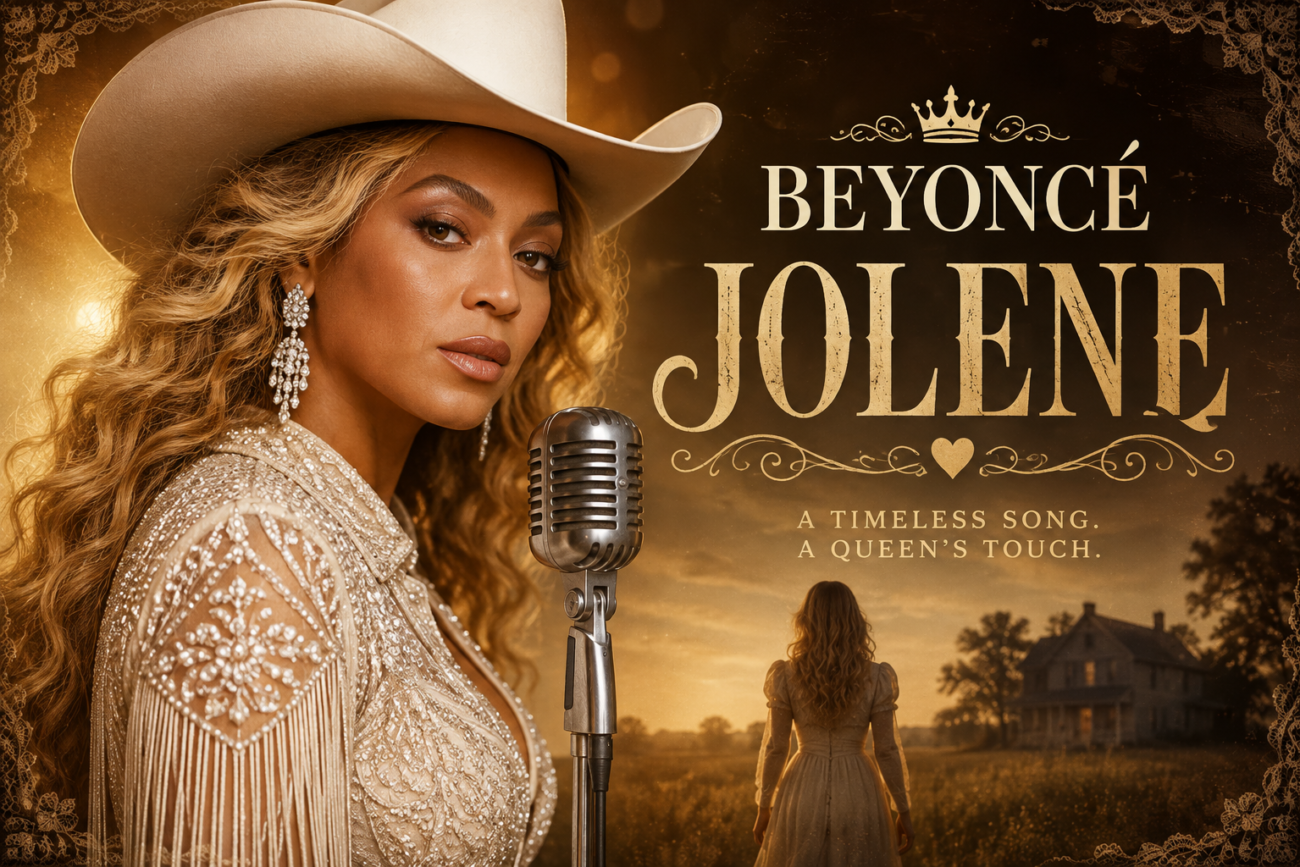
Beyonce Jolene refers to Beyoncé’s 2024 reinterpretation of Dolly Parton’s country classic “Jolene,” released on Beyoncé’s album Cowboy Carter. While the song retains the central idea of confronting another woman over a relationship, Beyoncé changes the emotional perspective dramatically.
Dolly Parton’s original is famous for its vulnerability: the narrator begs Jolene not to take the man she loves. Beyoncé approaches the same premise with considerably more confidence and confrontation. Rather than pleading with a romantic rival, her version presents a woman who believes deeply in her relationship and is prepared to defend it.
That difference is what makes Beyoncé’s recording more than a straightforward cover. It preserves the identity of a beloved country song while reshaping its narrative, tone, and emotional stakes for a new musical context.
Key Takeaways
- Beyoncé recorded “Jolene” for her 2024 album Cowboy Carter.
- The song originally comes from Dolly Parton, who released “Jolene” in 1973.
- Beyoncé transforms the original plea into a much more assertive warning.
- Dolly Parton appears immediately before the song in the “DOLLY P” interlude.
- Beyoncé’s version connects naturally with themes of relationships, betrayal, loyalty, and self-confidence explored elsewhere in her work.
- The cover demonstrates how a classic song can retain its core identity while receiving a new artistic interpretation.
Beyonce Jolene: How Her Version Differs From Dolly’s
Beyoncé’s “Jolene” and Dolly Parton’s Original
To understand Beyoncé’s version, it helps to begin with Dolly Parton’s “Jolene.”
Parton released the original “Jolene” in 1973. The song became one of the defining recordings of her career and eventually one of country music’s most recognizable songs. Its narrative is simple but emotionally powerful: a woman addresses Jolene, a beautiful rival whom she believes could take away the man she loves.
The emotional power comes from vulnerability.
The narrator does not approach Jolene as an enemy she can easily defeat. Instead, she openly admits that Jolene has qualities that make her frighteningly attractive. The song’s famous plea creates tension because the narrator knows she cannot completely control what happens next.
Beyoncé keeps the basic setup but changes the narrator’s position.
Her version sounds less like someone desperately asking for mercy and more like someone establishing boundaries.
The Biggest Difference: Plea vs. Warning
The clearest distinction between the two recordings is their emotional stance.
| Aspect | Dolly Parton | Beyoncé |
|---|---|---|
| Emotional tone | Vulnerable and pleading | Assertive and confrontational |
| Approach to Jolene | Asks her to stay away | Warns her not to interfere |
| Relationship perspective | Fear of losing love | Confidence in an established relationship |
| Storytelling | Focuses on insecurity | Focuses on boundaries and loyalty |
| Musical context | Classic country | Contemporary country-pop/R&B fusion |
| Overall effect | A heartfelt plea | A firm warning |
Parton’s narrator feels threatened by the possibility of losing her relationship.
Beyoncé’s narrator presents herself as someone who has already built a substantial life with her partner. That distinction changes the psychological center of the song.
Instead of asking, “Could you please leave him alone?” the newer interpretation effectively asks, “Do you really want to challenge what we have built?”
That shift gives the song a very different kind of energy.
Why Beyoncé Changed the Perspective
Beyoncé’s reinterpretation makes sense within the broader artistic world of Cowboy Carter.
Released in 2024, Cowboy Carter explored American musical traditions through Beyoncé’s perspective, bringing together country, R&B, soul, blues, rock, gospel, and other influences. The album included several notable connections to country music history, including Dolly Parton, Willie Nelson, and Linda Martell.
“Jolene” therefore functions as more than an isolated cover.
Beyoncé takes a familiar country narrative and places it inside her own musical and lyrical universe. Her version is particularly striking because listeners may already associate her with songs exploring love, betrayal, marriage, and complicated emotions.
That makes the change in perspective feel intentional rather than accidental.
How “DOLLY P” Sets Up “Jolene”
One of the most clever elements of Beyoncé’s version is that Dolly Parton herself appears immediately before the song.
On Cowboy Carter, “DOLLY P” introduces “JOLENE.” Parton speaks directly to Beyoncé, creating the feeling of a conversation between two generations of major female artists. The Recording Academy identifies “JOLENE” as one of the album’s covers and notes Parton’s radio-style introduction.
The sequencing gives the song additional meaning.
Rather than Beyoncé simply borrowing a famous country song, the album creates a bridge between Parton’s original and Beyoncé’s reinterpretation.
It is almost as if the original creator is handing the song over to another artist.
That makes the transition into Beyoncé’s version especially effective.
Beyoncé’s “Jolene” Is More Than a Traditional Cover
Calling Beyoncé’s recording a simple cover does not fully describe what she does with it.
The basic framework remains recognizable, but the story is substantially reinterpreted. Contemporary coverage described Beyoncé’s recording as a reimagining rather than merely a reproduction of Parton’s original.
The difference can be understood through three major changes.
1. The Narrator Has More Power
Parton’s narrator sounds emotionally exposed.
Beyoncé’s narrator sounds established and self-assured. She presents the relationship as something that has survived difficulties and carries significant history.
This changes the stakes of the confrontation.
2. Jolene Becomes a Boundary Problem
In Parton’s version, Jolene represents the possibility of romantic loss.
In Beyoncé’s version, Jolene is treated more like someone who needs to understand where the boundaries are.
That creates a stronger sense of agency.
3. The Song Connects to Beyoncé’s Existing Themes
Beyoncé has spent much of her career exploring relationships from multiple perspectives, including love, commitment, jealousy, betrayal, forgiveness, and independence.
Her interpretation of “Jolene” therefore feels connected to themes that longtime listeners may recognize from her broader catalog.
The Recording Academy has also highlighted the connection between Beyoncé’s Cowboy Carter era and her earlier work, particularly in the way the album engages with American musical history.
How the Lyrics Change the Meaning
The most important lyrical difference is not simply individual wording. It is the relationship between the narrator and Jolene.
Dolly’s narrator is asking another woman to show compassion.
Beyoncé’s narrator establishes consequences.
That distinction turns the song from a story about insecurity into one about confidence and relationship boundaries.
Beyoncé also expands the narrator’s sense of history. Her version emphasizes the length and depth of the relationship rather than presenting the romantic bond as something that could disappear overnight.
This creates an important contrast:
Dolly Parton: “I am afraid of losing him.”
Beyoncé: “You are not going to disrupt what we have built.”
That is the heart of the reinterpretation.
The Connection to “Sorry” and “Becky”
There is another important layer to Beyoncé’s “Jolene.”
The Cowboy Carter sequence connects the song to Beyoncé’s earlier exploration of infidelity and relationship conflict in Lemonade. Dolly Parton’s “DOLLY P” introduction explicitly references the famous “good hair” idea associated with “Sorry.” Contemporary coverage noted this connection and described Beyoncé’s “Jolene” as carrying forward themes associated with that earlier work.
This creates an interesting artistic conversation across Beyoncé’s career.
“Jolene” originally tells the story of a woman worried about another woman taking her partner.
Beyoncé’s interpretation approaches similar territory from a more experienced perspective.
The result is not a direct continuation of “Sorry,” but the thematic relationship is difficult to miss.
The Musical Difference Between the Two Versions
The lyrical transformation is only part of the story.
Dolly Parton’s recording is firmly rooted in the sound of 1970s country music. Its emotional impact comes from the simplicity of the arrangement and the intimacy of Parton’s vocal performance.
Beyoncé brings a heavier, more contemporary sound to the material.
The Recording Academy described her rendition as receiving additional symphonic weight, while Cowboy Carter as a whole deliberately moves between multiple musical styles rather than staying within a narrow definition of country music.
This matters because Beyoncé does not attempt to imitate Dolly Parton.
Instead, she interprets the song through her own vocal identity.
Her performance is more dramatic and forceful, matching the revised perspective of the lyrics.
Where “Jolene” Fits on Cowboy Carter
“Jolene” appears on Cowboy Carter after “DOLLY P” and before “DAUGHTER” in the album’s track sequence. Official Beyoncé track listings show the pairing as “DOLLY P / JOLENE” in some editions and as separate tracks in others.
That placement is meaningful.
“DOLLY P” establishes the connection to Parton.
“JOLENE” then reinterprets Parton’s classic.
“DAUGHTER” follows with a very different emotional and musical direction.
The sequence helps demonstrate that Beyoncé’s country project was never simply about reproducing traditional country music. Instead, she used the genre as a foundation for a much broader musical conversation.
Why the Cover Matters to Beyoncé’s Country Era
Beyoncé’s decision to include “Jolene” was significant because Dolly Parton represents one of the most recognizable figures in country music.
By placing Parton directly inside Cowboy Carter, Beyoncé connects her contemporary interpretation to country music history.
The album itself was widely described as a genre-spanning project rather than a conventional country album. The Recording Academy highlighted its mixture of covers, original songs, collaborations, and multiple American musical traditions.
“Jolene” is therefore an ideal example of the album’s broader philosophy.
The song is recognizable.
The story is familiar.
But Beyoncé changes the perspective.
Beyoncé vs. Dolly: Which Version Is More Vulnerable?
Neither version is simply “better.” They emphasize different emotions.
Dolly Parton’s performance is powerful because the narrator admits fear. Her vulnerability makes the listener understand exactly why Jolene is intimidating.
Beyoncé’s version is powerful for almost the opposite reason.
Her narrator is not trying to convince Jolene that she deserves the relationship. She believes she already has a strong claim to it.
That contrast makes the two recordings interesting to hear side by side.
Parton captures the fear of losing love.
Beyoncé captures the confidence of protecting it.
Why Both Versions Continue to Work
The enduring appeal of “Jolene” comes partly from its simplicity.
The central situation is instantly understandable: someone outside a relationship threatens something that matters deeply to the narrator.
That idea can be interpreted through insecurity, jealousy, loyalty, confidence, anger, or self-respect.
Dolly Parton chose vulnerability.
Beyoncé chose authority.
Neither approach eliminates the original song’s emotional core. Instead, Beyoncé demonstrates how a classic composition can take on a new meaning when another artist brings a different life experience and musical identity to it.
Frequently Asked Questions
Is Beyoncé’s “Jolene” a cover of Dolly Parton’s song?
Yes. Beyoncé recorded her version of Dolly Parton’s “Jolene” for Cowboy Carter, released in 2024. The Recording Academy lists “JOLENE” among the album’s cover songs.
What is the biggest difference between Beyoncé’s and Dolly Parton’s “Jolene”?
The biggest difference is the narrator’s attitude. Dolly Parton’s original is a vulnerable plea asking Jolene not to take her partner, while Beyoncé’s version is substantially more assertive and framed as a warning.
Did Dolly Parton appear on Beyoncé’s “Jolene”?
Yes. Parton provides the spoken “DOLLY P” introduction immediately before “Jolene” on Cowboy Carter. The album’s official track listings place the two together.
What album is Beyoncé’s “Jolene” on?
Beyoncé’s “Jolene” appears on Cowboy Carter, her 2024 album that explores country music alongside numerous other American musical traditions.
Is Beyoncé’s “Jolene” about the same story as Dolly’s?
It uses the same basic premise and character, but Beyoncé significantly changes the narrator’s perspective. Her version emphasizes confidence, relationship history, and boundaries rather than the original’s vulnerable pleading.
Why is “Jolene” important to Cowboy Carter?
The song connects Beyoncé’s contemporary sound with one of country music’s most recognizable compositions and artists. Dolly Parton’s presence also reinforces the album’s dialogue with country music history.
Does Beyoncé’s version connect to “Lemonade”?
Yes, thematically. Beyoncé’s version deals with relationship loyalty and a potential romantic rival, while the “DOLLY P” introduction references the “good hair” imagery associated with “Sorry” from Lemonade.
Conclusion
Beyonce Jolene stands out because Beyoncé does not simply reproduce Dolly Parton’s classic. She takes its familiar story and changes its emotional center.
Dolly Parton’s original is memorable because its narrator is vulnerable enough to admit that she fears losing the person she loves. Beyoncé’s version takes that same situation and gives the narrator substantially more authority. She is not begging a rival to spare her relationship; she is making it clear that the relationship has history, value, and boundaries.
The presence of Dolly Parton through the “DOLLY P” introduction makes the reinterpretation even more significant. It creates a direct connection between the original country classic and Beyoncé’s modern interpretation on Cowboy Carter.
Ultimately, the two versions work precisely because they are different. Parton’s “Jolene” captures vulnerability, while Beyoncé’s captures confidence. Together, they show how a great song can remain recognizable while taking on an entirely new emotional perspective.
