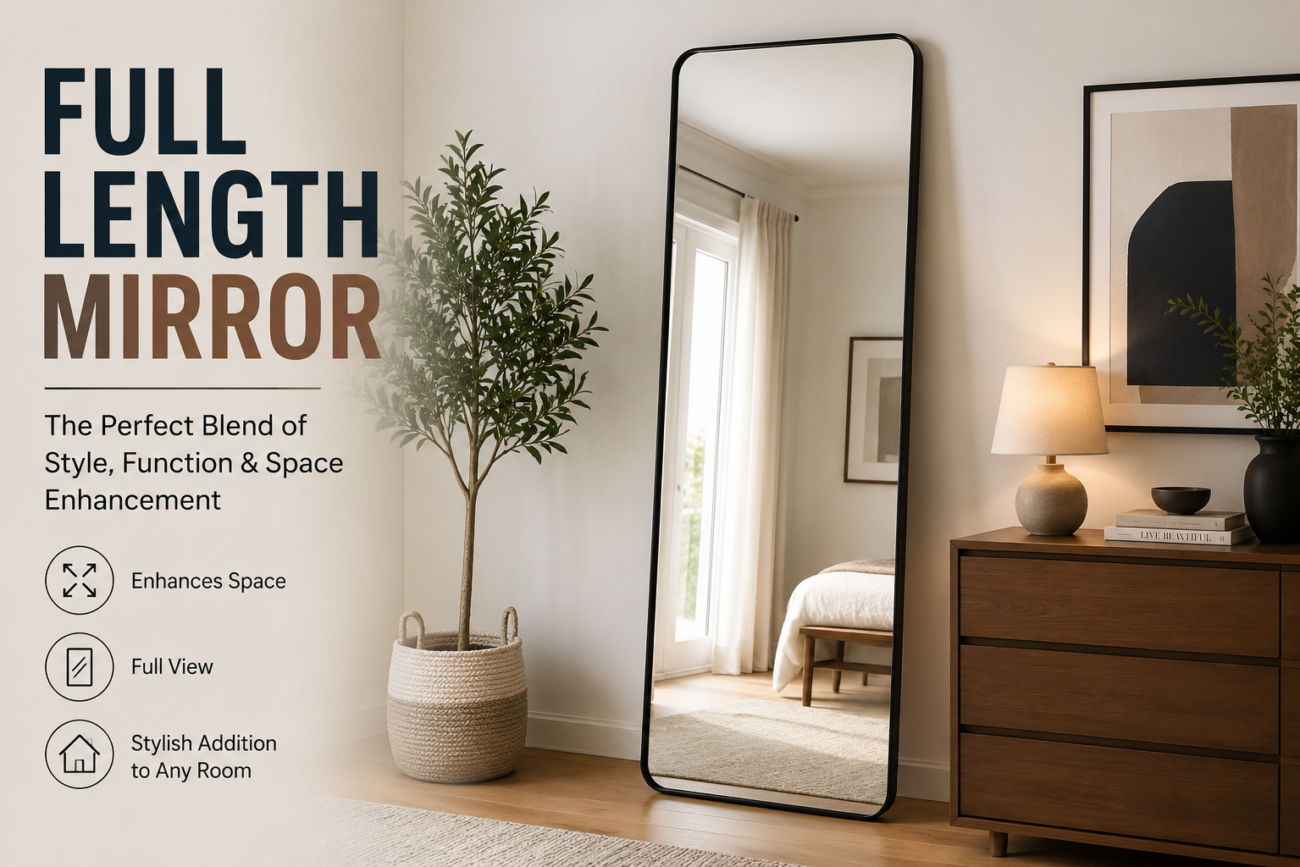
A full length mirror can do much more than provide a head-to-toe reflection. The right mirror can make getting dressed easier, add depth to a room, improve natural light, and complement your interior style. However, choosing one can be surprisingly difficult because mirrors vary widely in size, shape, frame design, mounting options, materials, and safety features.
Before buying, it is worth considering where the mirror will go, how much wall or floor space is available, how you plan to use it, and whether you prefer a freestanding, leaning, or wall-mounted design.
This full length mirror buying guide explains the most important factors to consider so you can choose a practical, attractive, and appropriately sized mirror for your space.
Key Takeaways
- Measure your available space before choosing a mirror.
- Consider the mirror’s height and width based on how you will use it.
- Choose between freestanding, leaning, over-the-door, and wall-mounted designs.
- Frame materials and finishes should complement your room’s existing decor.
- Safety matters, particularly with large or heavy mirrors.
- The best mirror balances reflection quality, proportions, durability, style, and placement.
Main Article
What Is a Full Length Mirror?
A full length mirror is designed to show most or all of your body in a single reflection. Unlike smaller vanity or wall mirrors, it is generally tall enough to let you see your outfit from head to toe.
These mirrors are commonly used in:
- Bedrooms
- Dressing rooms
- Walk-in closets
- Hallways
- Entryways
- Apartments
- Retail dressing areas
- Home gyms and studios
There is no single universal size that defines a full length mirror. The appropriate dimensions depend on the user’s height, viewing distance, installation method, and available space.
For everyday clothing checks, a vertically oriented mirror is usually the most practical choice. A wider model can also provide a broader view and make a room feel more visually spacious.
How to Choose the Right Full Length Mirror
Choosing the right mirror starts with function rather than appearance. A beautiful mirror that does not fit your wall or provide the viewing angle you need may become frustrating to use.
Consider these factors before purchasing.
1. Measure Your Available Space
Measure the area where you intend to place the mirror before shopping.
Record:
- Available height
- Available width
- Floor space
- Distance from nearby furniture
- Door and drawer clearance
- Wall space for mounting
- Available space around the mirror
Do not measure only the empty wall. Think about how the mirror will interact with furniture, doors, windows, electrical outlets, and walking paths.
For example, a large leaning mirror may look excellent in a spacious bedroom but could interfere with a closet door in a smaller room.
2. Consider the Mirror’s Height
Height is one of the most important considerations.
If your goal is to see your entire outfit, the reflective area needs to be tall enough to show your body from head to feet when viewed from a suitable distance.
A useful principle is that the required mirror height does not need to equal your own height to provide a full-body reflection. What matters is the geometry between the viewer, mirror, and reflection.
For a wall-mounted mirror, positioning also matters. A mirror mounted too high or too low can make it less comfortable to use.
3. Choose an Appropriate Width
Height gets most of the attention, but width also affects usability.
A narrow mirror can work well when space is limited. A wider mirror provides a larger viewing area and can make it easier to inspect clothing from different angles.
Consider a wider design if:
- You have sufficient wall space.
- More than one person may use the mirror.
- You want a stronger decorative statement.
- You want the mirror to visually expand a larger room.
For small bedrooms or apartments, a slimmer design may be more practical.
Full Length Mirror Types
Different mounting and support styles suit different rooms and lifestyles.
Freestanding Mirrors
Freestanding mirrors have their own support structure and can usually be positioned without permanent wall installation.
Advantages:
- Easy to reposition
- Useful for renters
- Available in many styles
- Can be moved when furniture is rearranged
Potential drawbacks:
- Requires floor space
- May be less suitable for narrow walkways
- Needs a stable base
A freestanding mirror is particularly useful if you expect to change your room layout regularly.
Leaning Mirrors
A leaning mirror is designed to rest against a wall rather than being completely mounted to it.
This style has become popular in bedrooms, dressing areas, and modern interiors because its large proportions can create a dramatic visual effect.
However, large leaning mirrors should be positioned securely and according to the manufacturer’s safety instructions. A mirror that is simply resting against a wall can present a tipping hazard, particularly in homes with children or pets.
Wall-Mounted Mirrors
Wall-mounted mirrors are attached directly to a wall using appropriate hardware.
They are useful when floor space is limited and can provide a clean, integrated appearance.
Before installation, check the mirror’s weight and the type of wall you have. The mounting hardware should be appropriate for both the mirror and the wall structure.
Over-the-Door Mirrors
Over-the-door models attach to or hang from a door.
They can be useful in small bedrooms, dorm rooms, and apartments because they make use of otherwise unused vertical space.
Their main limitation is that the door must have enough clearance for the mirror and its mounting system.
What Shape Should a Full Length Mirror Be?
Rectangular mirrors remain one of the most versatile choices, but other shapes can change the character of a room.
Rectangular Mirrors
Rectangular designs offer a practical combination of height and width. They work well in bedrooms, dressing rooms, hallways, and entryways.
They are also easy to position against furniture or walls because of their straight edges.
Arched Mirrors
Arched mirrors have a curved top and can give a room a softer architectural appearance.
They work particularly well with interiors that use curved furniture, rounded lighting, or softer decorative elements.
Oval Mirrors
Oval designs introduce curves throughout the entire outline. They can create a more traditional or decorative appearance while still providing a substantial reflective area.
Irregular or Organic Shapes
Asymmetrical mirrors can function as decorative focal points. However, if your main priority is checking your complete outfit, make sure the shape still provides enough useful reflective surface.
Choosing the Right Frame
The frame can significantly influence how a mirror looks in a room.
Wood Frames
Wood can create a warm, natural appearance. It works especially well with traditional, rustic, Scandinavian, farmhouse, and contemporary interiors.
Metal Frames
Metal frames can provide a cleaner or more modern appearance. Depending on the finish, they can work with minimalist, industrial, contemporary, or traditional decor.
Frameless Mirrors
A frameless mirror places emphasis on the reflective surface rather than the surrounding material.
This can be a good option for minimalist rooms or spaces where you want the mirror to blend into the background.
Decorative Frames
Ornate or statement frames can turn a mirror into a major decorative feature.
If the frame is visually prominent, consider the other furniture and accessories in the room. A highly decorative mirror can become overwhelming when combined with too many competing focal points.
Where Should You Place a Full Length Mirror?
Placement affects both functionality and appearance.
Bedroom
A bedroom mirror is convenient for checking outfits before leaving the room. Position it somewhere that provides enough viewing distance without blocking wardrobes, drawers, or doors.
Dressing Area
A dressing area is an obvious location because the mirror can be paired with clothing storage, seating, lighting, and accessories.
Entryway
An entryway mirror can be useful for a final appearance check before leaving home. It can also make a narrow entrance appear more open.
Hallway
A hallway can provide an unused vertical surface for a large mirror. However, ensure the mirror does not obstruct traffic or create a collision risk.
Near a Window
Placing a mirror where it can reflect daylight may help make a room feel brighter. However, the result depends on the room’s layout and what the mirror reflects.
Instead of simply placing a mirror opposite a window, consider the entire reflected view. A mirror can amplify the visual presence of whatever appears in front of it.
How to Make a Small Room Feel Larger
A strategically positioned mirror can contribute to a greater sense of visual space.
For smaller rooms:
- Choose a vertically oriented design.
- Avoid blocking natural walking paths.
- Consider a frameless or slim-frame style.
- Position the mirror to reflect useful light or attractive features.
- Avoid placing it where the reflection makes the room feel cluttered.
A mirror cannot physically increase the size of a room, but its reflection can influence how spacious the room appears.
Mirror Glass Quality Matters
The reflective surface is more important than many buyers realize.
A good mirror should provide a clear, consistent reflection without obvious distortion.
When shopping, inspect the mirror from different distances and angles if possible. Look for:
- Uneven reflections
- Visible waviness
- Distortion around the edges
- Imperfections in the glass
- Damage or chips
- Poorly finished edges
For a large mirror, even minor distortion can become noticeable because more of the reflective surface is visible.
Safety Considerations
Large mirrors can be heavy and fragile, so safety should be part of the buying decision.
Secure Large Mirrors Properly
Follow the manufacturer’s installation instructions and use suitable hardware for the mirror’s weight and your wall type.
For leaning mirrors, consider using the supplied anti-tip hardware where recommended.
Check the Frame and Backing
Inspect the frame, backing, brackets, and other structural components for signs of poor construction or damage.
Think About Household Use
If children, pets, or other people could accidentally knock into the mirror, stability becomes especially important.
A large decorative mirror should not be treated as a piece of furniture that can simply be positioned anywhere without considering its stability.
Full Length Mirror Buying Checklist
Before purchasing, run through this checklist:
| Feature | What to Consider |
|---|---|
| Height | Is the reflective area tall enough for your needs? |
| Width | Does it provide enough viewing space without overwhelming the room? |
| Type | Freestanding, leaning, wall-mounted, or over-the-door? |
| Frame | Does the material and finish suit your decor? |
| Glass | Is the reflection clear and free from obvious distortion? |
| Placement | Will it fit without blocking doors, drawers, or walkways? |
| Weight | Can the floor, wall, or mounting system safely support it? |
| Stability | Is it secure against tipping or accidental movement? |
| Style | Does its shape complement the room? |
| Maintenance | Can the surface and frame be cleaned easily? |
Common Buying Mistakes to Avoid
Choosing Based Only on Appearance
A mirror can look beautiful online but be unsuitable for your available space.
Always check its actual dimensions.
Ignoring the Frame Dimensions
When a listing gives both overall dimensions and mirror dimensions, do not confuse the two.
A mirror advertised as a certain width may include a substantial frame.
Forgetting Door Clearance
If the mirror is near a door, closet, or cabinet, measure the opening and movement area before installation.
Buying Without Considering Weight
Large mirrors can be considerably heavier than smaller decorative mirrors. Make sure the intended mounting or support method is suitable.
Prioritizing Size Over Usability
Bigger is not automatically better. A mirror that dominates a small room or restricts movement may be less useful than a slightly smaller option.
How Much Should You Spend?
The appropriate budget depends on the mirror’s size, construction, frame, glass quality, design, and installation requirements.
Rather than choosing based solely on price, compare what you are actually receiving.
A lower-cost mirror may make sense for a temporary rental or secondary space, while a well-built framed mirror may be worthwhile for a bedroom or dressing area where it will be used every day.
Look at:
- Construction quality
- Glass quality
- Frame durability
- Mounting hardware
- Warranty or return policy
- Overall dimensions
- Stability
The cheapest option is not always the best value, and the most expensive option is not automatically the highest quality.
How to Clean a Full Length Mirror
Regular cleaning helps keep the reflective surface clear.
Use a clean, soft microfiber cloth and a suitable glass-cleaning method. Avoid excessive moisture around the frame, edges, backing, or mounting hardware.
For stubborn marks, follow the care instructions supplied by the manufacturer.
Avoid abrasive materials that could scratch the surface or damage the frame.
Frequently Asked Questions
What is the best size for a full length mirror?
The best size depends on your height, available space, and intended use. Choose a mirror with enough vertical reflective area for comfortable head-to-toe viewing while leaving adequate clearance around it.
Is a full length mirror better leaning or wall-mounted?
Neither is universally better. Leaning mirrors are flexible and visually striking, while wall-mounted mirrors save floor space and can provide a more secure, integrated installation when properly fitted.
Should a full length mirror be wider?
A wider mirror provides more reflective area, but it also takes up more space. Choose the widest practical option that fits your room without interfering with furniture, doors, or walkways.
Where is the best place for a full length mirror?
Bedrooms, dressing areas, entryways, and hallways are common choices. The best location is one that provides comfortable viewing space and does not obstruct normal movement.
Can a full length mirror make a room look bigger?
A strategically positioned mirror can create the impression of greater visual depth by reflecting light and parts of the room. Its effect depends heavily on placement and what it reflects.
Are leaning mirrors safe?
They can be safe when properly positioned and secured according to the manufacturer’s instructions. Large leaning mirrors should not be left unstable, particularly in homes where children or pets may bump into them.
What frame is best for a full length mirror?
There is no single best frame. Wood can add warmth, metal can create a contemporary appearance, and frameless designs suit minimalist spaces. Choose a finish that complements the room.
How do I know if a mirror has good glass quality?
Look for a clear, consistent reflection without obvious waviness or distortion. When possible, inspect the mirror from multiple angles and distances before buying.
Conclusion
Choosing the right full length mirror involves more than selecting the largest or most attractive design. The best option should fit your available space, provide a useful reflection, complement your interior, and be appropriate for the way you intend to use it.
Start by measuring your space, then consider height, width, mirror type, frame style, glass quality, placement, stability, and installation requirements. If you are shopping online, pay close attention to the actual product dimensions rather than relying on photographs.
A thoughtful choice can give you a practical everyday dressing tool while also becoming an attractive part of your room’s overall design.
