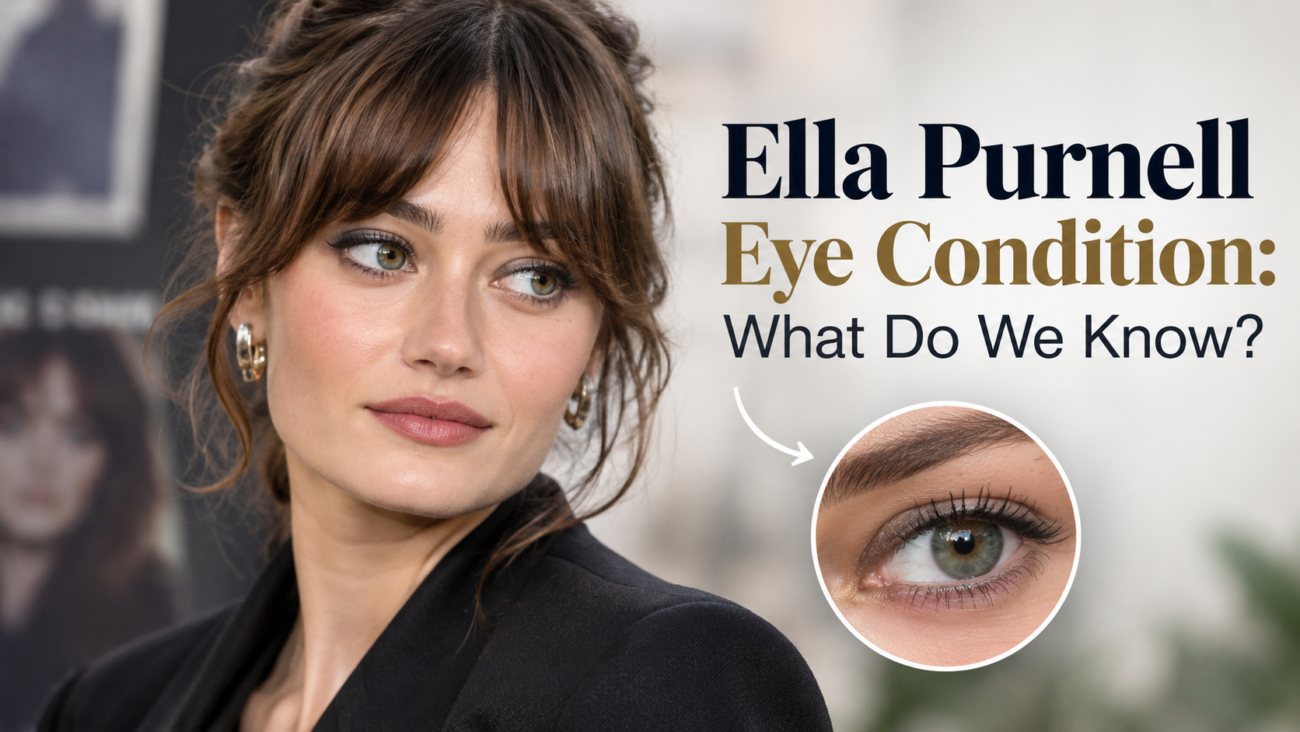
Ella Purnell has become widely recognized for her performances in television series and films, including Yellowjackets, Arcane, and Fallout. Alongside her acting talent, her distinctive facial features and expressive eyes have attracted attention from fans, prompting online searches for the ella purnell eye condition.
But does the actress have a publicly confirmed eye condition, or does the interest in her eyes stem primarily from their natural appearance and the way they are presented on screen?
These questions deserve a careful, fact-based answer. A person’s appearance alone cannot establish a medical diagnosis, and online discussions do not necessarily reflect verified health information. It is important to distinguish between information the actress has publicly shared, reliable reporting, and speculation based on photographs or television appearances.
This article examines what is known about Ella Purnell’s eyes, why people may notice their appearance, and how to evaluate claims about a celebrity’s health without confusing visual observations with medical facts.
Key Takeaways
-
Ella Purnell is an English actress known for productions such as Yellowjackets, Arcane, and Fallout.
-
Online interest in her eyes does not, by itself, establish that she has an eye condition.
-
A confirmed diagnosis should not be inferred from photographs, facial features, or screen appearances.
-
Lighting, makeup, camera angles, facial expressions, and individual anatomy can influence how eyes appear.
-
Claims about a celebrity’s medical history should be assessed using reliable reporting and direct public statements.
-
Without credible confirmation, the most accurate approach is to avoid assigning Ella Purnell a specific eye condition.
Biography Table
| Detail | Information |
|---|---|
| Full Name | Ella Summer Purnell |
| Date of Birth | September 17, 1996 |
| Age | 30 years old as of October 2026 |
| Birthplace | London, England |
| Nationality | British |
| Profession | Actress |
| Education | Attended the Forest School in London and trained at the Sylvia Young Theatre School |
| Years Active | 2009–present |
| Known For | Yellowjackets, Fallout, Arcane, Miss Peregrine’s Home for Peculiar Children |
| Major Achievements | Recognition for her work in television, film, and voice acting, including leading roles in internationally popular productions |
Ella Purnell Eye Condition: Is There a Confirmed Diagnosis?
The central question is whether Ella Purnell has publicly confirmed an eye condition. Based on the publicly available information identified for this article, there is no reliable confirmation that she has a diagnosed eye disorder.
Her eyes are frequently described as large and expressive, but those characteristics do not automatically indicate a medical problem. Eye shape, eyelid structure, facial proportions, and the surrounding bones vary naturally from person to person.
It is also important to recognize the difference between a confirmed medical condition and an online theory. A diagnosis requires appropriate medical assessment, not simply observations made from photographs or television footage.
What Has Ella Purnell Said About Her Eyes?
Purnell has discussed how people notice her eyes. In an interview about her acting career, she recalled being surprised when reviews of Miss Peregrine’s Home for Peculiar Children drew attention to their size.
This provides useful context: the distinctive appearance of her eyes has been a subject of public discussion throughout her career.
However, comments about appearance should not be interpreted as confirmation of an illness. An observation that someone’s eyes look unusually large is not equivalent to a medical diagnosis.
Without a clear, reliable statement confirming an eye disorder, it would be inaccurate to attribute a particular condition to her.
Is There Evidence of Proptosis?
Proptosis is a medical term describing the forward displacement or protrusion of one or both eyeballs. It can have several causes and may require medical investigation.
Some online discussions about celebrities’ eyes speculate about proptosis when a person’s eyes appear prominent. However, photographs cannot reliably establish whether someone has this condition.
There is no verified basis in the information reviewed here for concluding that Ella Purnell has proptosis. Her facial appearance should not be treated as evidence of the condition.
Is There Evidence of Graves’ Eye Disease?
Graves’ eye disease, also known as thyroid eye disease, is an autoimmune condition associated with inflammation and changes in the tissues around the eyes. It can sometimes cause the eyes to appear more prominent.
Other possible symptoms include:
-
Dryness or a gritty sensation.
-
Redness and irritation.
-
Swelling around the eyelids.
-
Eye discomfort or pressure.
-
Double vision in some cases.
-
Difficulty closing the eyelids completely in more severe cases.
These symptoms vary, and not everyone experiences all of them.
Although prominent eyes can occur with thyroid eye disease, their appearance alone does not establish the diagnosis. No verified information identified for this article confirms that Purnell has Graves’ eye disease or another thyroid-related eye condition.
It is therefore important not to confuse a possible medical explanation with evidence that a particular person has that condition.
Why Are Ella Purnell’s Eyes So Noticeable?
There are several ordinary reasons why a person’s eyes may attract attention. In Purnell’s case, her naturally distinctive features have become part of her recognizable appearance on screen.
1. Natural Eye Shape and Facial Anatomy
People have different eye shapes, eyelid folds, brow positions, and facial proportions. These characteristics influence how large or prominent their eyes appear.
Some people naturally have wider-looking eyes or more visible areas around the iris. Others have deeper-set eyes or heavier upper eyelids.
These variations are part of normal human anatomy. They do not necessarily indicate an underlying health problem.
Purnell’s eyes have been described as a distinctive feature in entertainment coverage, but a visual description cannot establish anything about her medical history.
2. Makeup and Styling
Makeup can significantly influence the perceived size and shape of the eyes.
For example, makeup artists may use the following techniques to emphasize the eye area:
-
Eyeliner that defines the upper and lower lash lines.
-
Mascara that makes eyelashes appear longer or fuller.
-
Eyeshadow that creates contrast around the eyelids.
-
Carefully shaped eyebrows that draw attention toward the eyes.
-
Concealer and foundation that create a more even appearance around the eye sockets.
These techniques are common in film, television, photography, and red-carpet styling.
Depending on the production, Purnell’s makeup may be designed to complement a character’s personality or the visual style of a scene. This can make her eyes appear different across roles and public appearances without implying a medical change.
3. Lighting and Camera Angles
Professional lighting can alter how facial features appear in photographs and videos.
Soft frontal lighting may reduce shadows around the eye sockets, while side lighting can emphasize the contours of the brow and eyelids. Close-up shots can also make the eyes appear more prominent relative to other facial features.
Camera lenses, shooting distance, image cropping, and post-production adjustments can affect facial proportions as well.
These factors are particularly relevant when comparing a professionally lit promotional photograph with an ordinary photograph taken in different conditions.
Consequently, differences in how Purnell’s eyes appear from one image to another should not be interpreted as proof of an eye condition.
4. Facial Expressions and Acting
Actors use their eyes to communicate emotion, intention, and personality.
A widened gaze may convey surprise, fear, excitement, or curiosity. A relaxed expression may make the same person’s eyes appear less prominent.
Purnell’s work across drama, fantasy, animation, and science fiction gives her opportunities to portray characters with very different emotional styles.
In live-action performances, close-up shots can emphasize these expressions. This may contribute to the attention viewers give to her eyes.
5. Recognition and Public Curiosity
Distinctive physical features often become talking points when an actor gains a larger audience.
As Purnell became more widely recognized through productions such as Yellowjackets and Fallout, viewers gained more opportunities to notice her appearance and compare performances across different roles.
Search engines can amplify this curiosity. Once people begin asking whether a recognizable feature has a medical explanation, others may repeat the question without checking whether any reliable evidence exists.
This can create a cycle in which the popularity of a question is mistaken for evidence that the underlying claim is true.
What Is the Difference Between Naturally Prominent Eyes and an Eye Condition?
Understanding the distinction helps explain why online speculation about celebrities’ appearances can be misleading.
| Feature | Natural Eye Appearance | Possible Medical Concern |
|---|---|---|
| Eye size | May naturally vary between individuals | Apparent changes may sometimes require assessment |
| Eye prominence | Can reflect normal facial anatomy | New or progressive protrusion can have medical causes |
| Eye symmetry | Minor differences are common | Sudden changes may warrant medical evaluation |
| Eyelid appearance | Varies naturally with anatomy and expression | Persistent swelling or difficulty closing the eyes may need attention |
| Visual comfort | Eyes may feel and function normally | Pain, double vision, or vision changes can indicate a problem |
| Diagnosis | Based on normal anatomical variation | Requires appropriate clinical evaluation |
This comparison is general educational information, not a method for diagnosing someone from photographs.
A person’s eyes can look unusual to an observer and still be healthy. Conversely, some eye conditions may cause symptoms that are not obvious in photographs.
The appearance of a celebrity’s eyes is therefore not enough to determine whether a condition exists.
How to Evaluate Claims About Ella Purnell’s Eye Health
Readers searching for information about a celebrity’s health may encounter contradictory explanations. A careful approach can help separate reliable information from speculation.
Look for Direct Statements
The strongest public evidence would be a clear statement from Purnell herself or an authorized representative confirming a particular condition.
A discussion about her eye shape, a makeup routine, or an acting technique should not be interpreted as a medical disclosure.
Distinguish Reporting From Repetition
An article may repeat a claim that originated in an online discussion without independently verifying it.
Before accepting a medical claim, consider whether the report provides a credible source for the diagnosis or merely describes what people are saying online.
Multiple websites repeating the same unsupported statement do not necessarily make it reliable.
Avoid Diagnosing From Photographs
Photographs do not provide the medical history, examination findings, or other information needed to establish many eye conditions.
Even when an image shows an unusual feature, there may be several explanations, including natural anatomy, lighting, makeup, and camera perspective.
Medical terminology should not be used to turn an unverified observation into a definite conclusion.
Respect Medical Privacy
Celebrities share parts of their lives with the public, but that does not mean every aspect of their health is public information.
If an actor has not disclosed a particular diagnosis, it is reasonable to acknowledge that the information is unknown. Respecting that boundary is more responsible than filling the gap with speculation.
Ella Purnell’s Acting Career and Her Distinctive Appearance
Purnell’s career offers context for why her appearance receives attention, but her professional achievements should remain distinct from unverified health claims.
She began acting at a young age and appeared in films including Never Let Me Go and Maleficent. Her role in Miss Peregrine’s Home for Peculiar Children brought further recognition, while later projects expanded her audience.
Her notable work includes:
-
Yellowjackets: A psychological drama featuring a story that unfolds across different periods.
-
Fallout: A television adaptation of the video game franchise in which she plays Lucy MacLean.
-
Arcane: An animated series in which she voices Jinx.
-
Miss Peregrine’s Home for Peculiar Children: A fantasy film directed by Tim Burton.
-
Army of the Dead: A heist and zombie-action film directed by Zack Snyder.
-
Sweetpea: A dark comedy thriller television series.
These roles demonstrate her range across different genres and performance styles.
Her eyes may be a recognizable part of her appearance, but they are only one aspect of her public image. Her acting, character development, and ability to work across different formats are more meaningful measures of her professional career.
Frequently Asked Questions
1. What eye condition does Ella Purnell have?
No specific eye condition has been reliably confirmed in the information reviewed for this article. Her distinctive eyes have attracted public attention, but their appearance alone does not establish a medical diagnosis.
2. Does Ella Purnell have proptosis?
There is no verified evidence identified here confirming that Purnell has proptosis. The condition involves forward displacement of the eyeball and cannot be diagnosed reliably from photographs.
3. Does Ella Purnell have Graves’ disease?
No reliable confirmation identified for this article establishes that Purnell has Graves’ disease or thyroid eye disease. Claims linking a celebrity’s appearance to these conditions should not be treated as established facts without credible evidence.
4. Why do Ella Purnell’s eyes look so big?
Her eyes are widely described as a distinctive facial feature. Natural anatomy, makeup, lighting, camera angles, and facial expressions can all influence how prominent eyes appear in photographs and on screen.
5. Are Ella Purnell’s eyes naturally large?
Her eyes have been publicly described as large, and she has discussed being surprised that reviewers noticed their size. However, a description of her appearance does not provide medical information about her eye health.
6. Does Ella Purnell have a vision problem?
There is no verified information identified here confirming that she has a vision problem. Without a reliable public statement, it would be inappropriate to make claims about her eyesight or visual health.
7. Can prominent eyes indicate a medical condition?
Sometimes. Certain conditions, including thyroid eye disease, can cause the eyes to become more prominent. However, naturally prominent eyes are also common, and appearance alone cannot determine the cause. New eye protrusion, pain, double vision, or sudden vision changes should be assessed by a medical professional.
8. Has Ella Purnell publicly confirmed an eye diagnosis?
The publicly available information reviewed for this article does not establish that she has confirmed a specific eye diagnosis. Unless reliable evidence emerges, claims about a particular condition should be regarded as unverified.
Conclusion
The interest in the Ella Purnell eye condition question appears to stem largely from curiosity about her distinctive eyes. Although her appearance has prompted online speculation, no specific eye disorder has been reliably confirmed in the information reviewed for this article.
Natural facial anatomy, makeup, lighting, camera angles, and expressions can all influence how eyes look on screen. None of these visual details, on their own, can establish a medical diagnosis.
The most responsible conclusion is to distinguish what is publicly known from what remains unverified. Ella Purnell is an accomplished actress whose eyes have become a recognizable feature, but that recognition should not be confused with evidence of an underlying health problem.
For readers seeking a trustworthy answer, the key point is simple: there is insufficient verified evidence to attribute a specific eye condition to Ella Purnell.
