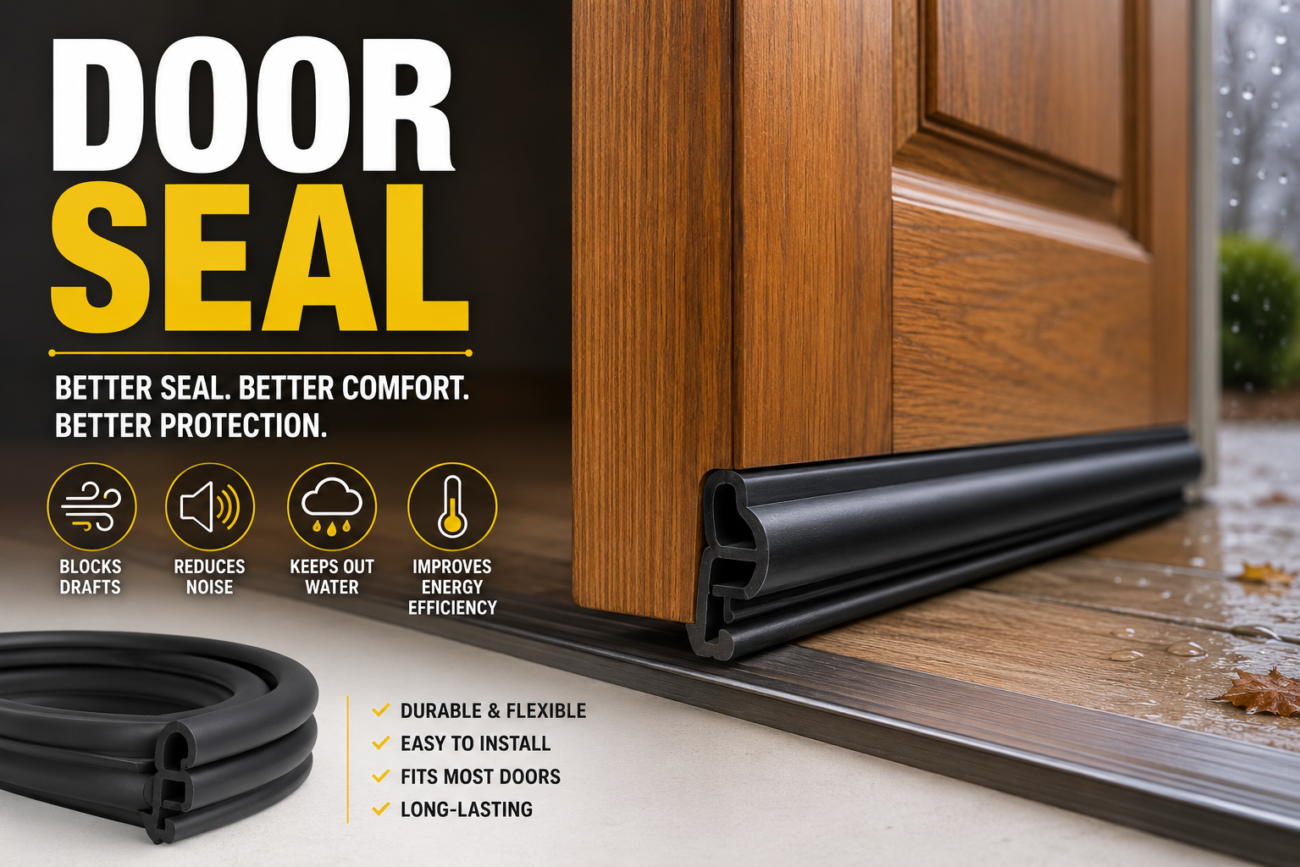
Introduction
A well-fitted door seal can make a noticeable difference to comfort, energy efficiency, and the overall condition of a door. Even a small gap around a door can allow outside air, dust, moisture, insects, and unwanted noise to enter. In some situations, gaps can also make heating or cooling systems work harder.
However, choosing the right seal is not simply a matter of buying the thickest or most expensive option. Door seals come in different designs and materials, and each type is suited to particular doors, gaps, and conditions.
This door seal buying guide explains what to look for before making a purchase. You will learn about common seal types, materials, measurements, installation methods, durability, and the signs that indicate it is time to replace an existing seal.
Key Takeaways
- Choose a door seal based on the door type, gap size, and location.
- Measure the door and frame carefully before buying a replacement.
- Rubber, silicone, foam, brush, and weather-resistant seals each have different strengths.
- A good seal should close gaps without making the door difficult to operate.
- Exterior doors generally require greater resistance to weather and temperature changes.
- Inspect existing seals regularly for cracking, compression, peeling, or gaps.
Door Seal Buying Guide
What Is a Door Seal?
A door seal is a flexible or semi-flexible component designed to close the gap between a door and its surrounding frame, threshold, or floor.
Depending on its design, a seal can help reduce air leakage, prevent rain or moisture from entering, limit dust and insects, and improve acoustic comfort. Some seals are also designed specifically for fire-rated, industrial, automotive, or specialist applications.
For residential doors, the most common purpose is to improve the fit between the moving door and the stationary frame.
A seal normally works by compressing, contacting, or brushing against the surrounding surface when the door closes.
Why Does a Door Seal Matter?
A door can appear completely closed while still having small gaps around its edges. These gaps can be particularly noticeable around older doors, poorly aligned frames, or doors that have been exposed to years of use.
A suitable seal can provide several practical benefits.
Better Draft Control
A weather seal can reduce unwanted airflow around an exterior door. This can make rooms feel more comfortable, particularly during cold or windy weather.
Improved Energy Efficiency
Reducing uncontrolled air leakage can help a building maintain its indoor temperature more effectively. The actual energy savings depend on factors such as the size of the gaps, the building’s insulation, climate, and heating or cooling system.
Protection From Moisture
Exterior door seals can help limit water intrusion during wet weather, provided the door, frame, threshold, and drainage system are properly designed and maintained.
Reduced Dust and Insects
Closing gaps around doors can make it harder for dust, dirt, and some insects to enter.
Better Noise Control
A seal cannot soundproof a room by itself, but reducing air gaps can help limit some sound transmission. The result depends heavily on the door construction and the size and location of the gaps.
Types of Door Seals
Different door seal designs solve different problems. Understanding the main types makes it easier to select the right product.
Rubber Door Seals
Rubber seals are widely used because they are flexible and resistant to regular movement.
They are suitable for many exterior and interior applications and can provide a durable barrier against drafts and dust.
A rubber seal may be a good choice when you need a material that can withstand repeated compression and everyday use.
Silicone Door Seals
Silicone is flexible and generally performs well across a broad range of temperatures. Silicone-based seals are often used where flexibility and resistance to environmental conditions are important.
They can be useful around doors exposed to changing temperatures, although the exact performance depends on the product formulation and installation method.
Foam Door Seals
Foam seals are lightweight and often inexpensive. They can work well for relatively small gaps where the seal does not need to withstand heavy wear.
Foam is commonly available with adhesive backing, making some products simple to install. However, lower-quality foam can lose its shape more quickly than more durable materials.
Brush Door Seals
Brush seals use rows of flexible bristles rather than a solid rubber or foam profile.
They are useful where a door needs to move over an uneven surface or where a flexible barrier is preferable. Brush seals are commonly used around thresholds and other locations where the gap varies.
Weatherstripping
Weatherstripping is a broad term covering products designed to reduce gaps around doors and windows.
It can include foam tape, rubber profiles, compression seals, adhesive strips, and other designs.
For exterior doors, weatherstripping is particularly useful for limiting unwanted air movement around the frame.
Door Bottom Seals
A door bottom seal is installed along the lower edge of the door. It is designed to address the gap between the door and the threshold or floor.
Some designs attach directly to the door, while others incorporate a sweep or flexible insert.
The correct choice depends on the size of the gap, floor surface, threshold design, and door movement.
How to Choose the Right Door Seal
The best door seal is the one that matches the actual conditions of your door.
1. Identify the Door Type
Start by determining what kind of door you are sealing.
For example:
- Exterior entrance door
- Interior room door
- Garage door
- Sliding door
- Patio or French door
- Commercial door
- Metal door
- Wooden door
A seal designed for a lightweight interior door may not be appropriate for an exposed exterior entrance.
2. Check Where the Gap Is
Inspect the entire door rather than focusing on one area.
Look for gaps:
- Along the hinge side
- Along the latch side
- Across the top
- Underneath the door
- Between the door and frame
The location of the gap often determines which type of seal you need.
For example, a door sweep may address a bottom gap, while compression weatherstripping may be more appropriate around the sides and top.
3. Measure the Gap
Accurate measurement is one of the most important steps.
Close the door normally and inspect the distance between the door and frame or threshold. Measure the gap at several points because it may not be uniform.
If the gap is larger in one corner than another, this may indicate that the door or frame is misaligned rather than simply missing a seal.
A seal should accommodate the intended gap without being excessively compressed.
4. Measure the Door and Frame
Measure the length of the areas that need sealing.
For a typical hinged door, measure the:
- Top edge
- Hinge-side edge
- Latch-side edge
- Bottom edge, if necessary
Buy enough material to cover the required area, allowing for the installation method and product instructions.
5. Consider the Material
Material affects flexibility, durability, temperature resistance, and performance.
| Material | Main Strength | Typical Consideration |
|---|---|---|
| Rubber | Durable and flexible | Good for repeated movement |
| Silicone | Flexible and temperature resistant | Often useful in demanding conditions |
| Foam | Affordable and easy to install | May wear faster |
| Brush | Handles some uneven gaps | Does not create the same compression barrier as solid seals |
| Vinyl | Practical and widely available | Performance varies by product |
There is no universally best material. The right option depends on the door and environment.
What Makes a Good Door Seal?
A quality seal should balance several factors rather than maximizing just one characteristic.
Proper Compression
Compression seals need enough contact to close the gap effectively. However, excessive compression can make a door difficult to close or place unnecessary stress on the seal and hardware.
Flexibility
The material needs to flex or compress as the door moves.
A seal that becomes rigid, brittle, or permanently deformed may stop working effectively.
Durability
Consider how frequently the door is used and whether it is exposed to sunlight, rain, temperature changes, cleaning chemicals, or physical contact.
A heavily used exterior door generally needs a more durable product than an interior cupboard door.
Secure Attachment
Even a high-quality sealing material will perform poorly if it does not remain securely attached.
Depending on the design, a seal may use:
- Adhesive backing
- Screws
- Clips
- A channel or groove
- Push-fit installation
Choose an attachment method appropriate for the door and frame material.
Adhesive vs Screw-Fixed Door Seals
One important purchasing decision is how the seal will be attached.
Adhesive Seals
Adhesive-backed seals are convenient and often suitable for straightforward applications.
They can be useful when you want an installation that does not require drilling.
However, the surface needs to be clean, dry, and suitable for the adhesive. Dust, grease, moisture, and loose paint can reduce adhesion.
Screw-Fixed Seals
Screw-fixed products generally provide a more mechanically secure attachment.
They can be particularly useful for high-use doors or applications where long-term attachment is important.
Installation takes more time and may require drilling and appropriate fasteners.
How to Measure for a Replacement Door Seal
Replacing a damaged seal is easier when you measure before removing the old one.
Step 1: Inspect the Existing Seal
Look for cracks, flattening, gaps, peeling, or areas where the seal has separated from the frame.
Step 2: Measure the Required Length
Measure each side that needs replacement. Do not assume every side has the same dimensions.
Step 3: Measure the Gap
Use a ruler or measuring tool to estimate the gap when the door is closed.
Check several locations.
Step 4: Identify the Attachment Style
Determine whether the existing seal is adhesive-backed, screwed in place, fitted into a channel, or attached using another method.
Step 5: Compare the Replacement Profile
The new seal should have a compatible shape and mounting method. A product that looks similar may not fit the existing channel correctly.
Common Door Seal Buying Mistakes
Choosing Based Only on Price
The cheapest product may not be the most economical choice if it wears out quickly or does not fit properly.
Consider the expected lifespan, installation method, material, and application.
Buying Without Measuring
A seal that is too small may leave gaps, while one that is too large may interfere with door operation.
Always measure first.
Using an Interior Seal Outdoors
Exterior doors are exposed to weather and temperature changes. A product intended only for indoor use may not provide suitable long-term performance outside.
Installing a Seal That Is Too Thick
A thick seal is not automatically better.
If it creates excessive resistance, the door may become difficult to close or latch properly.
Ignoring Door Alignment
A large or uneven gap can sometimes indicate a problem with hinges, the frame, or door alignment.
Replacing the seal without addressing the underlying issue may provide only a temporary solution.
How to Install a Door Seal
The exact installation process depends on the product, but a typical adhesive seal can be installed using the following approach.
- Clean the mounting surface thoroughly.
- Allow the surface to dry completely.
- Measure and cut the seal according to the manufacturer’s instructions.
- Position the seal without fully attaching it first to confirm the fit.
- Remove the adhesive backing gradually if the product uses adhesive.
- Press the seal firmly into position.
- Close the door carefully and check that it operates normally.
- Inspect the seal for gaps or areas that are excessively compressed.
For screw-fixed or channel-mounted products, follow the manufacturer’s installation instructions and use suitable fasteners.
When Should You Replace a Door Seal?
A door seal may need replacement when it shows visible deterioration or no longer closes the gap effectively.
Common warning signs include:
- Cracks or splits
- Permanent flattening
- Brittle material
- Peeling adhesive
- Missing sections
- Visible daylight around the closed door
- Increased drafts
- Water entering around the door
- Difficulty maintaining indoor comfort near the door
Regular inspection can help identify problems before they become more significant.
Door Seal vs Door Sweep
The terms can sometimes be used interchangeably, but they generally describe different components.
A door seal is a broad term for a sealing product used to close gaps around a door.
A door sweep typically refers to a component attached to the bottom of a door that contacts the floor or threshold.
A single door may use both a perimeter seal and a bottom sweep to address different gaps.
Frequently Asked Questions
What is the best material for a door seal?
There is no single best material for every application. Rubber and silicone can provide good flexibility and durability, while foam may be suitable for smaller, lower-wear applications. The best choice depends on the door, gap, exposure, and installation method.
How do I know what size door seal I need?
Measure the gap at several points and check the dimensions of the existing seal or mounting channel. The replacement should be designed to accommodate the measured gap without excessive compression.
Can a door seal stop drafts?
A properly fitted seal can significantly reduce airflow through gaps around a door. Its effectiveness depends on the condition and alignment of the door, frame, threshold, and surrounding structure.
Can I install a door seal myself?
Many basic adhesive and screw-fixed seals are suitable for DIY installation. More complicated installations may require additional tools or professional assistance, particularly when the door or frame is misaligned.
Should a door seal be tight?
A seal should make appropriate contact without preventing the door from closing and latching normally. Excessive pressure can make operation difficult and may accelerate wear.
How long does a door seal last?
Lifespan varies considerably according to material, product quality, usage, weather exposure, and maintenance. Inspect the seal regularly rather than relying on a fixed replacement schedule.
Why is my new door seal making the door hard to close?
The seal may be too thick, incorrectly positioned, or incompatible with the door gap. Check the installation instructions and confirm that the door and frame are correctly aligned.
Can I use the same seal around every part of a door?
Not necessarily. The sides and top may require one type of weatherstripping, while the bottom may need a sweep or threshold seal. Different sections can require different solutions.
Conclusion
Choosing the right door seal starts with understanding the problem you are trying to solve. Before buying, identify the door type, locate the gaps, measure carefully, and consider the environment in which the seal will be used.
Material, attachment method, flexibility, durability, and profile all influence performance. A suitable seal should close the intended gap while allowing the door to open, close, and latch normally.
For a straightforward replacement, matching the existing profile and mounting method can simplify the process. For larger or uneven gaps, however, it is worth checking whether door alignment, hinges, the frame, or the threshold is contributing to the problem.
With accurate measurements and the right product for the application, a door seal can provide a practical way to improve comfort, reduce unwanted drafts, and protect the area around a door from everyday environmental exposure.
