Introduction
When people search for Michael Douglas young, they are often curious about more than old photographs. They want to understand what the award-winning actor was like before he became one of Hollywood’s most recognizable stars.
Born into a famous acting family, Michael Douglas had an unusual starting point. His father, Kirk Douglas, was already a major Hollywood star, which gave Michael an extraordinary connection to the film industry. Yet his early career was not simply a continuation of his father’s success. Michael had to establish his own identity as an actor and producer.
His journey from a young actor appearing in television productions to an Oscar-winning producer and leading man is one of the more interesting stories in modern Hollywood. His early years also reveal how he gradually moved away from being known primarily as Kirk Douglas’s son and became a major star in his own right.
This article explores Michael Douglas’s early life, education, first acting roles, breakthrough television work, producing achievements, and the career decisions that shaped his later success.
Key Takeaways
- Michael Douglas was born on September 25, 1944, in New Brunswick, New Jersey.
- He is the son of legendary actor Kirk Douglas and actress Diana Dill.
- He studied drama at the University of California, Santa Barbara.
- His early career included television roles and work as an assistant director.
- The Streets of San Francisco became his major early television breakthrough.
- His work as a producer on One Flew Over the Cuckoo’s Nest helped establish him as a serious filmmaker before his biggest acting successes.
Biography Table
| Detail | Information |
|---|---|
| Full Name | Michael Kirk Douglas |
| Date of Birth | September 25, 1944 |
| Age | 81 years old in 2026 |
| Birthplace | New Brunswick, New Jersey, U.S. |
| Nationality | American |
| Profession | Actor and producer |
| Education | University of California, Santa Barbara; studied drama |
| Years Active | 1960s–present |
| Known For | The Streets of San Francisco, Wall Street, Fatal Attraction, Basic Instinct, Romancing the Stone |
| Major Achievements | Academy Award for producing One Flew Over the Cuckoo’s Nest and Academy Award for Best Actor for Wall Street |
Michael Douglas’s Early Life
Michael Kirk Douglas was born on September 25, 1944, in New Brunswick, New Jersey. His parents were Kirk Douglas, one of the most famous actors of Hollywood’s Golden Age, and actress Diana Dill.
Growing up in the Douglas family meant that Michael was surrounded by the entertainment industry from an early age. His father’s career included major films such as Spartacus, Paths of Glory, and The Vikings. As a result, Michael understood the demands of acting long before he began building his own professional career.
However, being Kirk Douglas’s son also created a significant challenge.
Michael had to develop a separate identity from his father. Audiences and industry professionals naturally compared the younger Douglas with the older Hollywood star. Rather than relying exclusively on his family name, Michael gradually built a career through television, film production, and eventually major leading roles.
Growing Up as Kirk Douglas’s Son
Being the child of a famous actor can provide opportunities, but it can also create enormous expectations.
Michael Douglas experienced both sides of that situation. His father’s name gave him an early connection to Hollywood, but Michael’s eventual career demonstrated that he had ambitions beyond simply becoming another version of Kirk Douglas.
Over time, he developed a different screen persona. Kirk Douglas was often associated with intense, physically commanding characters, while Michael eventually became particularly effective in roles involving ambition, wealth, power, relationships, and moral conflict.
That distinction became especially visible later in films such as Wall Street and Fatal Attraction.
Michael Douglas’s Education
Douglas studied drama at the University of California, Santa Barbara, where he developed his interest in acting and performance.
His education helped give him a foundation outside the immediate influence of his father’s Hollywood career. Studying drama also gave him an opportunity to develop his own understanding of performance and storytelling.
He later studied at acting institutions in New York, including the Neighborhood Playhouse School of the Theatre and the American Place Theatre.
These experiences were important because Douglas was not simply entering Hollywood as a celebrity’s son. He was also developing the professional skills required to work as an actor.
Michael Douglas Young: His First Career Steps
Michael Douglas began working professionally in the entertainment industry during the 1960s.
One of his early experiences was working as an assistant director on some of his father’s films. This gave him exposure to filmmaking from behind the camera rather than only from an actor’s perspective.
That experience would become particularly valuable later.
Douglas eventually began appearing in television productions and drama programs. His early screen work allowed him to gain practical experience while developing his own professional reputation.
His career was still in its early stages, however, and he had not yet become the major movie star audiences would recognize decades later.
Early Acting Roles
During the late 1960s and early 1970s, Douglas appeared in a number of television productions and films.
One of his early notable film appearances came in Hail, Hero! in 1969. He also appeared in films such as Adam at 6 A.M. and Napoleon and Samantha.
These projects gave audiences opportunities to see Michael Douglas as a young performer before his major breakthrough.
At this stage, his career was still developing. He was known within the industry, but he had not yet reached the level of recognition associated with his father.
His youthful screen appearances are particularly interesting today because they show an actor still experimenting with his style and trying to establish a distinct identity.
The Streets of San Francisco Changed His Career
The biggest early turning point in Michael Douglas’s acting career came with the television series The Streets of San Francisco.
The crime drama premiered in 1972 and starred Karl Malden as veteran detective Mike Stone, with Douglas playing his younger partner, Steve Keller.
The series became a major television success and ran from 1972 to 1977.
For Douglas, the role was important for several reasons.
First, it gave him sustained exposure to a national television audience. Instead of appearing briefly in individual productions, he was now part of a successful series with a recurring central character.
Second, working alongside Karl Malden gave him an opportunity to learn from an established actor.
Douglas has spoken positively about Malden’s influence on his professional development. The experience helped him understand acting, character development, and the practical demands of television production.
Michael Douglas as Steve Keller
Steve Keller was younger and less experienced than Malden’s character, making the relationship between the two detectives central to the series.
The role also allowed Douglas to establish himself as a leading television performer.
Importantly, he was no longer simply introduced as Kirk Douglas’s son. Audiences began recognizing Michael Douglas as an actor in his own right.
The show became the foundation for his next stage of development.
Michael Douglas Young as a Producer
One of the most important facts about Michael Douglas’s early career is that he became a successful producer before becoming one of Hollywood’s biggest movie stars.
In 1975, he produced One Flew Over the Cuckoo’s Nest, based on Ken Kesey’s acclaimed novel.
The project had an unusual family connection. Kirk Douglas had previously acquired the rights to the story and had tried to develop a film version. Eventually, the rights passed to Michael, who helped bring the project to the screen with producer Saul Zaentz and director Miloš Forman.
The result became one of the most celebrated films of the 1970s.
One Flew Over the Cuckoo’s Nest
The 1975 film starred Jack Nicholson as Randle P. McMurphy and Louise Fletcher as Nurse Ratched.
Michael Douglas served as one of the producers, and the movie became a major critical and commercial success.
It won five major Academy Awards:
- Best Picture
- Best Director
- Best Actor
- Best Actress
- Best Adapted Screenplay
The success was enormously important for Douglas because it established his credibility as a producer.
It also demonstrated that his ambitions extended beyond acting.
Why Producing Was Important to Michael Douglas
Douglas’s producing career helped him gain greater control over the projects he wanted to make.
This became especially important because his success as a producer sometimes made Hollywood executives view him primarily as a filmmaker rather than an actor.
After One Flew Over the Cuckoo’s Nest, he continued developing projects while working to strengthen his acting career.
His producing experience also taught him about the business side of filmmaking, including financing, casting, scripts, directors, and production decisions.
That combination of acting and producing knowledge would later become one of his greatest professional advantages.
The China Syndrome and a New Phase
In 1979, Douglas starred in and co-produced The China Syndrome, alongside Jane Fonda and Jack Lemmon.
The film dealt with nuclear power and became especially relevant because of its release shortly before the Three Mile Island nuclear accident.
For Douglas, the project represented another important step toward becoming a major film actor and producer.
His career was moving away from television and toward feature films.
However, his biggest acting breakthrough was still ahead.
Michael Douglas Before Hollywood Stardom
The phrase Michael Douglas young is often associated with photographs of him during the 1960s and 1970s, but his early career is more interesting when viewed as a progression.
He moved through several stages:
- Family influence — Growing up with Kirk Douglas exposed him to Hollywood.
- Education — Drama studies helped him develop professional acting skills.
- Early television and film — Smaller roles gave him practical experience.
- The Streets of San Francisco — The series established him as a recognizable television actor.
- Producing — One Flew Over the Cuckoo’s Nest proved his filmmaking ability.
- Feature-film success — Projects such as The China Syndrome and later Romancing the Stone moved him toward major stardom.
This progression explains why his later success was not an overnight development.
Romancing the Stone and His Rise as a Movie Star
Douglas’s career took another major step forward with Romancing the Stone in 1984.
The adventure comedy paired him with Kathleen Turner and Danny DeVito. The movie became a major box-office success and helped establish Douglas as a leading Hollywood actor.
It also demonstrated that he could successfully carry a mainstream commercial movie.
By this point, his career had changed dramatically from his early television years.
He was no longer simply the young actor from The Streets of San Francisco. He had become a bankable film star.
Michael Douglas Young and the Road to Wall Street
The next major phase of Douglas’s career came in the 1980s.
He starred in films such as:
- Fatal Attraction
- Wall Street
- The War of the Roses
- Black Rain
Among these, Wall Street became particularly important.
Douglas played Gordon Gekko, a wealthy and ruthless corporate financier whose famous philosophy about greed became closely associated with the era.
His performance earned him the Academy Award for Best Actor.
The role was a major contrast with his younger television persona. Douglas had developed into an actor capable of playing complex, morally ambiguous characters.
How Michael Douglas’s Early Career Shaped His Acting Style
Looking at Michael Douglas’s career chronologically helps explain why he became so effective in certain roles.
His early television experience taught him consistency and character development.
His work with established actors such as Karl Malden gave him practical lessons in performance.
His producing experience gave him a deeper understanding of storytelling and filmmaking.
His later film career combined these skills.
As a result, Douglas became particularly convincing when playing characters who appeared successful or powerful on the surface but had complicated motivations underneath.
That quality became a defining feature of several of his best-known performances.
Michael Douglas’s Legacy
Michael Douglas eventually became one of the most accomplished actors and producers of his generation.
His career includes major films such as Wall Street, Fatal Attraction, Basic Instinct, The Game, Wonder Boys, and Behind the Candelabra. He also became part of the Marvel Cinematic Universe through his role as Hank Pym in the Ant-Man films.
However, his later achievements make his early career even more interesting.
The young Michael Douglas was still searching for his place in Hollywood. He had the advantage of a famous family but also faced the challenge of establishing his own reputation.
His progression from television actor to Oscar-winning producer and leading film star shows how much his career developed over time.
Frequently Asked Questions
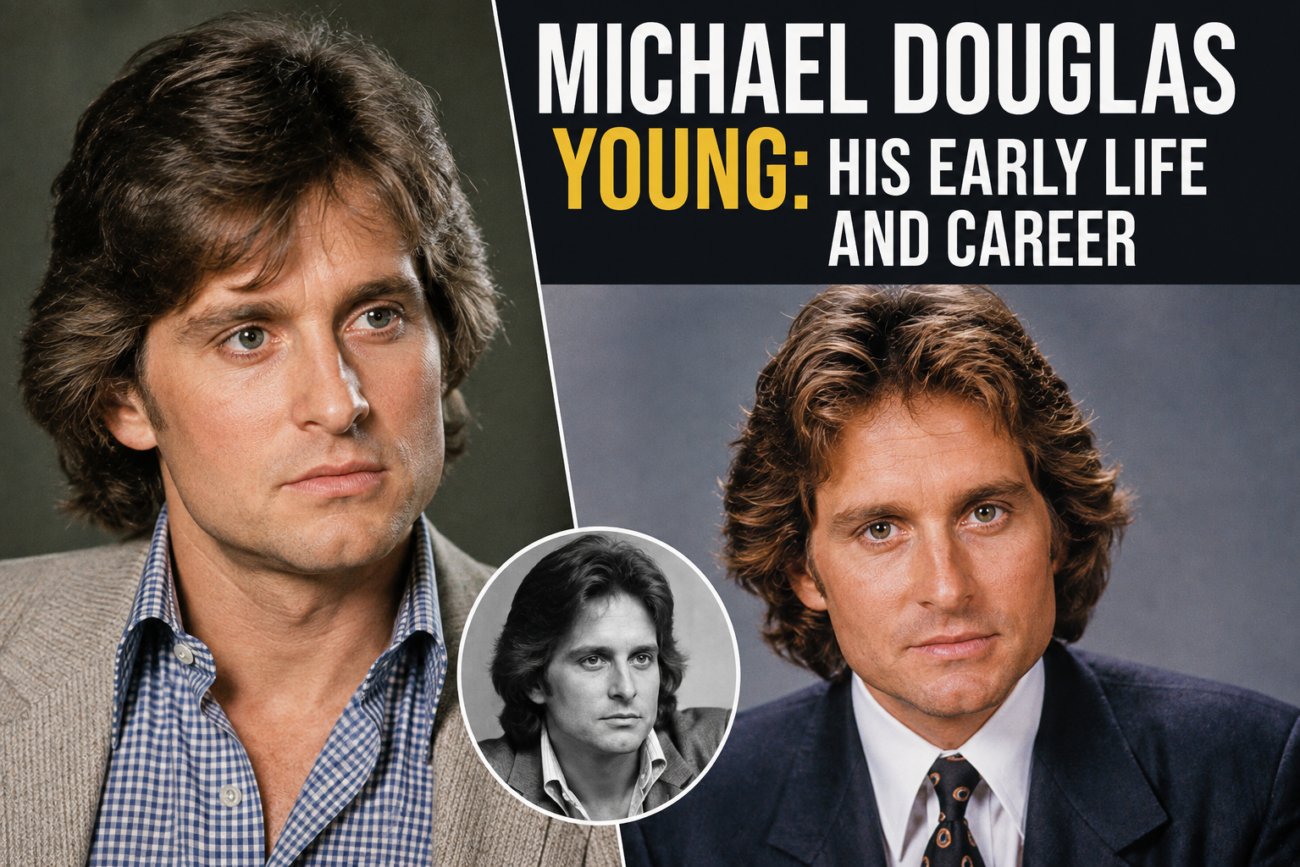
What did Michael Douglas look like when he was young?
Young Michael Douglas had dark hair and a lean appearance, and his early screen roles often presented him as a relatively youthful television and film performer. Photographs and films from the 1960s and 1970s show how his appearance changed as his career developed.
When did Michael Douglas start acting?
Douglas began his professional acting career during the 1960s. His early work included television appearances and film roles before his major television breakthrough in The Streets of San Francisco.
What was Michael Douglas’s first major television role?
His major early television breakthrough was playing Steve Keller in The Streets of San Francisco, which ran from 1972 to 1977.
Was Michael Douglas a producer before he became a major movie star?
Yes. Douglas became an important producer before reaching the height of his acting career. His work on One Flew Over the Cuckoo’s Nest was especially significant and earned the film the Academy Award for Best Picture.
Did Michael Douglas work with his father Kirk Douglas?
Michael grew up in the Hollywood environment created by his father, Kirk Douglas, and worked on some of his father’s productions early in his career. The two were also connected professionally through the development of One Flew Over the Cuckoo’s Nest.
What movie made Michael Douglas a major film star?
Romancing the Stone in 1984 was a major turning point in his film career. It became a commercial success and helped establish him as a leading Hollywood actor.
When did Michael Douglas win his Oscar for acting?
Douglas won the Academy Award for Best Actor for his performance as Gordon Gekko in Wall Street.
Why is Michael Douglas’s early career important?
His early career shows how he built an identity separate from his famous father. Television work, producing experience, and early film roles all contributed to the success he achieved later as a major Hollywood actor.
Conclusion
The story of Michael Douglas young is ultimately a story of development, persistence, and professional reinvention.
Born into one of Hollywood’s most famous acting families, Douglas had access to an entertainment industry that few young performers could experience. But his early career still required him to establish his own reputation.
His drama education, early film and television roles, and work behind the camera gave him a broad foundation. The Streets of San Francisco brought him widespread television recognition, while producing One Flew Over the Cuckoo’s Nest demonstrated that he could succeed behind the scenes as well as in front of the camera.
The success of The China Syndrome, Romancing the Stone, Fatal Attraction, and eventually Wall Street transformed him into one of Hollywood’s leading stars.
Looking back at Michael Douglas’s younger years therefore provides more than a glimpse at what the actor looked like before fame. It reveals how he developed his craft, separated his identity from his father’s legacy, and built the combination of acting and producing skills that defined his remarkable career.
