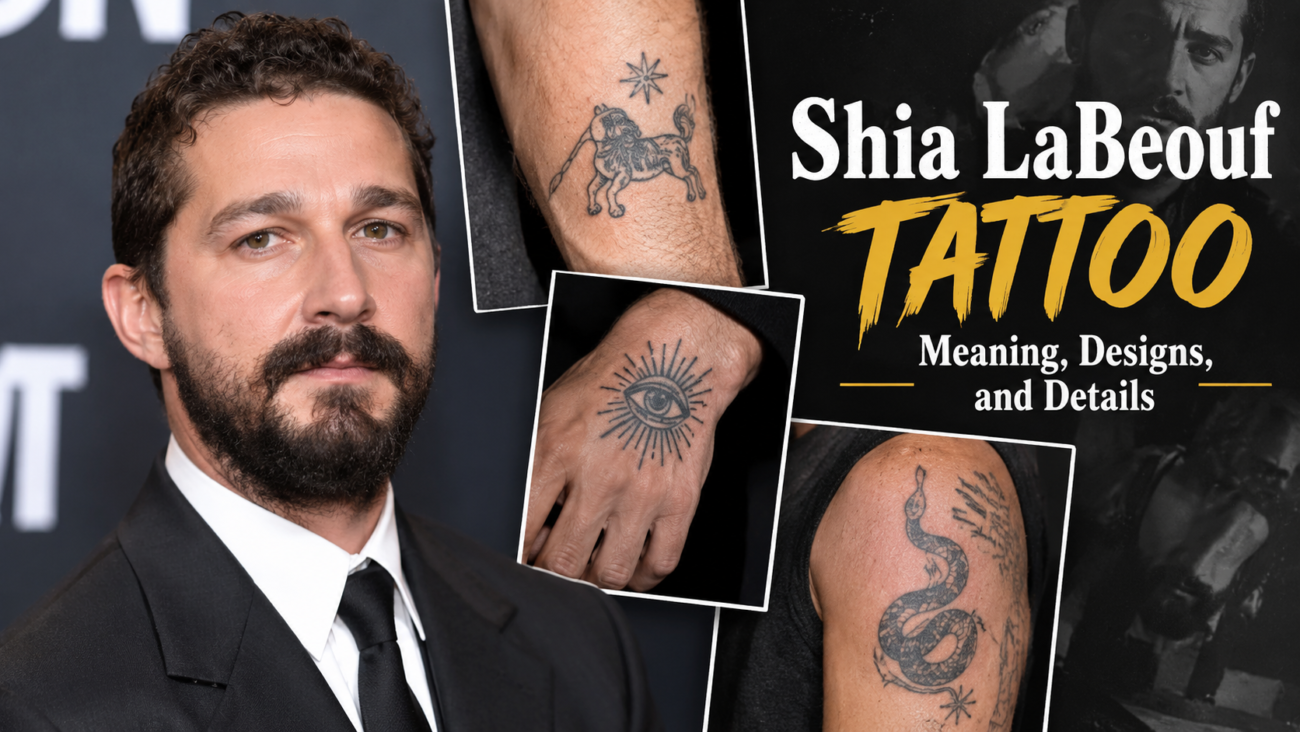
The tattoos of Shia LaBeouf have attracted considerable attention from fans of the actor, particularly after his striking transformation for the war film Fury. Known for his intense acting style and commitment to challenging roles, LaBeouf has used physical changes to help portray complex characters. His tattoos have become part of the conversation surrounding his appearance, career, and approach to acting.
However, an important distinction exists between tattoos an actor wears in real life and those created or modified for a movie. Some of LaBeouf’s most recognizable body art has been discussed in connection with his film performances, while other details about individual designs and their personal meanings are less clearly documented.
This guide explores the Shia LaBeouf tattoo story, including his best-known tattoo work, the connection between tattoos and Fury, what is known about their possible meanings, and how his appearance relates to his career. It also separates publicly discussed information from interpretations that should not be treated as confirmed facts.
Key Takeaways
-
Shia LaBeouf is an American actor known for films including Transformers, Fury, and Honey Boy.
-
His extensive chest tattoo became particularly well known through his role in The Tax Collector.
-
His tattoos and changing appearance have attracted attention because of his immersive approach to acting.
-
Movie-related tattoos and real-life body art should not automatically be treated as the same thing.
-
Individual tattoo meanings should be verified through LaBeouf’s own statements or reliable reporting rather than assumptions based on appearance.
Biography Table
| Detail | Information |
|---|---|
| Full Name | Shia Saide LaBeouf |
| Date of Birth | June 11, 1986 |
| Age | 40 years old (as of October 2026) |
| Birthplace | Los Angeles, California, United States |
| Nationality | American |
| Profession | Actor, filmmaker, and screenwriter |
| Years Active | 1996–present |
| Known For | Transformers, Fury, The Tax Collector, Honey Boy |
| Education | Attended Alexander Hamilton High School in Los Angeles |
| Major Achievements | BAFTA Rising Star Award; recognition for acting and screenwriting |
| Estimated Net Worth | Not included because reliable, independently verified figures are unavailable |
Main Article
What Is the Story Behind Shia LaBeouf’s Tattoo?
The story behind the Shia LaBeouf tattoo that attracts the most attention begins with his work on The Tax Collector, a 2020 crime thriller directed by David Ayer.
LaBeouf plays Creeper, a criminal enforcer who collects money on behalf of a powerful crime boss. The character has an intimidating appearance, and his extensive body art forms a significant part of that visual identity.
Unlike many actors who rely on temporary tattoos or makeup to transform their appearance, LaBeouf underwent extensive permanent tattooing. His large chest and stomach design became one of the film’s most discussed details.
Director David Ayer publicly praised LaBeouf’s commitment to the role. Tattoo artist Bryan Ramirez also confirmed that the work was real and described elements inspired by the actor’s parents.
The tattoo is particularly interesting because it combines personal imagery with a fictional character’s identity. It is not simply a collection of decorative designs created to look intimidating on screen.
Why Did Shia LaBeouf Get His Chest Tattooed?
LaBeouf’s extensive chest tattoo was closely associated with his preparation for The Tax Collector. He chose a permanent transformation rather than relying entirely on special effects or temporary body art.
This decision attracted attention because permanent tattoos can affect an actor’s appearance long after filming ends. They may also influence costume choices, continuity requirements, and the kinds of characters an actor can portray without additional makeup.
However, the tattoo artist indicated that the chest piece had a longer history than a single movie production. This makes the popular explanation that LaBeouf simply got the entire design for one role incomplete.
The project illustrates the difference between a tattoo’s original personal significance and the additional associations it acquires when an actor incorporates it into a film character.
Shia LaBeouf Chest Tattoo: Designs and Details
The chest and stomach artwork associated with The Tax Collector is the actor’s most widely reported tattoo design.
The large tattoo across LaBeouf’s front torso combines several visual elements. Rather than resembling a small, isolated symbol, it forms an extensive composition that covers much of his chest and abdomen.
1. Portraits Inspired by His Parents
One of the most significant elements of the tattoo is its use of portraits.
According to tattoo artist Bryan Ramirez, the upper portion of the artwork was inspired by LaBeouf’s parents. The portraits give the design a personal dimension beyond its association with The Tax Collector.
Family-inspired tattoos can serve as tributes, expressions of identity, or reminders of important relationships. In LaBeouf’s case, the artist’s account supports a connection between the imagery and his parents.
Nevertheless, it is important not to assign a specific emotional interpretation to every detail without a direct explanation from the actor himself.
2. The Word “CREEPER”
The word “CREEPER” is among the most recognizable parts of the design.
It appears across the lower portion of his torso and directly references the character LaBeouf portrays in The Tax Collector.
This lettering makes the tattoo especially distinctive. It also explains why the design is frequently associated with the movie, even though other elements have personal significance.
The name connects the actor’s real-life body art with the fictional world of the film.
3. Floral Details and Decorative Shading
The tattoo also includes flowers and decorative elements that help connect its different components.
These details create a more unified composition instead of leaving the portraits and lettering as separate images. The combination of portraits, shading, and decorative motifs gives the piece a layered appearance.
Flowers are common in tattoo art and can represent many different ideas depending on their type, placement, and the person wearing them. Without a confirmed explanation of each flower in LaBeouf’s design, it would be misleading to assign a definite meaning to every element.
4. Mickey Mouse-Inspired Imagery
Reports describing the tattoo also identify Mickey Mouse-style hands pointing toward one another beneath the lettering.
This unusual detail contrasts with the otherwise intense visual style of the tattoo.
Its inclusion demonstrates why the design is more complex than a conventional collection of gangster-inspired symbols. The piece combines personal portraits, character-related lettering, and recognizable imagery in a single composition.
The precise personal significance of this particular detail has not been clearly established in reliable public reporting.
Shia LaBeouf Tattoo Meaning: What Is Confirmed?
Understanding the meaning of LaBeouf’s tattoos requires separating documented information from speculation.
| Tattoo element | What is publicly reported | What remains uncertain |
|---|---|---|
| Portraits | Inspired by his parents, according to tattoo artist Bryan Ramirez | The complete personal story behind each portrait |
| “CREEPER” lettering | Connected to his character in The Tax Collector | Whether the lettering has any additional private significance |
| Flowers | Part of the larger torso composition | The exact meaning of each flower |
| Decorative hand imagery | Identified in descriptions of the design | Its precise symbolism or intended message |
The strongest evidence comes from the tattoo artist’s account and statements by the film’s director.
These sources establish that the artwork is real, that it includes imagery inspired by LaBeouf’s parents, and that the word “CREEPER” connects it to his film role.
Other interpretations should be treated more cautiously. A photograph can show what a tattoo looks like, but it cannot establish the wearer’s private reasons for choosing every symbol.
Does the Tattoo Represent His Personal Life or Acting Career?
It has a connection to both.
The portraits reportedly inspired by his parents give the design a personal dimension. The inclusion of his character’s name connects it directly to his professional life.
This combination is what makes the tattoo particularly interesting. It blurs the boundary between personal expression and a physical transformation associated with acting.
However, it would be inaccurate to conclude that every part of the design represents a particular event, belief, or relationship unless that interpretation has been confirmed.
Shia LaBeouf Tattoos in Fury: What Was Real?
Another common question concerns LaBeouf’s appearance in Fury, the 2014 World War II film directed by David Ayer.
The film stars LaBeouf as Boyd “Bible” Swan, a member of an American tank crew fighting in Europe during the Second World War.
LaBeouf became known for taking an intense approach to preparing for demanding roles. Ayer later discussed the actor’s commitment to Fury, including his decision to have a tooth removed during production.
That story is often mentioned alongside reports about the actor’s later chest tattoo for The Tax Collector. However, the two situations should not be confused.
Were His Fury Tattoos Real?
The large, permanent chest tattoo publicly associated with LaBeouf is the one connected to The Tax Collector.
For Fury, the better-known account concerns his physical preparation and tooth removal. Claims about individual tattoos visible in the war film should be checked against specific production reporting rather than assumed to describe permanent ink.
Film productions routinely use makeup, temporary tattoos, and other techniques to reproduce a character’s appearance. This is particularly common in historical films, where actors may need markings that suit a particular period or military background.
The key distinction is that a tattoo visible on screen does not automatically prove that the actor has the same design permanently on their body.
Shia LaBeouf’s Tattoos in American Honey
LaBeouf’s tattoo history also includes his work on American Honey, Andrea Arnold’s 2016 road drama.
The film follows a group of young people who travel across the American Midwest selling magazine subscriptions. LaBeouf plays Jake, a charismatic member of the travelling sales crew.
Reports about the production describe LaBeouf acquiring numerous tattoos during the filming period. These included images associated with musician Missy Elliott.
This episode is another example of the actor’s willingness to alter his appearance while working on a film. It also shows why his tattoos cannot all be understood through a single movie or one consistent symbolic theme.
Some tattoos have been associated with specific roles, while others have personal or humorous elements. The context surrounding each design matters.
How American Honey Differs From The Tax Collector
The two films demonstrate different aspects of LaBeouf’s approach to appearance.
-
American Honey became associated with a collection of smaller, varied tattoo designs.
-
The Tax Collector featured an extensive torso piece that attracted attention because of its scale and the inclusion of the character’s name.
-
Fury is more closely associated with his demanding physical preparation than with the origin of the large chest tattoo.
Together, these examples help explain why searches for LaBeouf’s tattoos often lead to several different films and stories.
How Shia LaBeouf’s Tattoos Influence His On-Screen Appearance
Tattoos can change the way an audience perceives a character before the character speaks.
In The Tax Collector, LaBeouf’s extensive body art contributes to Creeper’s visual presentation. The tattoos help establish a hard-edged appearance that fits the film’s crime-drama setting.
The effect is not limited to the imagery itself. Permanent tattoos also create practical considerations for future productions.
Costume and Makeup Considerations
When an actor has extensive permanent tattoos, filmmakers must decide whether to show them, cover them, or adapt the character’s appearance around them.
Common approaches include:
-
Costume design: Clothing can conceal tattoos when they do not suit the character.
-
Cover-up makeup: Specialized products can reduce the visibility of unwanted ink.
-
Continuity planning: Makeup artists must reproduce the same appearance across scenes filmed at different times.
-
Character design: Directors may incorporate an actor’s existing tattoos into the character’s visual identity.
LaBeouf’s chest tattoo is a notable example of a permanent physical feature becoming part of the public conversation around a film.
Does Having Real Tattoos Make an Actor More Committed?
Not necessarily.
LaBeouf’s tattooing decision was unusual, but actors have many ways to prepare for roles. Research, rehearsals, movement training, dialect coaching, costume work, and collaboration with directors can all contribute to a convincing performance.
Permanent body modification is not a requirement for realistic acting. Temporary effects can often achieve the same visual result without lasting consequences.
The significance of LaBeouf’s choice lies in the specific decision he made for his role, not in establishing permanent tattoos as a standard that other performers should follow.
Can You Identify Every Shia LaBeouf Tattoo?
Not with complete confidence from publicly available descriptions alone.
Photographs taken at different times can show different portions of an actor’s body. Tattoos may be partly obscured by clothing, lighting, makeup, or image quality. Some designs may also be misidentified when photographs circulate without context.
There is a further complication: reports often combine details from different productions, making it easy to attribute a tattoo to the wrong film.
A reliable identification process should consider three things:
-
The date of the photograph: This helps establish when a tattoo was visible.
-
The production or event: A film still may show temporary effects, while an off-set photograph may provide evidence of permanent body art.
-
Direct confirmation: Statements from the actor, tattoo artist, or production team provide stronger evidence than online speculation.
This approach is particularly useful when researching the Shia LaBeouf tattoo collection for an article, biography, or visual reference.
What Makes Shia LaBeouf’s Tattoo Story Different?
Celebrity tattoos frequently attract attention because fans want to understand the meaning behind an image or phrase. LaBeouf’s story stands out because a prominent permanent design is closely connected to a specific film character.
The large torso tattoo associated with The Tax Collector combines family-inspired imagery with the word “CREEPER.” That mixture of personal and professional associations gives the artwork a more complicated background than a tattoo created solely as a fictional prop.
His other reported tattoo experiences, including those linked to American Honey, reinforce the connection between his changing appearance and his film work.
Still, it is important to avoid turning an actor’s body art into a complete explanation of his personality. Tattoos may offer insight into particular decisions, but they cannot reveal everything about a person’s beliefs, relationships, or motivations.
Frequently Asked Questions
1. Does Shia LaBeouf have a real chest tattoo?
Yes. LaBeouf has a large, permanent chest and torso tattoo associated with The Tax Collector. Director David Ayer discussed the tattoo, and tattoo artist Bryan Ramirez confirmed that the artwork was real.
2. What does Shia LaBeouf’s chest tattoo say?
One of its most recognizable features is the word “CREEPER,” the name of LaBeouf’s character in The Tax Collector.
3. Why did Shia LaBeouf get the word “CREEPER” tattooed on his stomach?
The lettering is connected to his role in The Tax Collector. Its placement and size made it a prominent part of his on-screen appearance as the character.
4. Does Shia LaBeouf’s tattoo include portraits of his parents?
According to tattoo artist Bryan Ramirez, the upper portion of the chest design was inspired by LaBeouf’s parents and includes portraits. The complete personal meaning of every element has not been publicly established.
5. Were Shia LaBeouf’s tattoos in Fury real?
The large permanent torso tattoo is associated with The Tax Collector, not the origin story of Fury. Claims about specific markings in Fury should be assessed individually because films can use temporary tattoos and makeup.
6. Did Shia LaBeouf get tattoos for American Honey?
Reports about the film describe LaBeouf getting multiple tattoos during the production period, including designs associated with Missy Elliott.
7. Can Shia LaBeouf’s tattoos be removed?
Laser tattoo removal and other treatments are available, but removing extensive, dense tattoos can require multiple sessions and may not completely eliminate the ink. There is no need to assume that LaBeouf has undergone removal without reliable confirmation.
8. What is the meaning of Shia LaBeouf’s entire tattoo collection?
There is no single confirmed meaning for his entire collection. Some designs have documented connections to his parents or acting roles, while the significance of other elements remains uncertain.
Conclusion
The story behind the Shia LaBeouf tattoo is a combination of personal expression, film preparation, and public curiosity. His extensive chest and torso artwork became especially famous through The Tax Collector, where the word “CREEPER” connected the design directly to his character.
The tattoo artist’s comments establish that the piece includes imagery inspired by LaBeouf’s parents, while the director’s remarks confirm the actor’s decision to undergo permanent tattooing for the production. His reported experiences with tattoos during American Honey provide further context for his changing on-screen appearance.
Ultimately, the most useful way to understand LaBeouf’s tattoos is to distinguish confirmed details from speculation. The designs offer an interesting look at the intersection of acting and personal appearance, but their exact meanings should be based on documented information rather than assumptions.
