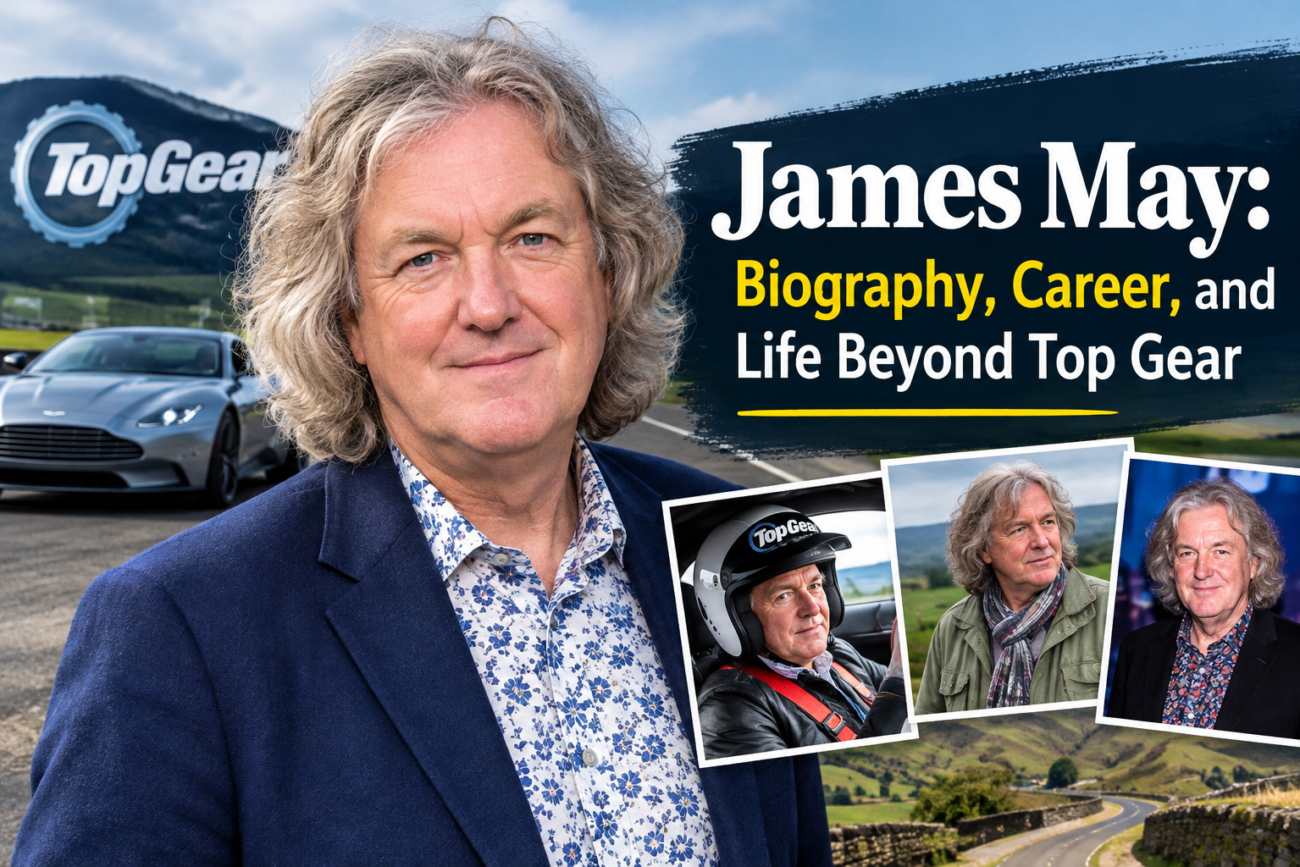
James May is one of Britain’s most recognizable television presenters, known for his dry humour, thoughtful explanations, and enthusiasm for cars, engineering, science, and travel. He became a household name through Top Gear, where his measured presenting style complemented the more energetic personalities of Jeremy Clarkson and Richard Hammond. Later, he reunited with his former colleagues for The Grand Tour, taking their motoring adventures to audiences around the world.
However, his career extends well beyond reviewing cars and travelling to unusual destinations. Before television made him famous, May worked as a journalist, developing the ability to explain complicated subjects in an entertaining and accessible way. He has since presented programmes about cooking, toys, technology, and everyday engineering, demonstrating a curiosity that reaches far beyond the automotive world.
This article explores James May‘s biography, early life, education, journalism career, rise to television fame, most notable programmes, personal life, interests, and continuing influence on British entertainment.
Key Takeaways
-
James May is a British television presenter and former newspaper journalist best known for Top Gear and The Grand Tour.
-
His career began in journalism before he moved into television presenting.
-
His nickname, “Captain Slow,” reflects his measured driving style and thoughtful on-screen personality.
-
His television work covers cars, engineering, science, travel, cooking, and popular culture.
-
May has maintained a relatively private personal life despite decades of public recognition.
-
His distinctive presenting style combines dry humour, technical explanations, and a genuine interest in how things work.
Biography Table
| Detail | Information |
|---|---|
| Full Name | James Daniel May |
| Date of Birth | 16 January 1963 |
| Age | 63 years old as of October 2026 |
| Birthplace | Bristol, England |
| Nationality | British |
| Profession | Television presenter, journalist, writer |
| Education | Studied music at Lancaster University |
| Years Active | From the 1980s |
| Known For | Top Gear, The Grand Tour, James May’s Toy Stories |
| Major Achievements | Established a long-running television career covering motoring, science, travel, and practical experiments |
| Estimated Net Worth | Public estimates vary and are not independently verified |
Early Life and Education
Growing Up in England
James Daniel May was born on 16 January 1963 in Bristol, England. He grew up in a family with three siblings and spent parts of his childhood in different areas of England and Wales. His early experiences helped shape the curious, observant personality that later became a defining feature of his television work.
May attended Caerleon Endowed School in Newport, Wales, before spending his teenage years in South Yorkshire. He subsequently attended Oakwood Comprehensive School in Rotherham.
As a young person, he developed interests in music, practical skills, and understanding how things worked. These interests would eventually find their way into his television programmes, many of which explore the relationship between technology, everyday life, and human ingenuity.
Studying Music at Lancaster University
May studied music at Lancaster University, where he attended Pendle College. During his studies, he developed his musical abilities, including playing the flute and piano.
Although he did not pursue a conventional career in music, his education gave him experience in a subject that requires patience, attention to detail, and an appreciation of how individual elements combine to create something meaningful.
Those qualities are also evident in his presenting style. Rather than rushing through an explanation, May often takes time to examine the details, explain the underlying principles, and consider why something matters.
His university education also demonstrates that a successful television career does not necessarily require a degree directly related to broadcasting or journalism.
James May’s Journalism Career
Before becoming a familiar television personality, May established himself as a journalist, particularly in motoring publications. His experience in print media helped him develop the writing skills and technical knowledge that later distinguished him from many other television presenters.
Working for Automotive Publications
During the early stages of his career, May worked as a sub-editor for publications including The Engineer and Autocar. These roles exposed him to technical reporting, vehicle reviews, and the demands of producing material for readers interested in engineering and motoring.
His time at Autocar also became associated with a well-known anecdote about a hidden message he inserted into a publication. The incident reportedly contributed to his departure from the magazine.
Although the episode is often recalled as an amusing example of his mischievous humour, his broader journalism career involved serious work explaining vehicles, technology, and engineering.
Becoming an Award-Winning Motoring Journalist
May continued writing for different publications, including Car magazine and The Daily Telegraph. His work covered motoring subjects while allowing room for personal observations and understated humour.
In 2000, he received the Guild of Motoring Writers’ Journalist of the Year award, recognising his achievements in automotive journalism.
His writing background became an important advantage when he moved into television. He could explain technical subjects without assuming that viewers already understood specialist terminology.
For example, a car review can easily become a list of horsepower figures, acceleration times, and mechanical specifications. May’s approach often adds context by explaining how those features affect the experience of driving or what they reveal about the vehicle’s design.
This ability to combine technical detail with accessible commentary helped him build a distinctive professional identity.
How James May Became Famous on Top Gear
The programme that made him a household name
Although the programme had existed for decades, its relaunched format in the early 2000s brought a stronger emphasis on humour, ambitious challenges, road trips, and the personalities of its presenters.
Joining Jeremy Clarkson and Richard Hammond
May became part of the programme’s presenting team alongside Jeremy Clarkson and Richard Hammond. The three presenters developed a distinctive dynamic based on their contrasting personalities.
-
Jeremy Clarkson often adopted a provocative, outspoken style.
-
Richard Hammond brought enthusiasm, energy, and a willingness to participate in demanding challenges.
-
James May frequently served as the measured, detail-oriented presenter whose dry observations provided a contrast to his colleagues.
Their differences helped make the show entertaining. Rather than presenting cars through conventional reviews alone, the trio turned motoring into a broader form of entertainment.
They travelled across countries, tested unusual vehicles, competed in challenges, and explored engineering questions through practical demonstrations.
Why Is James May Called Captain Slow?
May’s best-known nickname is “Captain Slow.” Clarkson popularised the name during their time on Top Gear, referring to May’s comparatively cautious driving style and his tendency to take a more measured approach to challenges.
The nickname became a running joke, particularly when the presenters competed against one another.
However, it does not mean May lacks driving experience. The programme featured him driving a wide variety of vehicles, including powerful sports cars and specialised machines.
The humour came from the contrast between his calm personality and the often exaggerated enthusiasm of his co-presenters.
The nickname also became part of his public identity, helping audiences recognise him even outside the programme.
Memorable Top Gear Features
May contributed to many of the show’s most recognisable segments, including road trips, vehicle comparisons, and ambitious engineering projects.
Some of the most appealing moments came when the presenters attempted to solve practical problems using limited budgets or unconventional ideas. These experiments demonstrated that cars could serve as a starting point for stories about design, economics, history, and human creativity.
May’s technical curiosity often made him particularly suited to explaining the reasoning behind a challenge, even when the final result was unsuccessful.
His time on the programme established him as more than a car reviewer. He became an entertainer who could make complicated subjects accessible to a broad audience.
The Grand Tour and Life After Top Gear
The programme retained many elements that had made their earlier collaboration popular while giving the presenters opportunities to explore new locations and formats.
A New Chapter in Motoring Television
The Grand Tour combined vehicle reviews, studio-style discussions, road trips, and elaborate challenges. Its international settings allowed the presenters to explore different driving conditions, automotive cultures, and landscapes.
The programme also gave them greater freedom to develop extended adventures rather than relying exclusively on the structure of a traditional motoring show.
May continued to play the thoughtful, technically minded member of the group. His understated reactions often provided an effective counterpoint to Clarkson’s dramatic commentary and Hammond’s enthusiasm.
The original trio’s journey concluded with their final special, filmed in Zimbabwe and Botswana and released in 2024. This marked the end of their long-running partnership in that format.
In February 2026, Amazon announced a new version of The Grand Tour featuring Francis Bourgeois, James Engelsman, and Thomas Holland. The new presenting team represents a fresh direction for the programme rather than a continuation of the original trio’s on-screen partnership.
What Did James May Do After The Grand Tour?
May’s career has never depended entirely on one programme. His work outside the original Top Gear and The Grand Tour formats illustrates his interest in travel, science, practical experiments, and everyday culture.
His other projects have allowed him to develop a more personal presenting style, often spending more time exploring a single subject rather than competing against his colleagues.
That variety is an important part of his appeal. Viewers who first discovered him through motoring programmes can also find him exploring history, cooking, or unfamiliar places.
James May’s Other Television Shows
One reason May has remained relevant beyond motoring television is his willingness to explore subjects that initially appear unrelated to cars.
James May’s Toy Stories
Instead of simply discussing toys, May investigated whether they could be used to create impressive practical achievements. The programme featured projects inspired by model aircraft, model railways, construction toys, and other familiar playthings.
Its appeal came from the combination of nostalgia and engineering. Toys became tools for exploring design, mathematics, teamwork, and the satisfaction of building something tangible.
The series also reflected May’s ability to treat apparently simple subjects seriously without losing his sense of humour.
James May’s Big Ideas
In James May’s Big Ideas, May investigated inventions and concepts that could influence the future.
The programme explored technological developments and ambitious proposals, examining how they might work and whether they could become practical solutions to real problems.
This approach reflected his background in technical journalism. Instead of presenting innovation as a collection of futuristic promises, he explored the ideas behind it and considered the obstacles involved in turning theories into reality.
James May’s Our Man in Japan
In the series, May travelled through Japan, experiencing its food, transport, traditions, technology, and regional cultures. He approached the country as an interested visitor rather than presenting himself as an expert on every subject he encountered.
The programme combined travel documentary elements with humour and personal discovery. It allowed May to explore unfamiliar customs and ask questions about everyday life.
The success of this format led to further Our Man In… travel adventures, including programmes set in Italy and India.
These shows demonstrate that his presenting skills are transferable. His curiosity, willingness to learn, and measured humour work just as effectively in cultural exploration as they do in automotive journalism.
James May: Oh Cook!
The series accompanied May’s cookbook, Oh Cook!: 60 Easy Recipes That Any Idiot Can Make. Its central appeal was the practical perspective of a presenter who approached cooking as a skill to learn rather than a performance to perfect.
Instead of focusing on elaborate restaurant techniques, the programme explored approachable recipes and the everyday process of making meals.
It also reflected a recurring theme in May’s work: ordinary activities can become interesting when someone explains the principles behind them.
James May’s Personality and Presenting Style
May’s public image is built around dry humour, intellectual curiosity, and a relatively calm manner. These qualities distinguish him from more theatrical television personalities.
Dry Humour and Thoughtful Explanations
His humour often depends on understatement. Rather than exaggerating every situation, he may respond to an absurd event with a quiet observation that makes the moment funnier.
This style works particularly well alongside presenters with more energetic personalities.
His explanations also tend to follow a clear progression. He introduces a problem, explores the relevant details, and explains what the results reveal. That structure reflects his background in journalism and makes technical subjects easier to follow.
An Interest in Engineering and How Things Work
May has repeatedly explored subjects that involve construction, mechanics, and problem-solving.
Whether he is examining a vehicle, building a large-scale model, or attempting a practical experiment, he often focuses on the process as much as the final result.
This interest gives his programmes educational value without making them feel like formal lessons. Viewers can learn about design and engineering while enjoying the entertainment.
James May’s Personal Life
Despite his public career, James May has generally kept his private life away from the spotlight.
Is James May Married?
James May has long been associated with journalist and dance critic Sarah Frater. They have been in a relationship since around 2000 and have generally maintained a private approach to their personal lives.
May is not widely known to have married Frater, and it is important to distinguish a long-term relationship from a legally confirmed marriage.
The couple’s preference for privacy means that limited public information is available about their everyday life together.
Does James May Have Children?
May is not publicly known to have children. He has generally avoided making his personal life a central feature of his television career, preferring to focus on his professional projects and interests.
As with any private matter, it is best to rely on confirmed public information rather than speculation.
Where Does James May Live?
May has been associated with Hammersmith in west London, where he has lived for many years. London provides convenient access to television production, publishing, and other professional opportunities.
His public appearances and programmes also involve frequent travel, particularly when filming international road trips and documentaries.
For privacy reasons, precise residential details are not necessary to understand his life or career.
James May’s Hobbies and Interests
May’s television projects offer a useful indication of his interests outside conventional motoring journalism.
Cars and Motoring
Cars remain a major interest in his professional life. His experience includes everything from everyday vehicles to high-performance sports cars and unusual engineering projects.
His approach is not limited to speed or prestige. He often considers a vehicle’s design, usability, history, and place in the wider automotive industry.
Music
May’s musical background remains a notable part of his biography. His studies at Lancaster University focused on music, and he has demonstrated an interest in musical performance and instruments.
Although music is not the primary focus of his television career, it illustrates the breadth of his interests.
Technology, Models, and Practical Projects
His work on Toy Stories and other factual programmes reflects a longstanding fascination with construction and practical problem-solving.
May often explores the relationship between an idea and the effort required to make it work. This is one reason his programmes appeal to viewers interested in engineering, models, inventions, and hands-on experimentation.
James May’s Net Worth and Career Earnings
James May’s net worth is a frequent subject of online searches, but there is no universally verified public figure that establishes his complete personal wealth.
His income over the years has likely come from several professional activities, including television presenting, journalism, book publishing, and other media projects. However, individual contracts, investments, expenses, and business interests are not necessarily public.
Online estimates should therefore be treated cautiously. They may use different assumptions, repeat unverified figures, or confuse reported earnings with total wealth.
A more reliable way to understand May’s financial success is to consider the length and diversity of his career. His work across broadcasting, publishing, and entertainment has provided multiple professional opportunities over several decades.
Without verified financial disclosures, assigning an exact net worth would create a misleading impression of certainty.
James May’s Legacy in British Television
James May’s contribution to British television lies in his ability to combine entertainment with explanation.
Through Top Gear, he helped turn motoring into a global entertainment format that appealed to people who were not necessarily passionate about cars. The programme used humour, competition, travel, and ambitious challenges to make automotive subjects accessible.
The Grand Tour extended that partnership into a new setting, while his solo programmes demonstrated that his interests were much broader than driving.
His work has also shown the value of a distinctive presenting style. May does not need to dominate a conversation to make an impression. His measured delivery, technical curiosity, and understated humour give his programmes a recognisable character.
As The Grand Tour moves into a new era with different presenters, the original trio’s work remains an important part of the programme’s history. May’s wider television career also continues to offer an example of how a journalist can develop into a versatile broadcaster without abandoning the curiosity that shaped the original career.
Frequently Asked Questions
1. Who is James May?
James May is a British television presenter, journalist, and author best known for co-presenting Top Gear and The Grand Tour with Jeremy Clarkson and Richard Hammond.
2. How old is James May?
James May was born on 16 January 1963. He is 63 years old as of October 2026.
3. Why is James May called Captain Slow?
He earned the nickname “Captain Slow” on Top Gear because of his comparatively cautious driving style and measured approach to challenges. The name became a running joke on the programme.
4. Is James May married to Sarah Frater?
May has been in a long-term relationship with journalist Sarah Frater since around 2000. They are not publicly known to be married.
5. Does James May have children?
James May is not publicly known to have children. He generally keeps his personal life private.
6. What did James May study at university?
He studied music at Lancaster University and developed skills in instruments including the flute and piano.
7. What happened to James May after The Grand Tour?
The original presenting trio concluded its run with a final special released in 2024. May’s broader career includes journalism, travel documentaries, cooking programmes, and other factual television projects. Amazon announced a new presenting team for The Grand Tour in 2026.
8. What is James May’s net worth?
There is no universally verified public figure for his net worth. Online estimates vary, and his full financial information is not publicly established.
Conclusion
James May has built a distinctive career by combining journalism, technical knowledge, dry humour, and a genuine curiosity about the world. Although Top Gear made him internationally famous, his work on The Grand Tour, James May’s Toy Stories, Our Man in Japan, and Oh Cook! shows that his interests extend well beyond cars.
His background in music and journalism helped shape a presenting style that values clear explanations and careful observation. Rather than relying entirely on spectacle, he often finds entertainment in understanding how things work and why people find them fascinating.
As British motoring television continues to evolve, James May’s contribution remains significant. His career demonstrates that curiosity, a distinctive personality, and the ability to make complex subjects understandable can create lasting appeal across a wide range of television genres.
