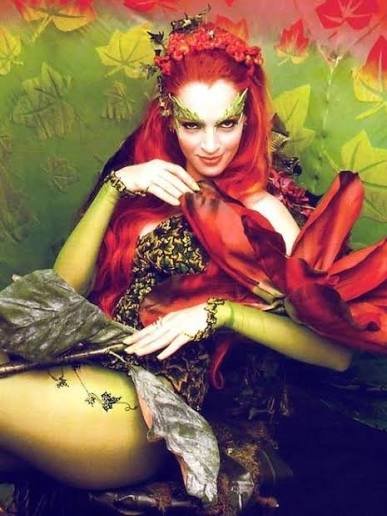
Uma Thurman is widely recognized for her performances in films such as Pulp Fiction, Kill Bill, and Gattaca. However, before she became an internationally recognized Hollywood star, she appeared in Poison Ivy, a psychological thriller released in 1992. Her performance as Ivy helped establish her reputation for portraying complex, mysterious, and unconventional characters.
The connection between Uma Thurman and Poison Ivy remains an interesting subject for film fans because the movie explores obsession, manipulation, friendship, and family tension. Thurman’s portrayal of Ivy brings a mixture of confidence, charm, and unpredictability to a character whose influence gradually transforms another teenager’s life.
The film also offers a glimpse into Thurman’s early career, before some of her most famous roles brought her wider recognition. Understanding her performance requires looking beyond the movie’s provocative premise and considering its characters, themes, production, and place in early 1990s cinema.
This article explores Thurman’s role in Poison Ivy, explains the story behind the film, introduces its main cast, and examines why audiences continue to revisit this early entry in her filmography.
Key Takeaways
-
Uma Thurman played Ivy in the 1992 psychological thriller Poison Ivy, directed by Katt Shea.
-
The story follows a teenage friendship that develops into a dangerous relationship involving deception and family conflict.
-
Drew Barrymore plays Sylvie Cooper, the teenager whose life becomes increasingly entangled with Ivy.
-
The film explores obsession, manipulation, loneliness, privilege, and dysfunctional family relationships.
-
Poison Ivy belongs to Thurman’s early screen career, preceding several of her most widely celebrated performances.
-
Its lasting interest comes from its unsettling character dynamics and its place in the psychological thrillers of the early 1990s.
Biography Table: Uma Thurman
| Detail | Information |
|---|---|
| Full Name | Uma Karuna Thurman |
| Date of Birth | April 29, 1970 |
| Age | 56 as of October 2026 |
| Birthplace | Boston, Massachusetts, United States |
| Nationality | American |
| Profession | Actress and former model |
| Education | Attended Northfield Mount Hermon School; later pursued acting |
| Years Active | 1980s–present |
| Known For | Pulp Fiction, Kill Bill, Gattaca, and Dangerous Liaisons |
| Major Achievements | Golden Globe Award for Hysterical Blindness; Academy Award nomination for Pulp Fiction |
| Estimated Net Worth | Public estimates vary and are not independently verified |
Main Article
Did Uma Thurman Star in Poison Ivy?
The first thing to clarify is that Uma Thurman did not play Ivy in the 1992 film Poison Ivy. That role belonged to Drew Barrymore.
Thurman’s connection to the name Poison Ivy comes from a different movie: Batman & Robin, released in 1997. In that superhero film, she portrayed Pamela Isley, a botanist who transforms into the villainous Poison Ivy.
The distinction matters because the two films feature different characters, stories, and performances. Although both involve the name Ivy, they belong to separate cinematic worlds.
The 1992 film Poison Ivy was directed by Katt Shea and starred Drew Barrymore, Sara Gilbert, Tom Skerritt, and Cheryl Ladd.
Uma Thurman’s Role as Poison Ivy in Batman & Robin

Uma Thurman played Dr. Pamela Isley, a scientist whose research into plant life leads her down a dangerous path. After a confrontation with her colleague, Dr. Jason Woodrue, she undergoes a transformation and adopts the identity of Poison Ivy.
In Batman & Robin, Thurman’s character uses plant-based toxins, seductive persuasion, and an intense connection to nature to pursue her goals. She becomes one of the principal antagonists in the film, putting her into conflict with Batman and Robin.
Thurman approached the role with a theatrical style that suited the movie’s colorful comic-book setting. Her Poison Ivy combines exaggerated confidence, playful humor, and menace, making her different from the more psychologically grounded characters found in many thrillers.
Her performance is particularly memorable for its bold costumes, stylized dialogue, and larger-than-life characterization. Rather than presenting Ivy as an ordinary criminal, the film portrays her as a theatrical villain with a personal ideology centered on protecting plant life, even when her methods threaten human beings.
Who Played Ivy in the 1992 Film Poison Ivy?

Drew Barrymore played the title character in Poison Ivy (1992), a psychological thriller directed by Katt Shea. Her character is a teenage girl who develops an intense friendship with Sylvie Cooper, played by Sara Gilbert.
Ivy initially appears confident, adventurous, and independent. Sylvie, who feels isolated despite her family’s wealth, is attracted to Ivy’s bold personality. Their friendship grows quickly, but Ivy’s interest in the Cooper family gradually becomes more troubling.
As the story develops, Ivy attempts to insert herself into the family’s private life. Her actions expose existing weaknesses within the household and turn an initially exciting friendship into a dangerous situation.
Barrymore’s performance drives the film’s tension. She portrays Ivy as a character whose appeal and unpredictability make it difficult for others to recognize the danger until the consequences become serious.
This role should not be confused with Thurman’s later portrayal of Poison Ivy in Batman & Robin. The 1992 thriller is a psychological drama about manipulation and family relationships, while the 1997 superhero film features a comic-book antagonist with extraordinary plant-related abilities.
What Is Poison Ivy (1992) About?
The original Poison Ivy follows Sylvie Cooper, a teenager who feels emotionally disconnected from her wealthy family. She lives with her father, Darryl, played by Tom Skerritt, and her seriously ill mother, Georgie, played by Cheryl Ladd.
Sylvie’s life changes when she befriends Ivy, a student whose confidence and rebellious attitude fascinate her. Ivy seems to offer the excitement and companionship Sylvie has been missing.
However, the friendship becomes increasingly manipulative. Ivy develops an interest in the Cooper household and begins exploiting the family’s emotional vulnerabilities.
The film builds suspense by showing how Ivy’s behavior affects each member of the household. Her influence becomes especially dangerous as she seeks greater control over the family’s relationships.
The Main Cast of Poison Ivy
| Actor | Character | Role in the Story |
|---|---|---|
| Drew Barrymore | Ivy | The charismatic teenager whose actions disrupt the Cooper family |
| Sara Gilbert | Sylvie Cooper | The lonely teenager who befriends Ivy |
| Tom Skerritt | Darryl Cooper | Sylvie’s father |
| Cheryl Ladd | Georgie Cooper | Sylvie’s mother |
| Leonardo DiCaprio | Guy | A supporting character in one of his early film appearances |
The film also includes supporting performers who help establish the social environment surrounding Sylvie and Ivy.
One notable detail is Leonardo DiCaprio’s appearance in a supporting role. For viewers interested in the early careers of major Hollywood actors, Poison Ivy provides an opportunity to see DiCaprio before his breakthrough performances in films such as What’s Eating Gilbert Grape and Titanic.
Uma Thurman’s Career Before and After Poison Ivy
Although Thurman was not part of the 1992 Poison Ivy cast, understanding her career helps explain why her 1997 portrayal of the character remains significant.
Thurman began acting in the late 1980s. Her early film appearances included Dangerous Liaisons (1988), which introduced audiences to her ability to play characters in elaborate period settings.
She later gained broader recognition through a variety of roles, including her performance in Quentin Tarantino’s Pulp Fiction (1994). As Mia Wallace, Thurman delivered a performance that became one of the defining parts of her career.
Her work in Gattaca (1997) demonstrated a different side of her acting, while Kill Bill: Volume 1 (2003) and Kill Bill: Volume 2 (2004) established her as a memorable presence in action cinema.
Against that background, her performance as Poison Ivy in Batman & Robin represents an interesting departure. Instead of the restrained drama of Gattaca or the grounded intensity of Pulp Fiction, she embraced the theatrical conventions of a superhero movie.
Her portrayal illustrates the range of roles she explored throughout her career.
How Is Poison Ivy Different in the Two Films?
The two films share a name but approach their central characters very differently.
| Feature | Poison Ivy (1992) | Batman & Robin (1997) |
|---|---|---|
| Ivy portrayed by | Drew Barrymore | Uma Thurman |
| Character | Ivy | Dr. Pamela Isley / Poison Ivy |
| Genre | Psychological thriller | Superhero action film |
| Central conflict | Manipulation and family tension | A villain’s battle against Batman and Robin |
| Character style | Unpredictable and psychologically unsettling | Theatrical, flamboyant, and comic-book inspired |
| Connection to nature | Not the defining basis of the character | Central to her identity and powers |
The comparison highlights why accurate identification is important when searching for these films. Someone looking for Thurman’s famous red-haired villain may be seeking Batman & Robin, whereas someone interested in Barrymore’s early thriller may be searching for the 1992 film.
Why Does the Uma Thurman Poison Ivy Connection Remain Popular?
The phrase “Uma Thurman Poison Ivy” continues to attract interest because it combines a recognizable actress with one of DC Comics’ best-known female villains.
Several factors help explain the character’s appeal.
A Distinctive Comic-Book Performance
Thurman’s Poison Ivy stands out because she fully embraces the exaggerated style of the film. Her expressive delivery, elaborate wardrobe, and confident screen presence make the character instantly recognizable.
A Memorable Villain
Poison Ivy is not simply interested in defeating Batman. Her fictional motivation involves environmental protection and resentment toward people who exploit nature. The character’s extreme methods create a conflict between her stated ideals and the harm she causes.
A Different Side of Uma Thurman
Fans familiar with Thurman’s dramatic and action-oriented performances may find her portrayal of Poison Ivy surprising. The role allowed her to explore comedy, theatrical villainy, and heightened physical expression.
Continued Interest in Earlier Hollywood Films
Audiences frequently revisit older films to compare performances, costumes, directing styles, and career trajectories. Both Poison Ivy and Batman & Robin offer different examples of how 1990s cinema presented complicated female characters.
Frequently Asked Questions
1. Did Uma Thurman play Poison Ivy in the 1992 movie?
No. Drew Barrymore played Ivy in Poison Ivy (1992). Uma Thurman portrayed the DC Comics villain Poison Ivy in Batman & Robin (1997).
2. What character did Uma Thurman play in Batman & Robin?
She played Dr. Pamela Isley, a scientist who becomes the villain Poison Ivy. The character uses plant-related abilities and toxins in her attempts to defeat Batman and Robin.
3. Who directed Poison Ivy (1992)?
Katt Shea directed the psychological thriller, which starred Drew Barrymore, Sara Gilbert, Tom Skerritt, and Cheryl Ladd.
4. Was Leonardo DiCaprio in Poison Ivy?
Yes. Leonardo DiCaprio appeared in a supporting role as Guy in the 1992 film. It was one of his early screen appearances.
5. What is the difference between the two Poison Ivy characters?
The 1992 film’s Ivy is a teenage character whose manipulation threatens a family. The Poison Ivy in Batman & Robin is Pamela Isley, a botanist who becomes a supervillain with plant-related powers.
6. Is Poison Ivy (1992) a superhero movie?
No. It is a psychological thriller focused on friendship, obsession, manipulation, and family conflict. The superhero character Poison Ivy appears in a separate fictional universe.
7. Why is Uma Thurman’s Poison Ivy memorable?
Her performance combines theatrical humor, flamboyant costumes, and a strong screen presence. She brings a distinctive style to the comic-book villain in Batman & Robin.
8. Is Poison Ivy (1992) part of a film series?
Yes. The original film was followed by Poison Ivy II: Lily (1996), Poison Ivy: The New Seduction (1997), and Poison Ivy: The Secret Society (2008). These films are separate from the Batman movie series.
Conclusion
The connection between Uma Thurman and Poison Ivy is memorable, but it is important to distinguish between two different films. Thurman portrayed Pamela Isley, the comic-book villain Poison Ivy, in Batman & Robin (1997). Drew Barrymore played the title character in the psychological thriller Poison Ivy (1992).
Both performances belong to different stories and reveal different approaches to portraying complex female characters. Barrymore’s Ivy creates tension through manipulation and emotional instability, while Thurman’s Poison Ivy brings theatrical flair and plant-inspired villainy to the superhero genre.
For anyone exploring Uma Thurman’s filmography, her role in Batman & Robin offers an entertaining example of her versatility. For viewers interested in the original Poison Ivy, Barrymore’s performance remains central to the film’s unsettling exploration of friendship, obsession, and family conflict.
